Every Bright Minds course has one unit where the walls between subjects come down on purpose — where the science refuses to stay in its box and pulls in history, reading, writing, and ethics because it cannot be honestly told without them. In this course, that story is built around one book: De humani corporis fabrica — "On the Fabric of the Human Body" — published in 1543 by a young anatomist named Andreas Vesalius. It is a single real event that turns out to touch everything the course is about.
The anatomy first
The claim at the center of it sounds almost obvious to us now: if you want to know how the human body is built, you should look inside a human body. But for thirteen hundred years, European medicine did not work that way. It trusted a library. The anatomy in every textbook came from Galen, a Greek physician of the second century, whose word on the body was treated as settled fact — even though Galen, barred from dissecting people, had cut open apes and pigs and dogs instead.
What makes Vesalius a perfect capstone is that grasping what he did requires nearly everything the course teaches at once. It is a lesson in observation — he dissected human bodies himself, at a time when a professor was expected to sit above the room and read aloud while a hired hand did the cutting. It is a lesson in structure and function — he described what organs, bones, and muscles actually looked like, not what tradition said they should. And it is a lesson in evidence: again and again he found that the body in front of him did not match the book, and he trusted the body. He was in his twenties when he did it.
The same habit a student uses to defend a structure on a specimen — trust what is in front of you, not what you were told to expect — is the habit that founded the whole science.
The history: an authority 1,300 years old
To feel the size of what Vesalius did, you have to feel the weight of what he challenged. Galen had been the final word on the body since the Roman Empire — through the fall of Rome, the whole of the Middle Ages, and into the Renaissance. To question him was very close to heresy. But Vesalius, teaching at Padua in the 1530s and 40s, kept finding Galen wrong in specific, checkable ways: bones, muscles, the structure of the heart. The reason was simple and damning — Galen had never dissected a human being, so his "human" anatomy was really the anatomy of animals. Thirteen centuries of doctors had been memorizing the inside of an ape and calling it themselves.
The book, and the ethics of the body
Vesalius did not just dissect differently; he published differently. The Fabrica paired his text with woodcut illustrations so detailed and so beautiful that they changed what a science book could be. The figures (muscled bodies posed standing in a landscape, peeled back layer by layer) are widely credited to artists from the workshop of Titian, the great Venetian painter. This is the reading-and-writing heart of the story: Vesalius understood that a true picture, drawn from the real thing, could teach what a wall of inherited text never had. He showed instead of told, and anatomy has been a visual science ever since.
And the course does not tiptoe past where those bodies came from. Human dissection has always carried an ethical weight — Renaissance anatomists often worked on the bodies of executed criminals, sometimes taken without anything we would call consent, and the history of the field is tangled with grave-robbing and the poor. We put that in front of students deliberately, because the founding act of this science teaches things no diagram can:
- Evidence beats authority. A claim is only as good as what you can check against the real body. Thirteen centuries of confident agreement did not make Galen right, and one young anatomist who looked for himself was enough to prove it.
- Knowledge has a cost. Everything we know about the human body was learned from real human bodies. A serious education names where that knowledge came from instead of hiding it, and treats every specimen with respect.
- Looking for yourself is a moral act. Choosing to check rather than to defer (to trust the body over the book) is the habit that makes science honest, and it is not always the comfortable one.
And back to the bench
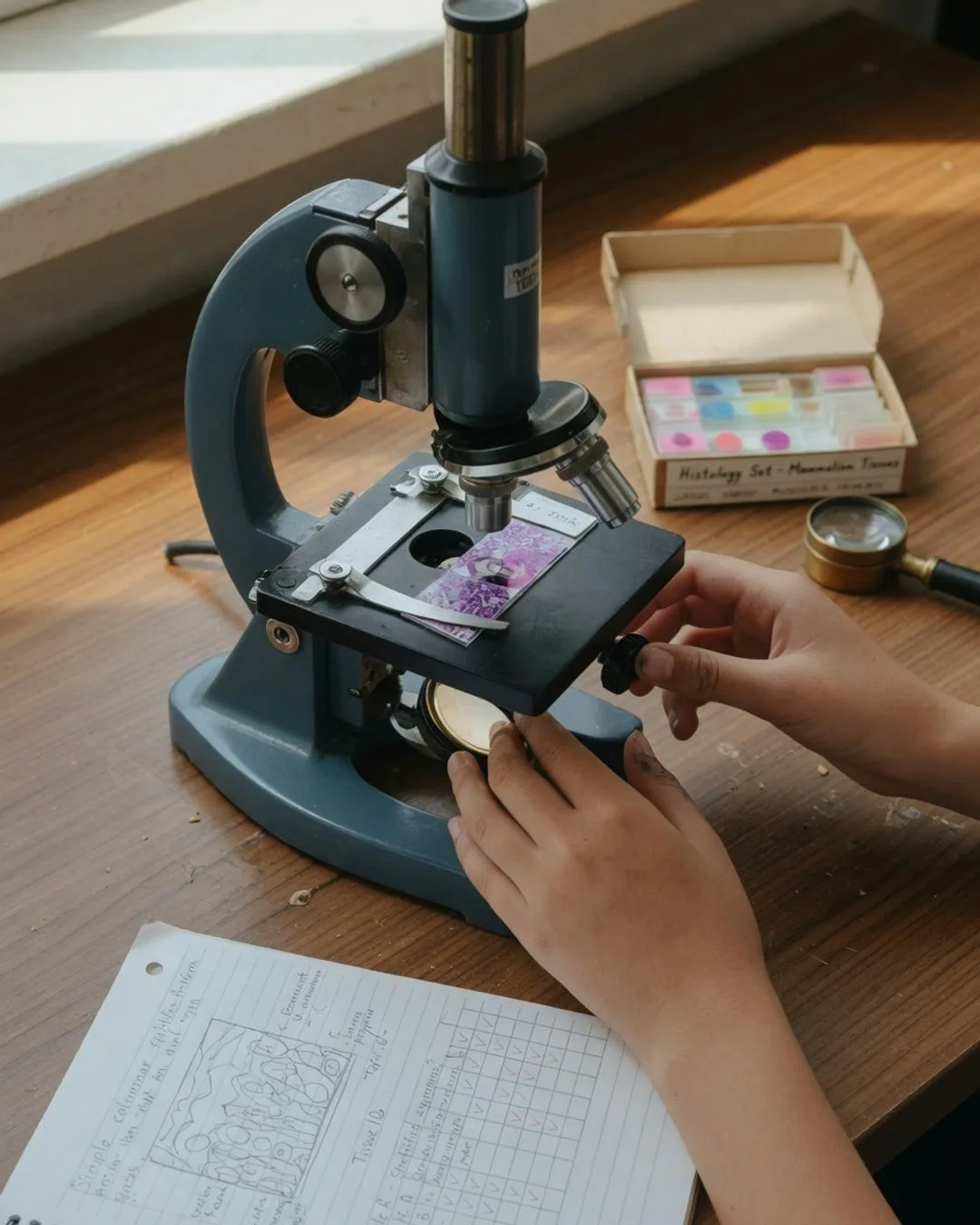
The thread runs full circle back to the student's own hands. Every time a student in this course stands over a specimen and trusts what they see over what they half-remember from a diagram, they are repeating Vesalius's move in miniature. The anatomy identification defense is the Fabrica in small: look at the real structure, describe it truly, and be ready to defend what you found. A student who connects the two understands something genuinely deep — that the whole method of this course, bench before book, is not a teaching gimmick but the founding act of the science itself.
That is what integration means here. Not an anatomy lesson with a history anecdote stapled on, but a single book held up to the light until a student can see, through it, how anatomy, history, reading, writing, and ethics were never really separate subjects at all. The core spokes, History, Reading, and Writing, are included in every unit; an applied-math lane (rates, volumes, pressures) runs underneath; and each unit reaches for the elective spokes its story earns — here, the history of medicine, the art of the anatomical plate, and the ethics of dissection. The integration guide lays out the full model.