Teaching examples, not student testimonials. The sample week, model notebook, and demonstration prompts illustrate the intended learning process; they do not report an enrolled student's results. Current program status and next steps.
Look inside the Human Anatomy pack.
No sign-up, no email required. Here is a sample week, a real rubric, a model lab-notebook entry, and a sample demonstration. These are the materials themselves, not a brochure. Every sample links to the full artifact it’s drawn from.
One week, two days under the microscope.
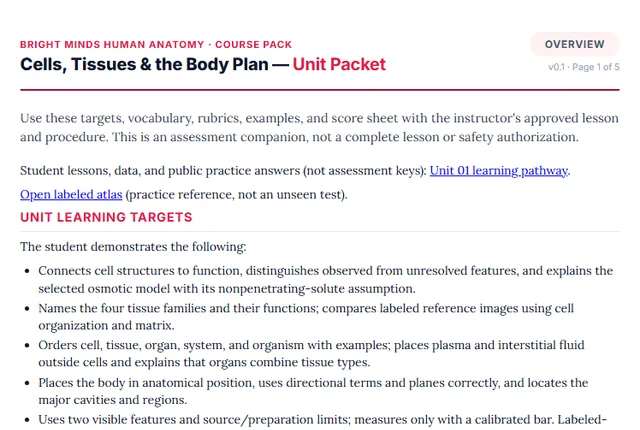
The course meets two days a week for about two hours a day, across roughly 32 weeks. Here is week one of Unit 1 — Cells, Tissues & the Body Plan: the student brings tissue into focus for real before a single structure is memorized.
- The four primary tissue types
- Anatomical position, planes & terms
- Reading: Vesalius & evidence-based anatomy
- Focus a prepared slide
- Classify the tissue type
- Defend the ID with two features
How “mastered” is actually judged.
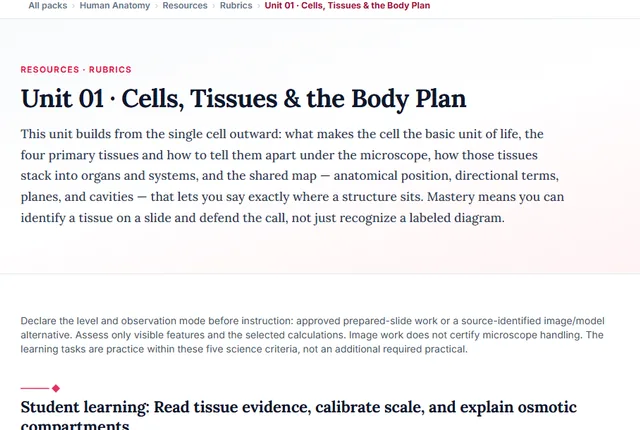
Every skill is scored at one of three levels against a published standard, without points or grading on a curve. Here is one criterion from the Cells, Tissues & the Body Plan rubric — lab technique: histology slide ID, shown as a parent or guide would read it:
| Level | What it looks like — “Focus & classify a tissue slide” |
|---|---|
| Developing | Skips microscope setup or cannot bring a prepared slide into focus. |
| Proficient | Focuses a slide and names a tissue type but cannot point to the features that justify the call. |
| Mastery | Focuses a prepared slide, classifies the tissue into one of the four types, and defends the ID with two visible distinguishing features. |
Browse the full rubric set → · How this becomes an A–F grade →
The artifact a student builds, keeps, and defends.
The lab notebook is the primary record of a student's work, written in pen at the bench and explained aloud. Here is one model day at the bench, showing how each section is recorded. Notice the crossed-out slip and the honest sources of error.
| Time | Pulse (bpm) |
|---|---|
| rest | 68 |
| right after | 132 |
| +1 min | 104 |
| +2 min | 84 |
| +3 min | 72 |
- Dated & titled entries
- A testable question & hypothesis
- Units on every number
- Significant figures, honestly reported
- Calculations shown, not just answers
- Written in pen during the lab; errors crossed out, not erased
- Error analysis with direction & size
The moment that can’t be faked.
Three times a year, a student performs and defends a demonstration, standing with their own work and reasoning aloud while an adult asks unscripted follow-ups. In the anatomy identification defense, they locate structures on a model or specimen and defend each structure–function relationship out loud.
“This is the tricuspid valve, between the right atrium and right ventricle. It snaps shut when the ventricle contracts, so blood is pushed out to the lungs instead of leaking back into the atrium.”
A passing answer from the anatomy identification defense — naming the structure and defending its function, not reciting a label.
The whole pack, ready for a binder.
Everything here is available to read online. Every rubric, checklist, and guide also has a print-ready packet version, formatted 8.5×11 for a clipboard or a three-ring binder. You assemble the student’s binder from the pack itself; there’s nothing else to buy to hold it in your hands. We’ve put them all in binder order on one page: Assemble the Human Anatomy binder →
Seen enough to start?
The whole Human Anatomy pack is open to read and print. Open it and begin, or ask us a question first. A real person answers.