Unit 01 · Characteristics & Needs of Living Things
This unit asks a question that sounds easy until you try to answer it: what makes something alive? You’ll compare living things, once-living things, and things that were never alive, and build a checklist of the traits every living thing shares — using energy, growing, responding to the world around them, and reproducing. You’ll also learn what living things need to stay alive. Mastery means you can look at something new and give evidence for whether it’s living, not just a guess.
Student learning: What evidence distinguishes living, once-living, and never-living?
Choose the level by readiness, not age alone, and record it before instruction. Foundation, core, and honors tasks are study pathways, not an AP course or a promise of college credit. The instructor retains practical assessment and the published science rubric; integration is reported separately.
Prerequisites: Read a short evidence table, count to twelve, and distinguish a description from an explanation.
Suggested sequence: read and discuss the explanation; attempt the worked model; analyze the data at your selected level; check the answers; then complete the source-linked response and a fresh transfer question. These activities supplement, not replace, supervised practical work and the full-year schedule.
Assigned reading and focus
- OpenStax Biology 2e, 1.2: Themes and Concepts of Biology. Read Properties of Life and Levels of Organization of Living Things. Compare a property of a lineage with what can actually be seen in one individual during one lesson. Public section checked 2026-09-27.
- OpenStax Microbiology, 3.1: Spontaneous Generation. Read The Theory of Spontaneous Generation through the Redi paragraph and Figure 3.2. Identify the 1668 comparison of uncovered, gauze-covered, and sealed jars. Analyze the published account only; do not reproduce these experiments. Checked 2026-09-27.
Learn the science
Movement alone is not a test for life: a motor moves and a dormant seed may not. Cellular organization, energy processing, regulated responses, growth, and reproduction across a life cycle form a connected set of evidence. An individual need not reproduce during a lesson, or at all, to be alive.
A dry seed might be dormant, damaged, or dead. A picture of it does not settle viability. Germination is evidence that a particular seed was alive; failure to germinate during a short trial does not prove death. Needs differ among organisms, so air or bright light should not be imposed as universal requirements.
Redi changed access by flies while retaining meat in the containers. Gauze admitted air while preventing direct contact with the meat, helping separate fly access from the sealed-jar change in air access. This tests one claim about maggots, not the origin of all life.

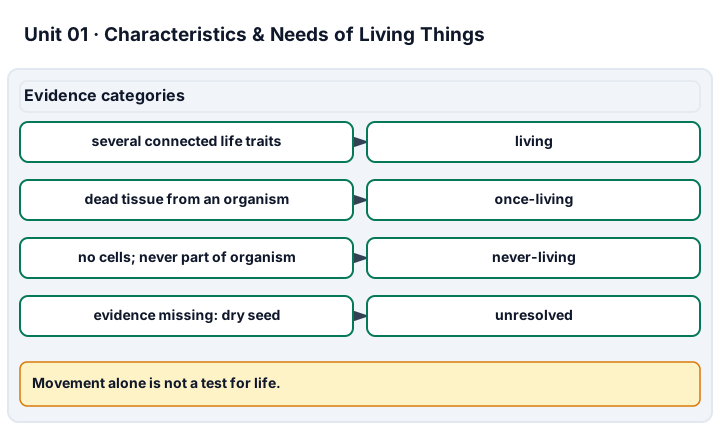
Diagram description
Several connected traits—cellular organization, energy use, growth, response, and reproduction across a life cycle—support a living claim, but not every trait must be observed in one lesson. Evidence of dead tissue from an organism supports once-living. Objects with no cells and no organismal origin support never-living. Missing evidence, such as an untested dry seed, gives unresolved, not once-living.
Data, provenance, and assumptions
| Cover | Containers | Air access | Fly access to meat | Maggots on meat in the account |
|---|---|---|---|---|
| Uncovered | 2 | Yes | Yes | Present |
| Gauze | 2 | Yes | No | Absent |
| Sealed | 2 | No | No | Absent |
| Day | Seeds at start | Seeds germinated so far |
|---|---|---|
| 0 | 12 | 0 |
| 3 | 12 | 3 |
| 6 | 12 | 9 |
| 9 | 12 | 10 |
| Card | Supplied evidence |
|---|---|
| A: pea seed that germinated | Had a root and shoot on day 6; organized cells are described in its reference image. |
| B: growing seedling | New leaf appeared; shoot bent toward a changed light direction. |
| C: dry wooden craft stick | Manufactured from dead tree tissue; does not grow as a stick. |
| D: granite pebble | Crystalline minerals; no cells or organism life cycle. |
| E: battery robot | Moves toward light; manufactured electronics, no cells or reproduction. |
| F: untested dry seed | No germination history or viability measurement is available. |
Worked model
By day 9, 10/12 x 100 = 83.33% of these seeds had germinated. Do not add 3 + 9 + 10: the same seeds recur in cumulative counts. Cards A and B are living, C once-living, D and E never-living; F remains unresolved. B supplies a stimulus (light direction) and a response (shoot bending), not proof of conscious choice.
Numerical calibration
- 83.33 % of the original twelve seeds by day 9
Attempt the assigned level
Try the tasks before reading the calibration. These are practice answers, not a secure examination; use a new dataset or changed assumption for the assessed transfer.
Foundation: typically grades 7-8
- Submit a six-row card classification with two evidence clues per decision; write unresolved for F and name a missing observation.
- Copy the three Redi treatments into an air-access versus fly-access comparison; explain why the gauze treatment matters.
Check after your attempt
- A/B living; C once-living tissue; D/E never-living; F unresolved. Movement alone misclassifies both the robot and dry seed.
- Uncovered and gauze admit air but differ in fly contact. That contrast addresses the claim that simply admitting air creates maggots.
Core
- Graph cumulative germination against day; calculate the day-9 percentage using the initial twelve as denominator.
- Explain which life properties the supplied seed record supports and which, such as reproduction, it does not directly show. Predict a consequence of missing water without designing a deprivation experiment.
Check after your attempt
- Plot (0,0), (3,3), (6,9), (9,10). The percentage is 83.33%, and there are twelve seeds, not thirty-six independent observations.
- Germination supports growth/development and prior viability. Reproduction and internal metabolism are not directly measured. Inadequate water may prevent germination, without proving a seed is dead.
Extension
- Explain why the Redi account supports a claim about fly access but not a universal statement about every form of life.
- A second synthetic batch germinates 7 of 8 seeds. Compare percentages, then give two reasons not to rank all seed suppliers from those batches.
Check after your attempt
- The manipulation concerns a specific organism and setting; replication, air conditions, and sources of contamination still matter. It does not test early-Earth origins.
- 7/8 = 87.5%, 4.17 percentage points above 83.33%. Small nonrandom samples and unreported batch/condition differences prevent a supplier-level conclusion.
History, reading, and writing connection
Original response: Write 4-6 sentences, or an equivalent labeled/audio response, to a reader who says "the maggots appeared, so meat made them." Cite Redi's 1668 comparison as described in OpenStax 3.1, use two specific treatment rows, explain the gauze control, and state what the account does not establish. Keep that historical claim separate from your synthetic seed graph.
Write in your own words or use an approved accessible equivalent. Cite a specific assigned section or figure, identify its evidence, and state one limitation or counterargument. Use the AI practice contract only for permitted coaching, never to invent observations or write the assessed response.
Transfer to a new case
A battery-powered toy grows a foam shape when water is added. Does movement plus apparent growth settle whether it is alive?
Calibration: No. These clues have nonbiological mechanisms. Ask about cells, energy processing and regulation, provenance, and a life cycle rather than deciding from two appearances alone.
Evidence to retain
Living, non-living & once-living: six classified cards with reasons and F unresolved. The traits all living things share: identify supported and unobserved properties. What living things need to survive: justified water-availability prediction. Stimulus & response: the light-direction example. Lab technique (observing & recording): separately assess hand-lens handling and an actual dated sketch with approved in-room material; supplied cards do not certify observation. Retain the seed graph, calculation, cited Redi response, source/date, and transfer answer; report integration separately.
Record units, calculations, source/date, uncertainty, and what is measured versus inferred. A simulation or supplied dataset must stay labeled as such. This is reading, paper-model, and data work, not authorization to collect pond water, swab people, culture organisms, dissect, expose wildlife, or ingest study materials. Use only instructor-approved prepared slides, images, or in-room materials for separately observed practical skills. Supplied data are not your observations.
Return to all eight learning pathways. Print this unit page for the student lessons; the linked five-page packet remains the separate assessment companion.
Unit mastery rubric
| Criterion | Developing | Proficient | Mastery |
|---|---|---|---|
| Living, non-living & once-living | Sorts things as living or not by a single clue, like “it moves.” | Sorts most things correctly but is stumped by tricky cases like seeds or a fallen log. | Sorts living, once-living, and never-living things and backs up each call with more than one trait. |
| The traits all living things share | Can name one or two traits but leaves out most. | Lists traits but treats every property as visible in one short observation. | Connects cells, energy use, growth, response and reproduction across a life cycle; distinguishes observed properties from unobserved ones. |
| What living things need to survive | Thinks living things only need food. | Lists needs but assumes every organism needs the same conditions. | Explains needs for the named organism and makes a bounded prediction when a condition changes. |
| Stimulus & response | Doesn’t connect a change in the surroundings to how a living thing reacts. | Gives one example of a response but can’t explain why it helps the organism. | Identifies a stimulus and the response, and explains how reacting helps the living thing survive. |
| Lab technique (observing & recording) | Rushes the observation or writes down guesses instead of what is seen. | Observes carefully but records vaguely or skips the hand lens. | Uses a hand lens well, records clear observations in words and labeled sketches, and separates what they saw from what they think. |
| Integration (cross-domain) | Makes no supported connection between the source and the science. | Uses the source but needs help connecting evidence, writing, or limitations to the science. | Independently connects History, Reading, and Writing using a cited source, appropriate evidence, a limitation, and a scientific explanation. |
Integration is reported separately and cannot lower the science grade or block a science demonstration pass. Science and practical criteria determine that pass. Use the integration guide's evidence checklist for the separately reported criterion.
“The supplied record says this pea seed germinated, which supports that it was alive. An untested dry seed could be dormant or dead; not moving does not decide. Ten of twelve germinated by day 9, or 83.33%. That does not show reproduction or prove the other two are dead.”
“It’s alive if it moves… so the seed isn’t alive, and I guess the rock might be?”
You demonstrate this unit through observation labs — comparing living and non-living things and watching what organisms need — plus short oral checks where you explain your reasoning aloud, not a multiple-choice test. A criterion counts as mastered only when you can both make the observation and explain the biology behind it. Mastery is demonstrated, not awarded.
A 5-page clipboard packet — unit overview, key terms, the mastery rubric, anchor examples, and a score sheet you can print and grade against.