Unit 08 · Human Impact on Living Systems
The year closes with the biggest living system of all: the one we share. This unit looks at how people change ecosystems — through pollution, habitat loss, invasive species, and a changing climate — and at what conservation and stewardship can do. You’ll use evidence to weigh the trade-offs of real choices. Mastery means you can back up a claim about human impact with evidence and suggest a fair way forward.
Student learning: How can evidence guide a conservation choice without overstating cause?
Choose the level by readiness, not age alone, and record it before instruction. Foundation, core, and honors tasks are study pathways, not an AP course or a promise of college credit. The instructor retains practical assessment and the published science rubric; integration is reported separately.
Prerequisites: Food webs, populations, site/date matching, averages and signed changes.
Suggested sequence: read and discuss the explanation; attempt the worked model; analyze the data at your selected level; check the answers; then complete the source-linked response and a fresh transfer question. These activities supplement, not replace, supervised practical work and the full-year schedule.
Assigned reading and focus
- US Environmental Protection Agency, DDT - A Brief History and Status. Read Development of DDT and Regulation Due to Health and Environmental Effects; then inspect Current Status as policy context, not pesticide-use advice. Locate Carson's Silent Spring (1962), EPA's cancellation order (1972), resistance, persistence, and accumulation. Updated 2026-08-24; checked 2026-09-27. No copy or purchase of Silent Spring is required.
- OpenStax Biology 2e, 47.3: Threats to Biodiversity. Read Habitat Loss, Exotic Species, and Climate Change. Choose a mechanism for each threat, and distinguish dated examples or forecasts from a current local measurement. Checked 2026-09-27.
Learn the science
Habitat loss removes living space and resources; invasive species can change competition, predation or disease; pollution and climate change can alter survival and reproduction. Specify the organism, exposure or habitat mechanism rather than attributing every change to "people" in general.
EPA describes DDT's early benefits, declining benefits through resistance, environmental persistence and accumulation, and regulation. Rachel Carson's Silent Spring in 1962 helped focus public attention; EPA's 1972 cancellation followed evidence and a regulatory process. It was not the work of one book alone or a worldwide disappearance of DDT.
A decline after an intervention is not automatically its effect. Compare an affected site with a reference under comparable timing and conditions. A reference can reveal a shared change but cannot remove every confounder or create independent replication.
The nitrate-N example below is not DDT exposure data and cannot be used to calculate pesticide risk. It is an original practice problem about comparison and a limited conservation recommendation, not a water-safety assessment or a report of the local creek.

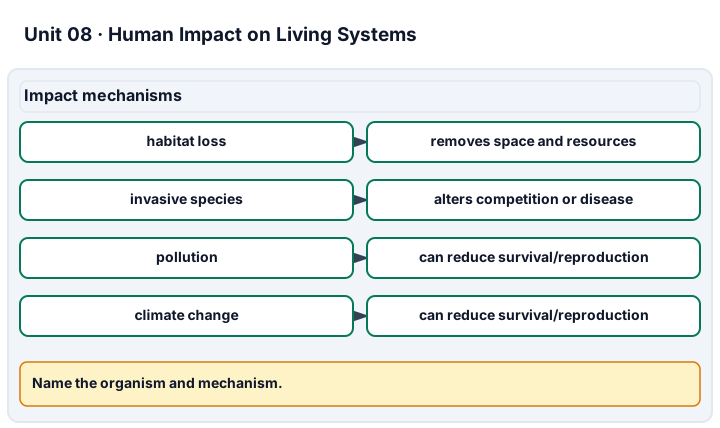
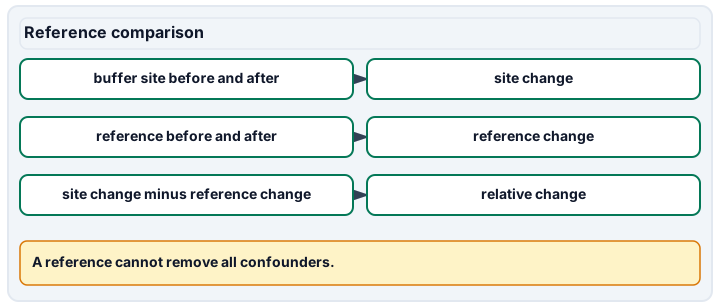
Diagram description
Habitat loss, invasive species, pollution, and climate change are separate mechanisms; they are not a causal chain. The second panel compares a changed buffer site with a reference using before/after means and a relative-change formula. The nitrate-N example is water-quality data, not DDT exposure or population evidence.
Data, provenance, and assumptions
| Site | Period | Date (modeled year) | Recent rain (mm) | Nitrate-N (mg/L) |
|---|---|---|---|---|
| Buffer site | Before | April 1 | 0 | 8 |
| Reference site | Before | April 1 | 0 | 5 |
| Buffer site | Before | April 8 | 10 | 10 |
| Reference site | Before | April 8 | 10 | 7 |
| Buffer site | After | May 1 | 0 | 5 |
| Reference site | After | May 1 | 0 | 4 |
| Buffer site | After | May 8 | 10 | 7 |
| Reference site | After | May 8 | 10 | 6 |
| Option | First-year cost | Space / trade-off |
|---|---|---|
| No buffer; retain monitoring | 200 | No space conversion; runoff source remains unaddressed |
| Small buffer plus monitoring | 1200 | Convert 20 m^2; maintenance and effectiveness uncertain |
| Covered bins plus monitoring | 700 | Reduce litter access; no supplied nitrate-effect estimate |
Worked model
Buffer-site mean changes from (8 + 10)/2 = 9 to (5 + 7)/2 = 6 mg/L: -3. Reference mean changes from 6 to 5 mg/L: -1. The before/after difference relative to reference is -3 - (-1) = -2 mg/L. This is compatible with a buffer benefit in the synthetic case, not proof: only one site received it, and season, flow and other changes are not fully controlled.
Numerical calibration
- -3 mg/L change at buffer site
- -1 mg/L change at reference site
- -2 mg/L change relative to the reference, not a proven causal effect
Attempt the assigned level
Try the tasks before reading the calibration. These are practice answers, not a secure examination; use a new dataset or changed assumption for the assessed transfer.
Foundation: typically grades 7-8
- Create a four-threat mechanism map using habitat loss, invasive species, pollution and climate. Cite one OpenStax section and distinguish an exotic species from evidence of harmful invasion.
- Make a before/after display for both sites. Choose one budget option and identify who gives up money or space.
Check after your attempt
- Name a specific ecological pathway for each. Introduction alone does not prove damage; impact evidence is needed.
- Buffer means 9 -> 6; reference 6 -> 5 mg/L. A defensible option must acknowledge cost/space and avoid claiming an unmeasured benefit.
Core
- Calculate both site changes and the change relative to reference, retaining signed values and units. Explain what the reference adds.
- Write an evidence-based recommendation with a review condition, one alternative explanation, and one missing measurement. Contrast this nitrate case with the EPA DDT evidence.
Check after your attempt
- -3, -1, and -2 mg/L. The reference suggests part of the decline may be shared, but does not prove the sites would otherwise have identical trends.
- For example, pilot the small buffer with monitoring within budget, review matched future dates, and track flow/season or upstream inputs. DDT persistence and resistance are different mechanisms and cannot be inferred from nitrate values.
Extension
- If the reference after-mean were 3 rather than 5 mg/L, recalculate the relative change and revise the strength of the buffer claim.
- Design a records-only follow-up comparison: define independent sites, matched times/conditions and a criterion for reconsidering your recommendation.
Check after your attempt
- The reference change becomes -3, so relative change is 0 mg/L. A decline at the buffer site alone is no longer differential evidence of benefit.
- Use several comparable sites per condition, consistent methods and units, flow/weather context, and an explicit review threshold agreed before analysis. No field exposure is authorized.
History, reading, and writing connection
Original response: Write a 150-200 word decision memo or equivalent with two parts. First cite the EPA Development and Regulation sections to explain how benefits, resistance, persistence, Carson's 1962 publication and the 1972 cancellation relate without a single-hero story. Then use the supplied site means and option costs to recommend a bounded action for the hypothetical school basin. Include an alternative, uncertainty and a review condition; label the nitrate dataset synthetic and do not claim a local observation or medical conclusion.
Write in your own words or use an approved accessible equivalent. Cite a specific assigned section or figure, identify its evidence, and state one limitation or counterargument. Use the AI practice contract only for permitted coaching, never to invent observations or write the assessed response.
Transfer to a new case
A neighborhood creek looks clearer a week after cleanup. Does that establish that dissolved nitrate or pesticide concentrations fell?
Calibration: No. Appearance measures neither dissolved nitrate nor pesticide concentration. Matched, documented measurements and a relevant comparison are needed; do not collect or ingest water for this task.
Evidence to retain
How humans change ecosystems: four-threat mechanism map. Invasive species & habitat loss: distinguish mechanism and impact evidence. Conservation & stewardship: budgeted option with a review condition. Weighing evidence & trade-offs: signed site comparison and bounded recommendation. Lab technique (human-impact evidence investigation): separately assess supervised method/record handling; supplied records do not demonstrate collection or instrument skills. Preserve the date/site table, provenance, source sections and transfer; report the EPA-linked integration memo separately from science.
Record units, calculations, source/date, uncertainty, and what is measured versus inferred. A simulation or supplied dataset must stay labeled as such. This is reading, paper-model, and data work, not authorization to collect pond water, swab people, culture organisms, dissect, expose wildlife, or ingest study materials. Use only instructor-approved prepared slides, images, or in-room materials for separately observed practical skills. Supplied data are not your observations.
Return to all eight learning pathways. Print this unit page for the student lessons; the linked five-page packet remains the separate assessment companion.
Unit mastery rubric
| Criterion | Developing | Proficient | Mastery |
|---|---|---|---|
| How humans change ecosystems | Thinks people have little effect on nature. | Names one way people affect ecosystems but not others. | Explains several ways people change ecosystems — pollution, habitat loss, invasive species, and climate. |
| Invasive species & habitat loss | Doesn’t know a new species or lost habitat can harm an ecosystem. | Gives an example but can’t explain the ripple effects. | Explains how an invasive species or lost habitat disrupts the living things around it. |
| Conservation & stewardship | Sees no way people can help ecosystems. | Names a conservation idea but not how it works. | Describes conservation and stewardship actions and explains how each helps living systems. |
| Weighing evidence & trade-offs | Gives an opinion with no evidence behind it. | Uses before/after data but overlooks a reference, alternatives or costs. | Calculates a matched site comparison and defends a bounded recommendation with costs, uncertainty and a review condition. |
| Lab technique (human-impact evidence investigation) | Omits where records came from or claims supplied data as personal observations. | Retains records but needs help checking methods, dates and comparison limits. | Audits an investigation record with source, method, dates and limits; demonstrates any collection or instrument skills separately. |
| Integration (cross-domain) | Makes no supported connection between the source and the science. | Uses the source but needs help connecting evidence, writing, or limitations to the science. | Independently connects History, Reading, and Writing using a cited source, appropriate evidence, a limitation, and a scientific explanation. |
Integration is reported separately and cannot lower the science grade or block a science demonstration pass. Science and practical criteria determine that pass. Use the integration guide's evidence checklist for the separately reported criterion.
“In the synthetic case, nitrate-N falls 3 mg/L at the buffer site and 1 mg/L at the reference: a relative change of -2 mg/L. One site per condition cannot prove cause. A 1,200-unit monitored buffer fits the budget but uses space and needs review; I did not sample a creek or test water safety.”
“People are bad for the planet. The creek looked kind of dirty. Someone should just fix it.”
Analyze the supplied records and approved sources; no field exposure, water collection, pesticide use or ingestion is requested. Label synthetic data honestly. A guide assesses record handling and reasoning, with any actual practical skill demonstrated separately under an approved in-room procedure. Integration is not part of the science-pass decision.
A 5-page clipboard packet — unit overview, key terms, the mastery rubric, anchor examples, and a score sheet you can print and grade against.