Unit 03 · Marine Plants, Algae & Kelp Forests
Algae are not a single evolutionary lineage. Green and red algae and brown kelps differ in pigments and ancestry. Seagrasses are flowering plants with roots, rhizomes, leaves, flowers and seeds; kelps are brown algae. Color can support, but cannot alone secure, an identification.
Student learning: Measure marine habitat cover and producer performance
Choose the level by readiness, not age alone, and record it before instruction. Foundation, core, and honors tasks are study pathways, not an AP course or a promise of college credit. The instructor retains practical assessment and the published science rubric; integration is reported separately.
Prerequisites: Units 1–2 salinity and net exchange; area, point counts, dry mass and per-time rates.
Suggested sequence: read and discuss the explanation; attempt the worked model; analyze the data at your selected level; check the answers; then complete the source-linked response and a fresh transfer question. These activities supplement, not replace, supervised practical work and the full-year schedule.
Assigned reading and focus
- OpenStax Biology 2e, 23.3: Groups of Protists. Read Stramenopiles and the red/green algal sections; inspect the brown-alga structures. The textbook’s proposed supergroups are historical classification hypotheses, not proof that all algae form one clade.
- NOAA: What is a kelp forest?. Read the kelp structure/habitat and monitoring paragraphs. Explain how repeated observations differ from a single striking canopy image.
- NOAA National Marine Sanctuaries: Seagrass Meadows. Read What are seagrass meadows?, Why are they important?, and What threats do they face? Compare flowering-plant organs with kelp, and distinguish biomass from durable blue-carbon storage.
Learn the science
Algae are not a single evolutionary lineage. Green and red algae and brown kelps differ in pigments and ancestry. Seagrasses are flowering plants with roots, rhizomes, leaves, flowers and seeds; kelps are brown algae. Color can support, but cannot alone secure, an identification.
A kelp holdfast anchors the body; it is not a root supplying a vascular shoot. A stipe supports blades, and some kelps have buoyant gas-filled structures. Seagrass roots/rhizomes anchor plants in sediment and participate in resource uptake. Both habitats require adequate light and provide food, nursery space and refuge.
Percent cover is a surface occupancy estimate, not a count of individuals. In a fixed point-intercept grid, assign the top visible target at each point consistently and keep unknowns as unknowns. Overlaying canopies can otherwise yield incompatible totals. Replicate quadrats sample spatial variation; many points in one quadrat are not many independent meadows.
Oxygen exchange from a producer chamber needs a water-only blank, chamber volume, elapsed time and a declared normalization such as supplied dry mass. Blank-corrected light exchange is net under the stated conditions, not gross production or permanent carbon storage. Respiration and microbial associates still matter.
A dry-biomass stock change integrates growth, loss, grazing and export. Multiplying by an assumed carbon fraction estimates standing carbon; it does not demonstrate long-term sediment burial or avoided emissions. Sediment carbon fate and a time horizon are needed for a sequestration claim.

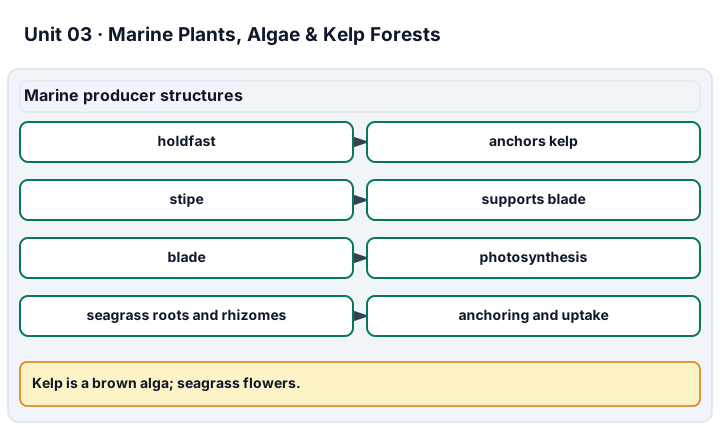
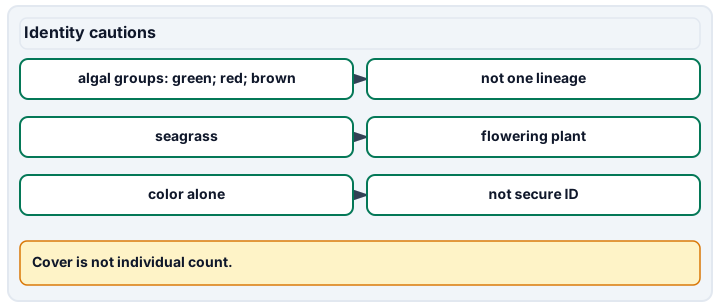
Diagram description
Kelp has holdfast, stipe, and blade structures; the blade photosynthesizes and the holdfast anchors. Seagrasses are flowering plants with roots and rhizomes. Percent cover is a surface-occupancy estimate from point-intercept hits, not a count of individuals.
Data, provenance, and assumptions
| Stratum | Quadrat area (m^2) | Points examined | Eelgrass hits |
|---|---|---|---|
| Meadow | 0.25 | 20 | 12 |
| Meadow | 0.25 | 20 | 16 |
| Meadow | 0.25 | 20 | 14 |
| Edge | 0.25 | 20 | 4 |
| Edge | 0.25 | 20 | 6 |
| Edge | 0.25 | 20 | 8 |
| Producer | Initial O2 (mg/L) | Final O2 (mg/L) | Blank change (mg/L) | Volume (L) | Time (h) | Supplied dry mass (g) |
|---|---|---|---|---|---|---|
| Kelp | 7 | 7.6 | 0.06 | 2 | 2 | 2 |
| Seagrass | 7 | 7.45 | 0.05 | 2 | 2 | 2 |
| Day | Dry biomass (g/m^2) | Assumed carbon fraction (g C/g) |
|---|---|---|
| 0 | 100 | 0.3 |
| 14 | 140 | 0.3 |
Worked model
Meadow cover = (12+16+14)/(20+20+20)×100 = 70%; edge cover is 30%. Kelp net exchange = [(7.6−7.0)−0.06]×2/(2×2) = 0.27 mg O2/g dry mass/h. Biomass change is 40/14 = 2.857 g/m^2/day and standing carbon change is 40×0.30 = 12 g C/m^2, not a verified burial flux.
Numerical calibration
- 70 % point-intercept cover
- 0.27 mg O2/g dry mass/h
- 2.857143 g dry biomass/m^2/day
- 12 g C/m^2 standing-stock change
Attempt the assigned level
Try the tasks before reading the calibration. These are practice answers, not a secure examination; use a new dataset or changed assumption for the assessed transfer.
Foundation
- Label holdfast/stipe/blade in the assigned kelp figure and root/rhizome/leaf in seagrass; calculate meadow and edge cover.
- Calculate the change in dry biomass and identify two habitat functions that a cover percentage alone cannot measure.
Check after your attempt
- Kelps lack true roots, stems and leaves; seagrasses are angiosperms. Cover is 70% versus 30% across equal point effort.
- The dry-biomass increase is 40 g/m^2. Nursery survival and food-web transfer require animal or feeding evidence, not just plant cover.
High-school core: typically grades 9-10
- Calculate blank-corrected net oxygen exchange per gram per hour for both producers.
- Calculate biomass growth rate and standing carbon change; explain why these are not long-term sequestration.
Check after your attempt
- Kelp is 0.27 and seagrass 0.20 mg O2/g dry mass/h under these chamber conditions. One record cannot establish a species-wide ranking.
- Rate is 2.857 g dry biomass/m^2/day; standing carbon change is 12 g C/m^2. Export, grazing, decomposition and sediment burial are unmeasured.
Honors extension: typically grades 11-12
- If one point per meadow quadrat could change classification, bound its pooled cover. Then bound the biomass-change rate using ±5 g/m^2 endpoint errors.
- Recompute carbon change for carbon fractions 0.25 and 0.35; state whether three quadrats are three independent sites.
Check after your attempt
- Cover could be 39/60 to 45/60 = 65–75%. Biomass change ranges from 30 to 50 g/m^2, or 2.143–3.571 g/m^2/day; these are conservative bounds.
- Carbon change ranges from 10 to 14 g C/m^2. Three quadrats sample one meadow stratum, not three independent sites.
History, reading, and writing connection
Using NOAA’s kelp-monitoring paragraph and Seagrass Meadows threats section, write a short restoration-budget recommendation. A supported answer cites the 70% versus 30% supplied cover but does not turn that difference into measured fish recruitment or permanent carbon credits. Name the additional nursery or sediment evidence the recommendation would need.
Write in your own words or use an approved accessible equivalent. Cite a specific assigned section or figure, identify its evidence, and state one limitation or counterargument. Use the AI practice contract only for permitted coaching, never to invent observations or write the assessed response.
Transfer to a new case
A new image has 14 eelgrass hits among 40 points, not 20. Is its cover the same as the third meadow quadrat?
Calibration: No: 35% rather than 70%. Point effort changed. Image area and point-placement rules also need to be comparable.
Evidence to retain
Retain annotated source figures, six-quadrat cover calculations, blank-corrected rates and the stock-versus-flux limitation. Inland image/data analysis replaces neither field collection nor a separately approved preserved-specimen preparation skill.
Record units, calculations, source/date, uncertainty, and what is measured versus inferred. A simulation or supplied dataset must stay labeled as such. The inland supplied-data pathway is available in every unit with equivalent analysis evidence, not a performed field/practical credential. Optional observations require instructor and site approval from a dry, accessible location. No diving, breath-holding, marine-mammal physiology imitation, boats, wading, hazardous tidal sites, handling wild animals, unapproved collection, ingestion, unknown-microbe culture, or hatchery experiments.
Return to all eight learning pathways. Print this unit page for the student lessons; the linked five-page packet remains the separate assessment companion.
Unit mastery rubric
| Criterion | Developing | Proficient | Mastery |
|---|---|---|---|
| Algae vs marine flowering plants | Treats all seaweeds as seagrasses. | Distinguishes groups but misses organs or ancestry. | Distinguishes algal lineages from flowering seagrasses using structural evidence, without treating all algae as one clade. |
| Algal structure & groups | Calls holdfasts true roots. | Labels structures but keys groups inconsistently. | Labels holdfast, stipe and blade; compares green, brown and red algae using a key and explicit identification limits. |
| Kelp forests & seagrass meadows | Treats cover as individual abundance. | Names habitat services but cannot measure cover. | Measures point-intercept cover with a denominator and explains shelter, nursery and food functions without claiming measured survival. |
| Photosynthesis, carbon & productivity | Equates biomass with permanent carbon storage. | Calculates exchange without blank or normalization. | Calculates blank-corrected net exchange and biomass change; distinguishes standing carbon from gross production and durable sequestration. |
| Lab technique (algal survey evidence) | Invents specimens or discards unknowns. | Records identifications but not effort or provenance. | Keys approved figures/specimens and records quadrat area, points, unknowns and uncertainty; labels inland data work separately from observed preparation. |
| Integration (cross-domain) | Makes no supported connection between the source and the science. | Uses the source but needs help connecting evidence, writing, or limitations to the science. | Independently connects History, Reading, and Writing using a cited source, appropriate evidence, a limitation, and a scientific explanation. |
Integration is reported separately and cannot lower the science grade or block a science demonstration pass. Science and practical criteria determine that pass. Use the integration guide's evidence checklist for the separately reported criterion.
Across 60 meadow points, 42 hits give 70% cover. The kelp chamber’s corrected rate is 0.27 mg O2/g/h. The 12 g C/m^2 increase is standing carbon, not measured long-term sequestration.
When a point is obscured, preserve it as unknown and calculate a bound; do not remove difficult points to inflate cover. No plant pressing, harvesting or ingestion is required.
Retain annotated source figures, six-quadrat cover calculations, blank-corrected rates and the stock-versus-flux limitation. Inland image/data analysis replaces neither field collection nor a separately approved preserved-specimen preparation skill. Integration is reported separately and cannot lower the science grade or block a science demonstration pass. Science and practical criteria determine that pass.
A 5-page clipboard packet — unit overview, key terms, the mastery rubric, anchor examples, and a score sheet you can print and grade against.