Unit 04 · Marine Invertebrates
Poriferans move water through pores and chambers; cnidarians have cnidocytes; molluscs have a mantle and muscular foot modified among groups; arthropods have jointed appendages and an exoskeleton; echinoderms have a water-vascular system. A reduced teaching key supports phylum-level reasoning, not reliable identification of every marine animal.
Student learning: Link invertebrate body plans to larval dispersal and recruitment
Choose the level by readiness, not age alone, and record it before instruction. Foundation, core, and honors tasks are study pathways, not an AP course or a promise of college credit. The instructor retains practical assessment and the published science rubric; integration is reported separately.
Prerequisites: Producer/consumer roles; classification keys; fractions, conditional probability and rate × time.
Suggested sequence: read and discuss the explanation; attempt the worked model; analyze the data at your selected level; check the answers; then complete the source-linked response and a fresh transfer question. These activities supplement, not replace, supervised practical work and the full-year schedule.
Assigned reading and focus
- OpenStax Biology 2e, 28.1: Phylum Porifera. Read the introduction and Morphology of Sponges, comparing mobile larvae with attached adults and tracing water through pores and feeding chambers. Use the published figure, not a collected animal.
- NOAA Corals Tutorial: How Do Corals Reproduce?. Read sexual reproduction, broadcast spawning, planula settlement and brooding. Distinguish producing many larvae from surviving to recruitment; the times described are examples, not a universal larval duration.
- NOAA: What is coral bleaching?. Read the first two paragraphs and infographic transcript. Distinguish a coral animal, its photosynthetic symbionts, bleaching and mortality.
Learn the science
Poriferans move water through pores and chambers; cnidarians have cnidocytes; molluscs have a mantle and muscular foot modified among groups; arthropods have jointed appendages and an exoskeleton; echinoderms have a water-vascular system. A reduced teaching key supports phylum-level reasoning, not reliable identification of every marine animal.
Body symmetry depends on life stage. Adult sea stars have a pentaradial plan, while their larvae are bilateral. Many adult sponges are asymmetrical. Filter feeding, tentacles and tube feet connect structure to function; they are not reasons to call invertebrates simple or interchangeable.
Many benthic invertebrates disperse as larvae before attachment and metamorphosis. Planktotrophic larvae feed while dispersing; lecithotrophic larvae rely mainly on yolk, and some species brood or develop directly. Pelagic duration alone does not determine travel: currents, behavior, mortality, competence and habitat availability all matter.
Settlement is attachment/transition to benthic habitat. Recruitment must be operationally defined: here it is surviving as a juvenile to day 30 after settlement. Conditional survival divides each stage count by the immediately preceding stage; egg-to-recruit survival divides final recruits by initial eggs. Multiplying conditional fractions is valid for this one tracked cohort, not for unrelated samples at different sites.
A coral polyp is an animal that can capture food. Many shallow reef-building corals also receive fixed carbon from photosynthetic dinoflagellate symbionts; not all corals have that partnership. Bleaching is loss of symbionts or pigments under stress, not automatic death. Reproduction and later juvenile survival can respond differently to temperature, salinity, oxygen and carbonate chemistry.

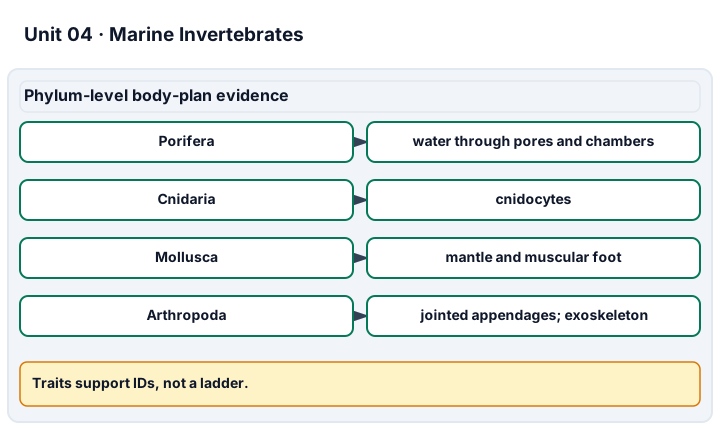
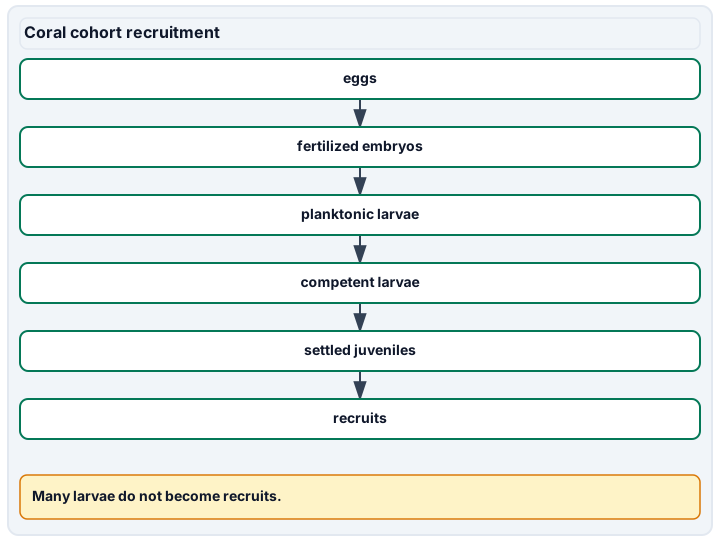
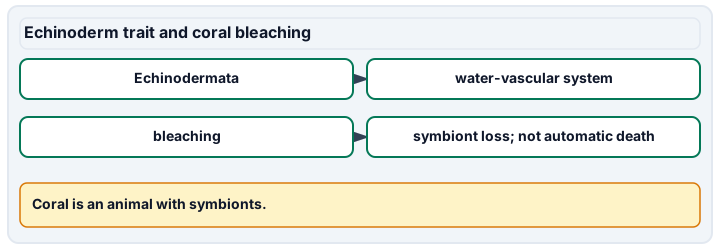
Diagram description
Marine invertebrate body-plan evidence is shown as separate rows, not a ladder. Recruitment is a true sequence from eggs to recruits, but survival is conditional at each stage and cumulative only from eggs to recruits. Bleaching is symbiont loss under stress, not automatic death.
Data, provenance, and assumptions
| Card | Diagnostic trait | Life-stage symmetry | Supported phylum |
|---|---|---|---|
| I1 | Pores and collar-cell feeding chambers | Often asymmetrical adult | Porifera |
| I2 | Tentacles with cnidocytes | Radial polyp | Cnidaria |
| I3 | Mantle and muscular foot | Bilateral | Mollusca |
| I4 | Jointed appendages and exoskeleton | Bilateral | Arthropoda |
| I5 | Water-vascular system | Pentaradial adult; bilateral larva | Echinodermata |
| Stage | Individuals remaining |
|---|---|
| Eggs | 100000 |
| Fertilized embryos | 60000 |
| Surviving planktonic larvae | 12000 |
| Competent larvae | 6000 |
| Settled juveniles | 600 |
| Recruits at day 30 after settlement | 150 |
| Destination/fate | Larvae |
|---|---|
| A (origin reef) | 300 |
| B | 180 |
| C | 120 |
| No settlement | 5400 |
Worked model
Conditional fractions are 0.60, 0.20, 0.50, 0.10 and 0.25. Their product is 0.0015, or 0.15% egg-to-recruit survival; 100,000×0.0015 = 150 recruits. Only 300/6,000 = 5% of competent larvae settle at their origin, but origin settlers are 300/600 = 50% of all settlers. These different denominators answer different questions.
Numerical calibration
- 0.0015 egg-to-day-30 recruit probability (0.15%)
- 150 modeled recruits
- 60 recruits at 10% post-settlement survival
- 0.05 origin settlers/competent larvae
- 0.5 origin settlers/all settlers
- 21.6 km in a constant-current teaching model
Attempt the assigned level
Try the tasks before reading the calibration. These are practice answers, not a secure examination; use a new dataset or changed assumption for the assessed transfer.
Foundation
- Classify the five trait cards and explain the symmetry change in I5.
- Draw the six-stage life cycle and distinguish the 600 settlers from the 150 recruits.
Check after your attempt
- I1–I5 support Porifera, Cnidaria, Mollusca, Arthropoda and Echinodermata. Adult pentaradial symmetry does not describe the bilateral echinoderm larva.
- Settlement is the habitat transition; recruitment here requires survival to day 30. Only one quarter of settlers remain at that checkpoint.
High-school core: typically grades 9-10
- Calculate every conditional survival fraction and the egg-to-recruit percentage.
- Compute local retention and the origin-reef share of settlers, then explain why settlement does not prove successful recruitment.
Check after your attempt
- The fractions are 60%, 20%, 50%, 10% and 25%; multiplied survival is 0.15%. Using 100,000 as every conditional denominator is incorrect.
- Local retention is 5% of competent larvae; the origin share is 50% of settlers. Later predation, food limitation, stress and habitat loss can change juvenile survival.
Honors extension: typically grades 11-12
- If post-settlement survival becomes 10% instead of 25%, compute recruits and the percent reduction; hold earlier stages fixed.
- A constant current of 0.05 m/s acts for five days. Calculate an advection distance and explain why it does not predict a settlement destination.
Check after your attempt
- 600×0.10 = 60 recruits, a 60% reduction from 150. This is a one-parameter sensitivity, not a causal estimate from field observations.
- Distance is 0.05×5×86,400/1,000 = 21.6 km. Changing currents, retention, swimming, mortality and competence violate the constant-current model; it cannot establish connectivity.
History, reading, and writing connection
Use NOAA’s reproduction section and the OpenStax sponge life-stage description to challenge “an attached adult cannot disperse.” A checked 150-word response distinguishes adult movement from offspring dispersal, cites the two sources, includes the 0.15% survival model and explains why many eggs do not guarantee reef recovery. Label the numbers synthetic.
Write in your own words or use an approved accessible equivalent. Cite a specific assigned section or figure, identify its evidence, and state one limitation or counterargument. Use the AI practice contract only for permitted coaching, never to invent observations or write the assessed response.
Transfer to a new case
A survey counts 150 day-30 juveniles but has no origin tags or egg count. Can it infer 0.15% local egg-to-recruit survival?
Calibration: No. Immigration, unobserved mortality, detection and the starting cohort are unknown. Our probability came from a tracked synthetic cohort, not a juvenile count alone.
Evidence to retain
Retain the trait-key decisions, life-stage diagram, all denominators, dispersal accounting and sensitivity. Inland published-image/data analysis is not a dissection credential. Any preserved-specimen anatomical technique needs a separate instructor-approved protocol and direct observation; no wild animals are handled.
Record units, calculations, source/date, uncertainty, and what is measured versus inferred. A simulation or supplied dataset must stay labeled as such. The inland supplied-data pathway is available in every unit with equivalent analysis evidence, not a performed field/practical credential. Optional observations require instructor and site approval from a dry, accessible location. No diving, breath-holding, marine-mammal physiology imitation, boats, wading, hazardous tidal sites, handling wild animals, unapproved collection, ingestion, unknown-microbe culture, or hatchery experiments.
Return to all eight learning pathways. Print this unit page for the student lessons; the linked five-page packet remains the separate assessment companion.
Unit mastery rubric
| Criterion | Developing | Proficient | Mastery |
|---|---|---|---|
| Major phyla & defining traits | Groups all invertebrates together. | Names phyla but confuses diagnostic evidence. | Keys Porifera, Cnidaria, Mollusca, Arthropoda and Echinodermata with defining traits and stated key limits. |
| Body plans & life stages | Assigns adult symmetry to every stage. | Recognizes radial/bilateral forms without life-history links. | Relates body plan, feeding and larval development; distinguishes adult pentaradial from larval bilateral echinoderms. |
| Adaptations, dispersal & recruitment | Equates eggs, larvae and recruits. | Describes dispersal without survival denominators. | Explains feeding adaptations and computes conditional survival, retention and recruitment with an operational checkpoint. |
| Coral as an animal | Calls coral a plant or rock. | Names symbiosis but equates bleaching with death. | Explains coral feeding, symbionts, reproduction and juvenile survival; distinguishes bleaching, calcification and mortality. |
| Lab technique (invertebrate evidence) | Invents traits or field histories. | Uses a key but skips evidence or life-stage context. | Records supported anatomical/key decisions and cohort calculations; separates inland data/image work from any observed approved preserved-specimen technique. |
| Integration (cross-domain) | Makes no supported connection between the source and the science. | Uses the source but needs help connecting evidence, writing, or limitations to the science. | Independently connects History, Reading, and Writing using a cited source, appropriate evidence, a limitation, and a scientific explanation. |
Integration is reported separately and cannot lower the science grade or block a science demonstration pass. Science and practical criteria determine that pass. Use the integration guide's evidence checklist for the separately reported criterion.
The tracked cohort produces 150 recruits from 100,000 eggs, or 0.15%. Local settlers are 5% of competent larvae but 50% of settlers. A sea-star larva can be bilateral even though the adult is pentaradial.
A juvenile survey without origin or cohort data cannot estimate local egg survival. Correct a denominator error with stage labels, not an invented hatchery experiment.
Retain the trait-key decisions, life-stage diagram, all denominators, dispersal accounting and sensitivity. Inland published-image/data analysis is not a dissection credential. Any preserved-specimen anatomical technique needs a separate instructor-approved protocol and direct observation; no wild animals are handled. Integration is reported separately and cannot lower the science grade or block a science demonstration pass. Science and practical criteria determine that pass.
A 5-page clipboard packet — unit overview, key terms, the mastery rubric, anchor examples, and a score sheet you can print and grade against.