Unit 05 · Fish & Sharks
Fins affect propulsion and stability; the lateral line detects water movement; gills exchange gases across a large, thin surface. Counter-current water and blood flow can maintain an oxygen gradient along the gill. Ventilation is water movement across gills; it is not the same process as buoyancy control.
Student learning: Explain fish structure, gas exchange and osmoregulation
Choose the level by readiness, not age alone, and record it before instruction. Foundation, core, and honors tasks are study pathways, not an AP course or a promise of college credit. The instructor retains practical assessment and the published science rubric; integration is reported separately.
Prerequisites: Cell membranes, diffusion and ATP; Units 1–4 water conditions; signed balances and ratios.
Suggested sequence: read and discuss the explanation; attempt the worked model; analyze the data at your selected level; check the answers; then complete the source-linked response and a fresh transfer question. These activities supplement, not replace, supervised practical work and the full-year schedule.
Assigned reading and focus
- OpenStax Biology 2e, 41.1: Osmoregulation and Osmotic Balance. Read Transport of Electrolytes across Cell Membranes and Osmoregulators and Osmoconformers, including Figure 41.3. Focus on freshwater/marine teleosts, urea/TMAO and the shark rectal gland, not the medical-career sidebar.
- OpenStax Biology 2e, 29.2: Fishes. Read Chondrichthyes and Osteichthyes and inspect the gill/skeleton examples. Distinguish ventilation, buoyancy and skeleton type rather than assuming every shark must swim continuously.
Learn the science
Fins affect propulsion and stability; the lateral line detects water movement; gills exchange gases across a large, thin surface. Counter-current water and blood flow can maintain an oxygen gradient along the gill. Ventilation is water movement across gills; it is not the same process as buoyancy control.
Many teleosts have a gas-filled swim bladder, but not all bony fish do. Sharks lack a swim bladder and can use an oil-rich liver and hydrodynamic lift. Some rely heavily on ram ventilation; others pump water while resting. The absence of a swim bladder does not itself force continuous swimming.
Osmosis depends on effective solute differences across a selectively permeable membrane. Marine teleost body fluids are usually less concentrated than seawater, so they tend to lose water and gain salts. Drinking, intestinal absorption, gill ionocytes and kidneys coordinate water and ion balance; ATP-dependent transport helps maintain gradients.
Freshwater teleosts face the opposite water tendency, taking up ions and excreting dilute urine. Euryhaline species can adjust transport over time; simply moving an animal between salinities is not a safe demonstration and many species cannot tolerate it.
Marine sharks retain urea and TMAO, bringing total osmolarity near or slightly above seawater while keeping many inorganic ions below seawater concentrations. TMAO helps stabilize proteins; the rectal gland secretes excess salt. Near-isosmotic does not mean identical ionic composition or no regulation. Many marine invertebrate osmoconformers still regulate individual ions.
A fin/body ratio must use comparable landmarks. A length–mass relation fitted to two constructed fish records is a model, not a universal biological law; shape, maturity, condition and species affect it. It must not be used to predict an unrelated shark’s mass.

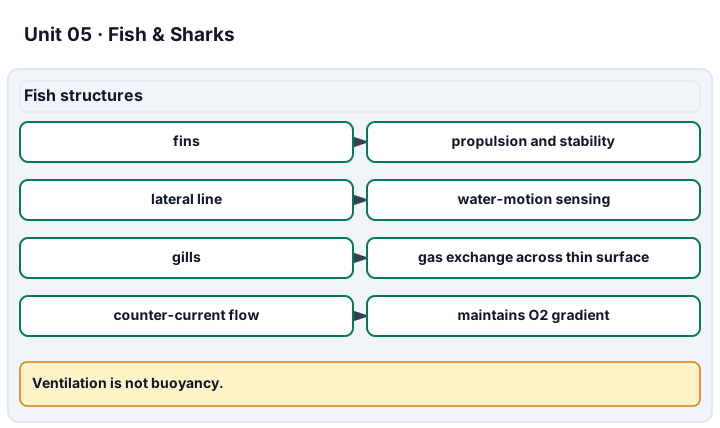
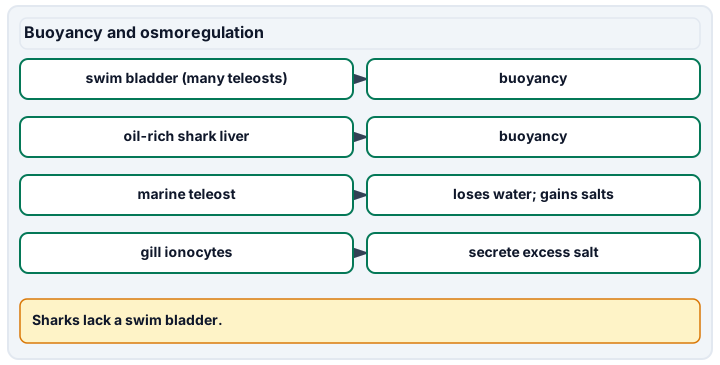
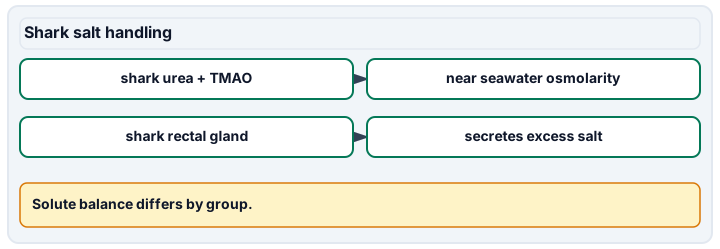
Diagram description
Fins, lateral line, gills, counter-current exchange, swim bladder, shark liver, ionocytes, urea/TMAO, and rectal gland are separated so ventilation, buoyancy, and osmoregulation are not confused. Osmolarity differences use supplied concentrations.
Data, provenance, and assumptions
| Organism model | Seawater osmolarity (mOsm/L) | Body-fluid osmolarity (mOsm/L) |
|---|---|---|
| Marine teleost | 1000 | 330 |
| Marine shark | 1000 | 1010 |
| Marine osmoconforming invertebrate | 1000 | 1000 |
| Direction | Process | Water flux (mL/kg/day) |
|---|---|---|
| Input | Absorbed drinking water | 25 |
| Input | Food and metabolic water | 5 |
| Output | Osmotic loss across surfaces | 22 |
| Output | Urine and other loss | 8 |
| Record | Body length (cm) | Fin length (cm) | Mass (g) |
|---|---|---|---|
| T1 | 20 | 4 | 160 |
| T2 | 30 | 5 | 540 |
| S1 | 40 | 8 | 700 |
Worked model
The teleost’s environment exceeds its body-fluid osmolarity by 670 mOsm/L, favoring outward water movement in the simplified model. The shark is 10 mOsm/L above the environment; urea contributes without making every ion concentration equal. Water balance is (25+5)−(22+8) = 0 mL/kg/day. T1 fin/body ratio is 4/20 = 0.20; T1 and T2 fit mass = 0.02×length^3 within this constructed model.
Numerical calibration
- 670 mOsm/L, environment minus body
- 10 mOsm/L, body minus environment
- 0 mL/kg/day net balance
- -5 mL/kg/day with added surface loss
- 0.2 cm/cm, dimensionless
- 3 two-record model exponent
- 1280 g at 40 cm, same teleost model only
Attempt the assigned level
Try the tasks before reading the calibration. These are practice answers, not a secure examination; use a new dataset or changed assumption for the assessed transfer.
Foundation
- Annotate fins, lateral line, gills and a swim bladder where present using the assigned fish figures; separate buoyancy from ventilation.
- Use the osmolarity table to predict water tendency and calculate the daily water balance.
Check after your attempt
- Fins move/stabilize; lateral lines sense flow; gills exchange gases; a swim bladder affects buoyancy in many teleosts. A shark lacking that bladder may still ventilate by pumping.
- Water tends out of the teleost and slightly into the shark in the simplified model; the invertebrate has no net osmotic tendency here. Inputs and outputs both total 30 mL/kg/day.
High-school core: typically grades 9-10
- Explain why gill salt transport, urea/TMAO retention and rectal-gland secretion are different solutions to osmoregulation.
- Calculate fin/body ratios for all three records and the water imbalance if surface loss rises by 5 with other fluxes fixed.
Check after your attempt
- Teleost ionocytes and kidneys regulate salts while drinking replaces water; sharks retain organic solutes and secrete salts through the rectal gland. Equal total osmolarity does not imply equal sodium concentration.
- Ratios are 0.20, 0.1667 and 0.20. The altered budget is −5 mL/kg/day; compensatory intake/excretion would be needed, but this table cannot predict an actual animal’s response.
Honors extension: typically grades 11-12
- Fit the exponent b in mass = a×length^b from T1/T2 and predict the mass at 40 cm within that model.
- Explain two reasons that the 10 mOsm/L shark difference does not uniquely determine its water flux or establish the same strategy for all sharks.
Check after your attempt
- b = ln(540/160)/ln(30/20) = 3 and a = 0.02; prediction is 1,280 g. It is not the shark’s measured 700 g; that extrapolation crosses species and condition.
- Permeability and effective solutes matter, as do active transport and species/environment differences. Rounded total concentrations do not provide membrane area, permeability or adaptation rates.
History, reading, and writing connection
Use Figure 41.3 and the shark paragraph in OpenStax 41.1 to revise a fictional museum label: “all fish solve salty water in the same way.” A checked response contrasts ion regulation with total osmolarity, cites the urea/TMAO evidence and limits the claim to the described marine models. Connect the correction to why comparative anatomical collections need physiological evidence as well as visible traits.
Write in your own words or use an approved accessible equivalent. Cite a specific assigned section or figure, identify its evidence, and state one limitation or counterargument. Use the AI practice contract only for permitted coaching, never to invent observations or write the assessed response.
Transfer to a new case
A fish has no swim bladder. Does that prove it is a shark that must swim continuously?
Calibration: No. Some bony fishes also lack one; skeleton, gill covering and other traits are needed. Ventilation mode is species-dependent and separate from buoyancy.
Evidence to retain
Retain annotated source figures, the signed water balance, osmoregulation explanation and within-species scaling limitation. Inland work uses supplied data/images only; any preserved-specimen anatomy observation is separate from a performed dissection assessment.
Record units, calculations, source/date, uncertainty, and what is measured versus inferred. A simulation or supplied dataset must stay labeled as such. The inland supplied-data pathway is available in every unit with equivalent analysis evidence, not a performed field/practical credential. Optional observations require instructor and site approval from a dry, accessible location. No diving, breath-holding, marine-mammal physiology imitation, boats, wading, hazardous tidal sites, handling wild animals, unapproved collection, ingestion, unknown-microbe culture, or hatchery experiments.
Return to all eight learning pathways. Print this unit page for the student lessons; the linked five-page packet remains the separate assessment companion.
Unit mastery rubric
| Criterion | Developing | Proficient | Mastery |
|---|---|---|---|
| Fish anatomy | Mislabels major structures. | Labels fins/gills but omits function or exceptions. | Identifies fins, gills, lateral line and swim bladder where present, linking visible structure to function and limits. |
| Cartilaginous vs bony fish | Uses size or danger as classification. | Names skeleton types without supporting traits. | Distinguishes sharks/rays from bony fish using skeleton and corroborating traits; avoids universal swim-bladder claims. |
| Buoyancy & gas exchange | Confuses ventilation with buoyancy. | Explains one process but conflates shark exceptions. | Explains buoyancy and counter-current exchange; separates ram/pump ventilation from absence of a swim bladder. |
| Adaptations & osmoregulation | Ignores salt/water balance. | Predicts osmosis but omits active transport. | Compares teleost ion regulation with shark urea/TMAO and rectal-gland function; balances water fluxes with limitations. |
| Lab technique (fish structure evidence) | Invents observations or incompatible lengths. | Records structures but not landmark or scale context. | Records supported anatomical identifications and comparable morphometric ratios; labels image/data evidence separately from observed specimen skills. |
| Integration (cross-domain) | Makes no supported connection between the source and the science. | Uses the source but needs help connecting evidence, writing, or limitations to the science. | Independently connects History, Reading, and Writing using a cited source, appropriate evidence, a limitation, and a scientific explanation. |
Integration is reported separately and cannot lower the science grade or block a science demonstration pass. Science and practical criteria determine that pass. Use the integration guide's evidence checklist for the separately reported criterion.
The teleost tends to lose water to its more concentrated surroundings; its simplified daily input and output both equal 30 mL/kg. Sharks retain urea/TMAO and secrete salt. Their lack of a swim bladder does not by itself require continuous swimming.
A two-point length–mass fit is not validated across species. Never test osmotic predictions by moving live animals between salinities.
Retain annotated source figures, the signed water balance, osmoregulation explanation and within-species scaling limitation. Inland work uses supplied data/images only; any preserved-specimen anatomy observation is separate from a performed dissection assessment. Integration is reported separately and cannot lower the science grade or block a science demonstration pass. Science and practical criteria determine that pass.
A 5-page clipboard packet — unit overview, key terms, the mastery rubric, anchor examples, and a score sheet you can print and grade against.