Teaching examples, not student testimonials. The sample week, model notebook, and demonstration prompts illustrate the intended learning process; they do not report an enrolled student's results. Current program status and next steps.
Look inside the Physical Science pack.
No sign-up, no email required. Here is a sample week, a real rubric, a model lab-notebook entry, and a sample demonstration. These are the materials themselves, not a brochure. Every sample links to the full artifact it’s drawn from.
One week, two days at the bench.
The course meets two days a week for about two hours a day, across roughly 32 weeks. Here is week one of Unit 1 — Matter & Its Properties: the student measures matter for real before a single definition is memorized.
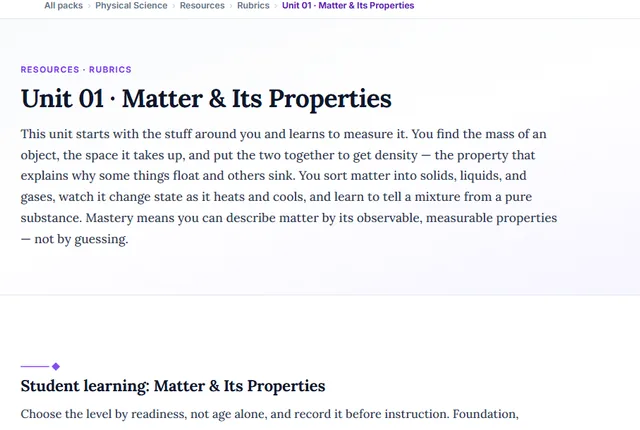
- Mass, volume & density
- States of matter & changes of state
- Mixtures vs. pure substances
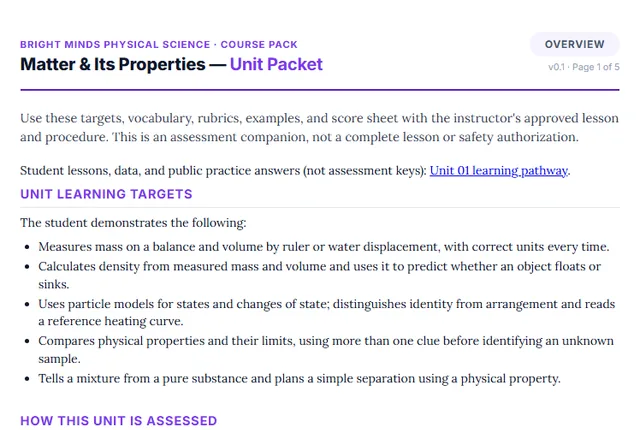
- Measure mass, volume & density
- Predict float vs. sink from density
- Report data with correct units
How “mastered” is actually judged.
Every skill is scored at one of three levels against a published standard, without points or grading on a curve. Here is one criterion from the Matter & Its Properties rubric — density, shown as a parent or guide would read it:
| Level | What it looks like — “Measure density, then predict float or sink” |
|---|---|
| Developing | Thinks heavier objects always sink. |
| Proficient | Knows density is mass over volume but cannot use it to predict floating or sinking. |
| Mastery | Calculates density from measured mass and volume and uses it to predict whether an object floats or sinks. |
Browse the full rubric set → · How this becomes an A–F grade →
The artifact a student builds, keeps, and defends.
The lab notebook is the primary record of a student's work, written in pen at the bench and explained aloud. Here is an illustrative partial entry showing how each section is recorded. Notice the flagged, retained timing note and the honest sources of error.
| Added mass (g) | Illustrative summary time (s) |
|---|---|
| 0 | 1.42 |
| 100 | 1.40 |
| 200 | 1.43 |
- Dated & titled entries
- A testable question & hypothesis
- Units on every number
- Significant figures, honestly reported
- Calculations shown, not just answers
- Written in pen during the lab; errors crossed out, not erased
- Error analysis with direction & size
The moment that can’t be faked.
Three times across the year, a student performs and defends a demonstration, standing with their own work and reasoning aloud while an adult asks unscripted follow-ups. In the timed prediction-and-test, they predict a physical outcome from their own measurements, then run it live and account for the difference.
“The steel bolt masses 31 g and displaced 4 mL of water, so its density is about 7.8 g/mL — well over water’s 1.0 — so I predicted it sinks. It did. The cork came out under 1.0, so I called it a float, and it floated.”
A passing answer from the timed prediction-and-test — reasoning from real measurements, not guessing from weight.
The whole pack, ready for a binder.
Everything here is available to read online. Every rubric, checklist, and guide also has a print-ready packet version, formatted 8.5×11 for a clipboard or a three-ring binder. You assemble the student’s binder from the pack itself; there’s nothing else to buy to hold it in your hands. We’ve put them all in binder order on one page: Assemble the Physical Science binder →
Seen enough to start?
The whole Physical Science pack is open to read and print. Open it and begin, or ask us a question first. A real person answers.