Unit 01 · Matter & Its Properties
This unit starts with the stuff around you and learns to measure it. You find the mass of an object, the space it takes up, and put the two together to get density — the property that explains why some things float and others sink. You sort matter into solids, liquids, and gases, watch it change state as it heats and cools, and learn to tell a mixture from a pure substance. Mastery means you can describe matter by its observable, measurable properties — not by guessing.
Student learning: Matter & Its Properties
Choose the level by readiness, not age alone, and record it before instruction. Foundation, core, and honors tasks are study pathways, not an AP course or a promise of college credit. The instructor retains practical assessment and the published science rubric; integration is reported separately.
Prerequisites: [density-separation] Subtract readings, divide mass by volume, compare ratios and distinguish a model from an actual observation.
Suggested sequence: read and discuss the explanation; attempt the worked model; analyze the data at your selected level; check the answers; then complete the source-linked response and a fresh transfer question. These activities supplement, not replace, supervised practical work and the full-year schedule.
Assigned reading and focus
- OpenStax Chemistry 2e 1.2: Phases and Classification of Matter. [density-separation] Read the solid/liquid/gas and pure-substance/mixture descriptions. Use particle sketches as models, not as photographs of individual atoms.
- OpenStax College Physics 2e 14.3: Phase Change and Latent Heat. [density-separation] Preview the heating-curve picture and identify the flat phase-change intervals. Unit 6 develops the energy calculation; no heating procedure is assigned.
- OpenStax Chemistry 2e 1.5: Measurement Uncertainty, Accuracy, and Precision. [density-separation] Read accuracy versus precision and the limits of a reported measurement. In the extension, use the supplied bounds; no statistical confidence level is implied.
- MacTutor, University of St Andrews: Archimedes. Read the discussion of Archimedes’ works on floating bodies and distinguish surviving work from later anecdotes. Our density records are modern practice, not ancient measurements.
Learn the science
Physical Science remains a grades 7-9 survey and early-high-school bridge, not a full AP Chemistry or Physics course. Choose guided Foundation, independent survey/bridge work, or optional higher-challenge reasoning by readiness. Use only the assigned textbook sections and focus; extra equations or probability work are not automatically NGSS middle-school assessment requirements. Paper evidence and approved observed practical work remain separate.
[density-separation] What properties can tell us about a sample. Density is mass divided by volume. For the compact nonreactive pieces here, water displacement gives volume: subtract the initial reading from the final reading. One mL equals one cubic centimeter. A property such as density can narrow possible identities, but overlapping values and uncertainty prevent a unique identification from one number. A mixture can be separated using a property difference without changing each component into a new substance. Dissolved salt ordinarily passes through a filter that retains suspended sand.
[density-separation] Assumptions: The pieces are modeled as dry, nonporous solids that neither dissolve nor react with the liquid. Displacement readings have no trapped-air contribution. Pooling all masses and displaced volumes estimates the common material density under that assumption. The extension gives mass bounds of plus/minus 0.2 g and volume bounds of plus/minus 0.5 mL for piece A only. The phase cards describe ordinary matter at stated conditions, not every unusual material.
[density-separation] Uncertainty: Wet surfaces, trapped air, solubility and instrument bias would alter a real result. The given bounds are limits for this exercise, not a 95% confidence interval. A pooled estimate does not make a shared calibration bias disappear. Solubility or magnetism needs separate evidence; a matching density does not establish an unknown substance or safe handling.

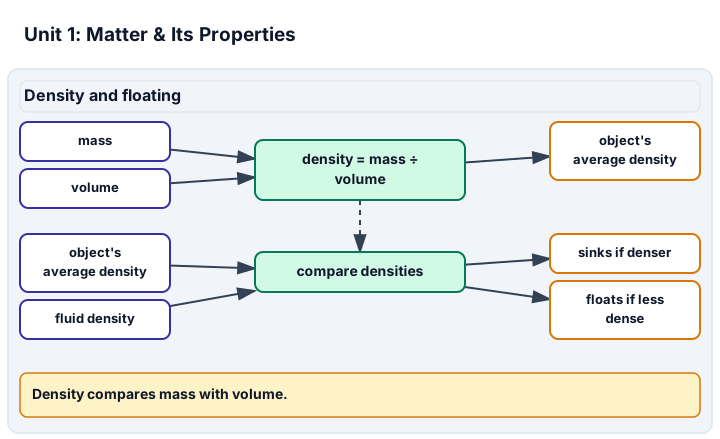
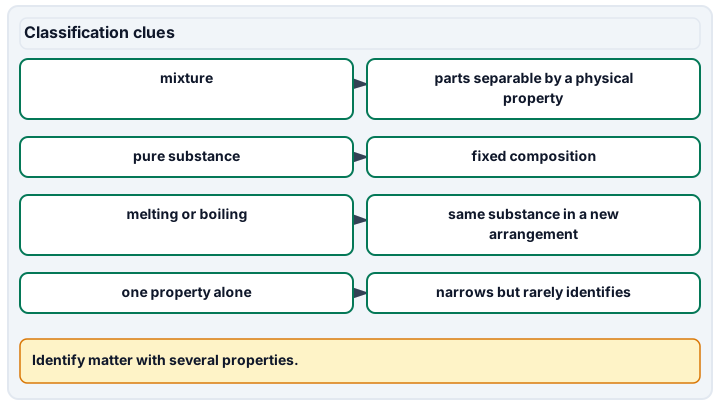
Diagram description
Density and floating shows mass and volume as inputs to density, density as the object's average density, and object density plus fluid density as inputs to a density comparison that predicts sinking or floating. Classification clues shows that mixtures can be separated by a physical property, pure substances have fixed composition, melting or boiling keeps the same substance with a new arrangement, and one property alone usually narrows rather than identifies matter.
Data, provenance, and assumptions
| Piece | Mass (g) | Initial liquid (mL) | Final liquid (mL) |
|---|---|---|---|
| A | 27 | 40 | 50 |
| B | 54.1 | 40 | 60 |
| C | 80.9 | 40 | 70 |
| State | Shape/volume behavior | Particle model |
|---|---|---|
| Solid | Retains shape and approximately fixed volume | Particles remain near positions but still move locally |
| Liquid | Changes shape; approximately fixed volume | Nearby particles rearrange and move past one another |
| Gas | Fills available container | Widely separated particles move through the available space |
| Energy supplied (J) | Temperature (C) | Reference endpoint |
|---|---|---|
| 0 | -10 | Ice |
| 210 | 0 | Melting begins |
| 3550 | 0 | Melting complete |
| 7730 | 100 | Boiling begins |
| 30330 | 100 | Boiling complete |
| 30530 | 110 | Water vapor |
| Component | Given property | Planning implication |
|---|---|---|
| Sand | Insoluble suspended grains in water | A suitable filter can retain grains |
| Salt | Dissolved ions in water | Ordinary grain filtration does not isolate these ions |
| Iron | Magnetic solid in this model | Magnetism can distinguish it from the other components |
Paper investigation sequence and evidence record
Scope and safety: All new records are supplied-data or reference-model work, not laboratory procedures. Do not improvise chemical mixtures, heating, impacts, laser or solar viewing, pressure systems, mains electricity or unreviewed wiring. An instructor must approve any real activity, equipment and accessible alternative separately. Paper calculations do not certify unobserved measuring or building skills; public solutions are nonsecure practice.
Materials and preparation
- [density-separation] Use the supplied density-records, state-cards, matter-heating-preview, separation-properties records, assigned source sections, calculator and an accessible graph or diagram. No physical apparatus is required.
Procedure and schedule
- [density-separation] Question: Which property comparisons support a model classification, and which would need additional evidence before identifying a sample? Prerequisites: Subtract readings, divide mass by volume, compare ratios and distinguish a model from an actual observation.
- [density-separation] Variables: Compare three different-size pieces and property cards while retaining the same material and fluid assumptions. Controls: Keep units, compact volume, dry mass, fluid identity and the stated error bounds consistent within each calculation. Replication: The three fictional pieces are different samples, not three repeated readings of one piece; shared measurement bias could still remain.
- [density-separation] Analysis: Compute volume differences and densities, pool compatible amounts, test bounds and justify a separation property with a stated limit. Review: An educator reviews prerequisites, source interpretation, reasoning and accessibility before assessment. A paper response does not certify unobserved practical technique; approved hands-on work requires a separate record.
Record: Retain density-separation, the selected level, original inputs and first attempt, source/date, system and axes, units, assumptions, calculation/graph, uncertainty, correction and fresh transfer. Link only to the stated science criteria.
Worked model
[density-separation] Displaced volumes are 10, 20 and 30 mL. Individual densities are 2.700, 2.705 and about 2.696667 g/mL; the pooled value is (27 + 54.1 + 80.9)/(10 + 20 + 30) = 2.700 g/mL. For A, lower and upper bounds are 26.8/10.5 = 2.552380952 and 27.2/9.5 = 2.863157895 g/mL. These wide bounds do not uniquely name a material.
Numerical calibration
- 2.7 g/mL
- 2.552380952381 g/mL lower bound
- 2.863157894737 g/mL upper bound
- 3 g/cm^3 in the changed sample
Attempt the assigned level
Try the tasks before reading the calibration. These are practice answers, not a secure examination; use a new dataset or changed assumption for the assessed transfer.
Foundation: typically grades 7-8, guided physical-science concepts
- [density-separation] Find each displaced volume and describe what the solid, liquid and gas cards say about particles. Select a property that could distinguish iron from salt without inventing a procedure.
Check after your attempt
- [density-separation] Volumes are 10, 20 and 30 mL. Solids still have particle motion, liquids can change shape, and gases spread into available space. Given magnetism distinguishes the iron card; a real procedure, equipment and handling must be approved separately.
Core: survey / bridge core with independent models and basic calculations
- [density-separation] Calculate the pooled density, distinguish a mixture from a pure substance and explain the salt/filter limitation. In the heating preview, identify the two flat intervals and state whether H2O changes identity there.
Check after your attempt
- [density-separation] Pooled density is 162/60 = 2.7 g/mL. A mixture contains separate component substances; dissolved ions pass through an ordinary grain filter. The flat 0 C and 100 C intervals represent melting and boiling in the reference model: state changes while H2O identity remains. Flat temperature does not mean no energy enters.
Honors extension: extra reasoning, not an AP course
- [density-separation] Calculate both density bounds for A and compare candidate reference densities of 2.70 and 2.80 g/mL. Explain why reporting many decimals is not the same as resolving the sample identity.
Check after your attempt
- [density-separation] Bounds are about 2.552381 to 2.863158 g/mL. Both candidate values fit, so density alone cannot identify a unique material. Extra decimal places in the arithmetic do not remove measurement limits, bias, or missing diagnostic properties.
History, reading, and writing connection
Use the assigned Archimedes account to identify a source-supported historical question about matter or floating bodies. Compare it with the supplied density/phase models, cite the source and state one limit. Do not treat a familiar bath story or our invented values as original experimental records.
Write in your own words or use an approved accessible equivalent. Cite a specific assigned section or figure, identify its evidence, and state one limitation or counterargument. Use the AI practice contract only for permitted coaching, never to invent observations or write the assessed response.
Transfer to a new case
[density-separation] A new compact, nonporous model piece has mass 24 g and volume 8 cm^3. Calculate density and predict whether it sinks in water of density 1 g/cm^3, stating a condition that could invalidate that prediction.
Calibration: [density-separation] Density is 24/8 = 3 g/cm^3, so the specified compact piece is denser than the water and sinks when unsupported in the simplified model. Trapped air, a hollow shape, deformation or a different fluid would require a different effective volume or comparison.
Evidence to retain
[density-separation] Science criteria 2-5: density, state/particle descriptions, diagnostic-property limits and mixture-separation reasoning. Reading supplied measurements does not demonstrate the actual balance/ruler/displacement skill in criterion 1.
Record units, calculations, source/date, uncertainty, and what is measured versus inferred. A simulation or supplied dataset must stay labeled as such. All new records are supplied-data or reference-model work, not laboratory procedures. Do not improvise chemical mixtures, heating, impacts, laser or solar viewing, pressure systems, mains electricity or unreviewed wiring. An instructor must approve any real activity, equipment and accessible alternative separately. Paper calculations do not certify unobserved measuring or building skills; public solutions are nonsecure practice.
Return to all eight learning pathways. Print this unit page for the student lessons; the linked five-page packet remains the separate assessment companion.
What work supports these criteria?
Integration is reported separately and cannot lower the science grade or block a science demonstration pass. Science and practical criteria determine that pass. Use the learner's own reasoning and an instructor-selected fresh variation. A supplied-data calculation covers only the stated analytical part of a criterion, not an unobserved measurement or build.
- What properties can tell us about a sample: science criteria 2, 3, 4, 5.
Unit mastery rubric
| Criterion | Developing | Proficient | Mastery |
|---|---|---|---|
| Mass, volume & measurement | Confuses mass with volume or reads the balance and ruler incorrectly. | Measures mass and volume but mixes up their units. | Measures mass on a balance and volume by ruler or water displacement, with correct units every time. |
| Density | Thinks heavier objects always sink. | Knows density is mass over volume but cannot use it to predict floating or sinking. | Calculates density from measured mass and volume and uses it to predict whether an object floats or sinks. |
| States of matter & changes of state | Cannot describe how solids, liquids, and gases differ. | Names the three states but stumbles on melting and boiling. | Uses particle models for states and changes of state; distinguishes identity from arrangement and reads a reference heating curve. |
| Physical properties | Cannot name a property that describes matter. | Lists a property or two but cannot measure or compare them. | Compares physical properties and their limits, using more than one clue before identifying an unknown sample. |
| Mixtures vs. pure substances | Treats every sample as “just one thing.” | Defines a mixture but cannot suggest how to separate it. | Tells a mixture from a pure substance and plans a simple separation using a physical property. |
| Integration (cross-domain) | Makes no supported connection between the source and the science. | Uses the source but needs help connecting evidence, writing, or limitations to the science. | Independently connects History, Reading, and Writing using a cited source, appropriate evidence, a limitation, and a scientific explanation. |
Integration is reported separately and cannot lower the science grade or block a science demonstration pass. Science and practical criteria determine that pass. Use the integration guide's evidence checklist for the separately reported criterion.
“For the supplied compact piece A, 27 g divided by 10 mL gives 2.7 g/mL. The stated bounds still allow several material identities. A floating object does not automatically displace its entire volume, so I cannot use that shortcut for every sample. These are model calculations, not my observed measuring technique.”
“The bolt sinks because… it’s heavier? And the cork floats because it’s light, I think.”
You demonstrate this unit through hands-on measurement — massing objects, finding volume, and calculating density — plus short oral checks where you explain your results aloud, not a multiple-choice test. A criterion counts as mastered only when you can both take the measurement and explain what the property tells you about the matter. Mastery is demonstrated, not awarded.
A 5-page clipboard packet — unit overview, key terms, the mastery rubric, anchor examples, and a score sheet you can print and grade against.