Unit 02 · Atoms, Elements & the Periodic Table
We use atomic models to explain ordinary matter. An ordinary light microscope cannot resolve individual atoms, while specialized instruments can provide atomic-scale images and evidence. An element is identified by its atoms’ proton number; a compound contains chemically combined elements; a mixture contains more than one component and can look uniform. The periodic table organizes atomic number and property patterns, including metals, nonmetals and metalloids. Use the supplied models and material records, then document any approved separation practical separately.
Student learning: Atoms, Elements & the Periodic Table
Choose the level by readiness, not age alone, and record it before instruction. Foundation, core, and honors tasks are study pathways, not an AP course or a promise of college credit. The instructor retains practical assessment and the published science rubric; integration is reported separately.
Prerequisites: [atomic-structures] Count repeated groups, read a table and distinguish an atom, molecule, extended structure and mixture. [materials-resources] Read multiple constraints, compare ratios and percentages, and distinguish sample performance from material identity.
Suggested sequence: read and discuss the explanation; attempt the worked model; analyze the data at your selected level; check the answers; then complete the source-linked response and a fresh transfer question. These activities supplement, not replace, supervised practical work and the full-year schedule.
Assigned reading and focus
- OpenStax Chemistry 2e 2.4: Chemical Formulas. [atomic-structures] Read the distinction between atoms, molecules and chemical formulas. Foundation counts supplied particle models; writing or balancing new symbolic equations is not required.
- OpenStax Chemistry 2e 2.5: The Periodic Table. [atomic-structures] Read periods, groups, metals, nonmetals and metalloids; compare the stated examples rather than treating a group as identical in every property.
- OpenStax Chemistry 2e 7.1: Ionic Bonding. [atomic-structures] Read the paragraph explaining why an ionic formula is a ratio in a lattice, not a separate molecule. Do not assign any element-reaction procedure.
- Science History Institute: Leo Hendrik Baekeland. [materials-resources] Read the introductory account of Baekeland and the search for a synthetic material with useful properties. Do not follow or reconstruct historical chemical processes; compare the history with the separate fictional performance table.
- OpenStax Chemistry 2e 1.2: Phases and Classification of Matter. [materials-resources] Read pure substances, mixtures and properties. Distinguish the origin of a resource from the identity and behavior of the finished material.
- OpenStax Chemistry 2e 2.5: The Periodic Table. Read the opening historical comparison of Mendeleev and Meyer and the role of later discoveries. This modern textbook account is not their original data or our invented material-performance table.
Learn the science
Physical Science remains a grades 7-9 survey and early-high-school bridge, not a full AP Chemistry or Physics course. Choose guided Foundation, independent survey/bridge work, or optional higher-challenge reasoning by readiness. Use only the assigned textbook sections and focus; extra equations or probability work are not automatically NGSS middle-school assessment requirements. Paper evidence and approved observed practical work remain separate.
[atomic-structures] Atoms, molecules and extended structures. An element is identified by proton number. Atoms of that element can have different neutron counts; changing electrons changes charge, not the nucleus. A water molecule has a definite grouping of atoms. A salt lattice is an extended structure, not a collection of isolated NaCl molecules. A formula or atom count alone does not show every spatial arrangement or prove what an ordinary light microscope can resolve.
[atomic-structures] Assumptions: All diagrams are represented by the supplied model counts, not photographs. H2O and O2 are given labels; students count their provided groupings instead of balancing equations. Salt lattice entries count Na and Cl sites, not separate molecules. The isotope/electron exercise is an optional bridge beyond the middle-school structural-model assessment; integer mass numbers are not precise atomic masses.
[atomic-structures] Uncertainty: Models omit scale, electron motion and many structural details. Identical element counts can describe different mixtures or structures; count matching is not unique chemical identification. Periodic groups help organize patterns, but carbon and silicon show why a group does not make all bulk properties identical.
[materials-resources] From resources to material choices. Manufacturing connects natural resources, physical processing and chemical changes to products with particular structures and properties. Synthetic does not mean made without natural resources, and natural does not mean automatically safe or environmentally preferable. The historical Bakelite account is one example, not the origin of every modern polymer. Our separate comparison asks whether three fictional packaging samples meet a stated use, not which material is universally best.
[materials-resources] Assumptions: The comparison uses matched test geometry and the supplied dry/wet supported loads, not a certified material strength. Required wet load is at least 30 N, sample mass at most 9 g and model cost at most 0.13 units. Costs are invented classroom units, not BML prices or current market prices. A and B/C stand for cellulose-paper and PET-based sample types, not actual branded products.
[materials-resources] Uncertainty: Properties depend on processing, shape, moisture and conditions. A load-per-mass ratio is a screening measure for these samples, not a universal tensile strength. No life-cycle inventory or actual product safety test is supplied; transport, service life, production and end-of-life treatment could change an environmental comparison.

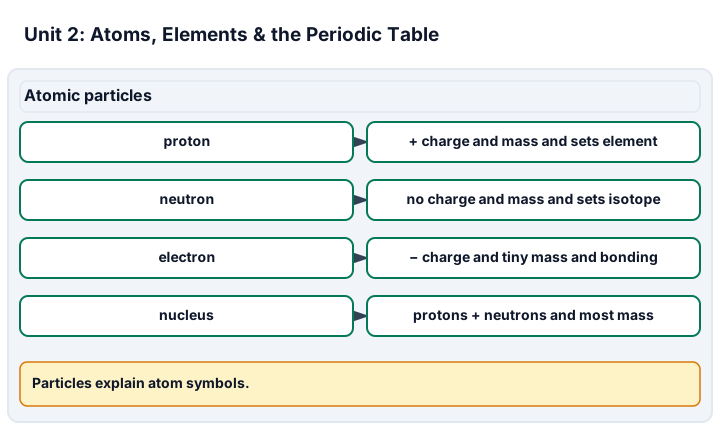
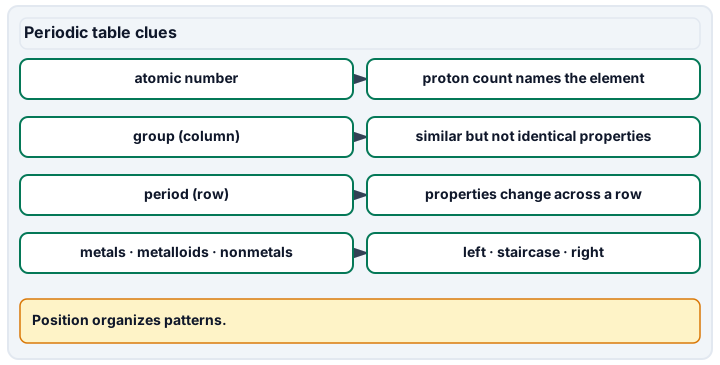
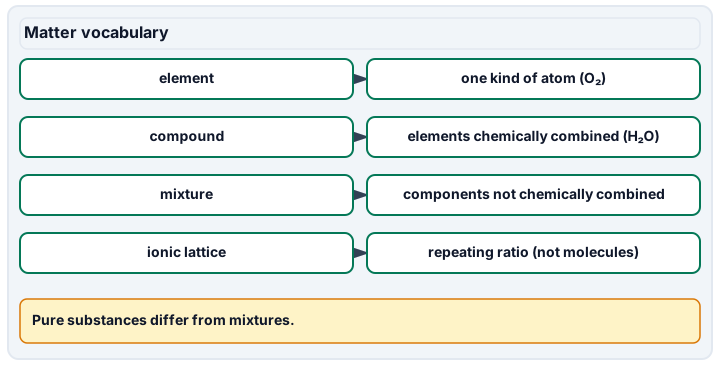
Diagram description
Atomic particles pairs protons, neutrons, electrons and nucleus with charge, mass and role. Periodic table clues shows atomic number naming the element, groups showing similar but not identical properties, periods showing across-row changes, and broad table regions. Matter vocabulary distinguishes element, compound, mixture and ionic lattice.
Data, provenance, and assumptions
| Atom label | Protons | Neutrons | Electrons | Period | Group | Class |
|---|---|---|---|---|---|---|
| C-12 | 6 | 6 | 6 | 2 | 14 | Nonmetal |
| C-14 | 6 | 8 | 6 | 2 | 14 | Nonmetal |
| Na | 11 | 12 | 11 | 3 | 1 | Metal |
| Cl | 17 | 18 | 17 | 3 | 17 | Nonmetal |
| Si | 14 | 14 | 14 | 3 | 14 | Metalloid |
| Ne | 10 | 10 | 10 | 2 | 18 | Nonmetal |
| Model | H2O units | O2 units | Na sites | Cl sites |
|---|---|---|---|---|
| Oxygen | 0 | 4 | 0 | 0 |
| Water | 4 | 0 | 0 | 0 |
| Mixture | 2 | 3 | 0 | 0 |
| Salt lattice | 0 | 0 | 8 | 8 |
| Sample type | Resource/process connection | Important distinction |
|---|---|---|
| Cellulose-paper model | Plant-derived cellulose, processed into a sheet | A natural polymer still undergoes manufacturing |
| Recycled PET model | Existing PET is recovered and reprocessed | Local collection and processing determine the real pathway |
| Virgin PET model | Starting chemicals from refined resources are chemically joined | A synthetic material still depends on natural resource inputs |
| Sample | Mass (g) | Model cost | Dry supported load (N) | Wet supported load (N) |
|---|---|---|---|---|
| A | 10 | 0.06 | 30 | 18 |
| B | 8 | 0.12 | 40 | 38 |
| C | 10 | 0.15 | 45 | 43 |
Paper investigation sequence and evidence record
Scope and safety: All new records are supplied-data or reference-model work, not laboratory procedures. Do not improvise chemical mixtures, heating, impacts, laser or solar viewing, pressure systems, mains electricity or unreviewed wiring. An instructor must approve any real activity, equipment and accessible alternative separately. Paper calculations do not certify unobserved measuring or building skills; public solutions are nonsecure practice.
Materials and preparation
- [atomic-structures] Use the supplied atom-cards, structure-models records, assigned source sections, calculator and an accessible graph or diagram. No physical apparatus is required.
- [materials-resources] Use the supplied material-pathways, material-performance records, assigned source sections, calculator and an accessible graph or diagram. No physical apparatus is required.
Procedure and schedule
- [atomic-structures] Question: What can a model’s particle grouping show that a total atom count or element list cannot? Prerequisites: Count repeated groups, read a table and distinguish an atom, molecule, extended structure and mixture.
- [atomic-structures] Variables: Compare model grouping, composition and the optional neutron/electron changes without relabeling the element arbitrarily. Controls: Retain the provided formula labels and meaning of a lattice site; models are not to-scale microscope images. Replication: Recounting a diagram checks arithmetic, not independent sample identity or a repeated molecular measurement.
- [atomic-structures] Analysis: Count by atom type, classify each supplied grouping, compare periodic patterns and state what arrangement information remains missing. Review: An educator reviews prerequisites, source interpretation, reasoning and accessibility before assessment. A paper response does not certify unobserved practical technique; approved hands-on work requires a separate record.
- [materials-resources] Question: Which material choice meets the actual problem, and what additional evidence would be needed for a broader environmental claim? Prerequisites: Read multiple constraints, compare ratios and percentages, and distinguish sample performance from material identity.
- [materials-resources] Variables: Compare the given sample configurations under one test context; change only B’s cost in the transfer decision. Controls: Keep the matched geometry, wet-test definition, requirement thresholds and fictional cost basis visible before comparing results. Replication: One supplied record per configuration cannot estimate production variability; repeat samples and uncertainty would be needed for real qualification.
- [materials-resources] Analysis: Screen every constraint, calculate only interpretable ratios, document the trade-off and list missing life-cycle or safety evidence. Review: An educator reviews prerequisites, source interpretation, reasoning and accessibility before assessment. A paper response does not certify unobserved practical technique; approved hands-on work requires a separate record.
Record: Retain atomic-structures, the selected level, original inputs and first attempt, source/date, system and axes, units, assumptions, calculation/graph, uncertainty, correction and fresh transfer. Link only to the stated science criteria. Retain materials-resources, the selected level, original inputs and first attempt, source/date, system and axes, units, assumptions, calculation/graph, uncertainty, correction and fresh transfer. Link only to the stated science criteria.
Worked model
[atomic-structures] Four water units contain 8 H and 4 O atoms, 12 altogether. The mixed model contains 4 H and 8 O atoms, also 12, but is not the same substance as the water model. The lattice has equal Na and Cl site counts, ratio 1:1. In the optional atom-card check, C-12 and C-14 have mass numbers 12 and 14 but both have six protons; Na losing one electron has ten electrons and charge +1. [materials-resources] B meets the three nominal constraints: 8 g, cost 0.12 and wet supported load 38 N. Its wet load per mass is 38/8 = 4.75 N/g, and it retains 38/40 x 100 = 95% of its dry supported load. C supports more load but exceeds both mass and cost limits; A is cheaper but misses mass and wet-load requirements.
Numerical calibration
- 12 mass number
- 14 mass number
- 10 electrons in the supplied ion model
- 12 atoms in the model
- 12 atoms in the model
- 1 Na/Cl site ratio
- 18 atoms in six water model units
- 4.75 N/g for this sample comparison
- 95 percent of dry supported load
- 0.01 model cost units above the stated limit
Attempt the assigned level
Try the tasks before reading the calibration. These are practice answers, not a secure examination; use a new dataset or changed assumption for the assessed transfer.
Foundation: typically grades 7-8, guided physical-science concepts
- [atomic-structures] Count the atoms in the water and oxygen models. Explain which is an element, which is a compound, and why a drawn particle grouping is not an image resolved by an ordinary light microscope.
- [materials-resources] Explain how each sample can depend on natural resources even when a finished material is synthetic. Find which samples meet the wet-load requirement without yet ignoring the other constraints.
Check after your attempt
- [atomic-structures] Four water units contain 12 atoms and are a compound; four O2 units contain 8 oxygen atoms and represent an element. The symbols describe a model at a scale an ordinary light microscope cannot resolve as individual atoms.
- [materials-resources] Manufacturing uses material and energy resources for every sample, including synthetic and recycled products. B and C meet the 30 N wet-load requirement, but that alone does not show that they meet the mass/cost limits or have the lowest environmental impact.
Core: survey / bridge core with independent models and basic calculations
- [atomic-structures] Compare the mixed and lattice models with the water model, then use periods, groups and classes from the atom cards to describe a similarity and a difference between carbon and silicon.
- [materials-resources] Apply all three constraints, select a nominally feasible sample, and calculate B’s wet supported load per mass and retained-load percentage.
Check after your attempt
- [atomic-structures] The mixture has two molecular substances; the ionic lattice has a repeated 1:1 site ratio rather than separate NaCl molecules. Carbon and silicon share group 14 but occupy different periods and have different broad material classes. Equal group labels or total atom counts do not establish identical properties.
- [materials-resources] Only B meets all supplied limits. Its screening ratio is 4.75 N/g and wet-load retention is 95%. C’s larger load is not enough to overcome the agreed cost and mass constraints; a selection must use the stated problem rather than one favorite metric.
Honors extension: extra reasoning, not an AP course
- [atomic-structures] Use the optional atom cards to distinguish proton identity, neutron variation and electron loss. Explain why complete atom counts still do not identify a unique arrangement or microscopic structure.
- [materials-resources] Critique a claim that the selected recycled sample must have the lowest environmental impact in every use. Identify missing evidence and distinguish this screening result from product certification.
Check after your attempt
- [atomic-structures] C-12 and C-14 share six protons but have mass numbers 12 and 14. Na losing one electron becomes a ten-electron positive ion without changing its element. Bonding and arrangement still matter; the same counts do not uniquely establish structure or a mixture’s identities.
- [materials-resources] A life-cycle comparison needs production, transport, service life, reuse, local recycling and disposal evidence. Recycled content alone is not a universal environmental ranking. These fictional load/cost records also do not establish actual product safety or a validated application.
History, reading, and writing connection
Use the opening periodic-table history to compare a prediction with later evidence and acknowledge more than one contributor. Then distinguish those historical claims from our particle and material models. Cite the assigned passage; a source-based explanation matters more than a single-hero story or an invented quotation.
Write in your own words or use an approved accessible equivalent. Cite a specific assigned section or figure, identify its evidence, and state one limitation or counterargument. Use the AI practice contract only for permitted coaching, never to invent observations or write the assessed response.
Transfer to a new case
[atomic-structures] Replace the four water units with six while keeping the same H2O grouping. Determine H atoms, O atoms and total atoms, then explain whether that count alone proves that every sample with those totals is water. [materials-resources] A revised quote raises B’s model cost to 0.14 units while its other records and the 0.13 budget limit stay unchanged. How far over budget is it, and may the original selection simply be retained?
Calibration: [atomic-structures] Six given water units contain 12 H and 6 O atoms, 18 total. That count follows the stated grouping. Counts alone, without bonding and identity evidence, do not prove that an arbitrary sample with those elemental totals consists only of water. [materials-resources] B is 0.01 model cost units over the limit. No listed option now meets every stated condition, so the designer must revise a solution, gather alternatives or explicitly renegotiate a constraint rather than silently ignore the budget.
Evidence to retain
[atomic-structures] Science criteria 1-4: particle models, substance classification, periodic-table interpretation and material-class limitations. This does not establish the separate observed mixture-separation technique. [materials-resources] Science criterion 4, material-property reasoning: connect resource/process history with a bounded property comparison and a defensible selection. This does not establish manufacturing skill or a measured life-cycle result.
Record units, calculations, source/date, uncertainty, and what is measured versus inferred. A simulation or supplied dataset must stay labeled as such. All new records are supplied-data or reference-model work, not laboratory procedures. Do not improvise chemical mixtures, heating, impacts, laser or solar viewing, pressure systems, mains electricity or unreviewed wiring. An instructor must approve any real activity, equipment and accessible alternative separately. Paper calculations do not certify unobserved measuring or building skills; public solutions are nonsecure practice.
Return to all eight learning pathways. Print this unit page for the student lessons; the linked five-page packet remains the separate assessment companion.
What work supports these criteria?
Integration is reported separately and cannot lower the science grade or block a science demonstration pass. Science and practical criteria determine that pass. Use the learner's own reasoning and an instructor-selected fresh variation. A supplied-data calculation covers only the stated analytical part of a criterion, not an unobserved measurement or build.
- Atoms, molecules and extended structures: science criteria 1, 2, 3, 4.
- From resources to material choices: science criteria 4.
Unit mastery rubric
| Criterion | Developing | Proficient | Mastery |
|---|---|---|---|
| Atoms as building blocks | Thinks atoms are alive or can be seen with a hand lens. | Knows atoms are tiny but cannot say what they build. | Uses an atomic model to explain elements and simple compounds; distinguishes that model from what an ordinary light microscope can resolve. |
| Elements, compounds & mixtures | Treats every sample as the same kind of thing. | Defines an element but mixes up compounds and mixtures. | Distinguishes elements, compounds, and mixtures, gives examples, and separates fixed-composition pure substances from mixtures. |
| Reading the periodic table | Sees the table as a random grid of boxes. | Finds an element by its symbol but cannot use rows or columns. | Reads the table by periods (rows) and groups (columns) and explains what elements in the same group share. |
| Material properties & element classes | Cannot say where metals sit on the table. | Points to the metals but cannot name a property that sets them apart. | Locates metals, nonmetals and metalloids; connects particle structure and processing with properties and bounded resource/design choices. |
| Lab technique (separating a mixture) | Mixes samples together and cannot recover them. | Separates part of a mixture but loses material along the way. | Separates a mixture by an appropriate physical property and explains how the recovered components retain their chemical identities. |
| Integration (cross-domain) | Makes no supported connection between the source and the science. | Uses the source but needs help connecting evidence, writing, or limitations to the science. | Independently connects History, Reading, and Writing using a cited source, appropriate evidence, a limitation, and a scientific explanation. |
Integration is reported separately and cannot lower the science grade or block a science demonstration pass. Science and practical criteria determine that pass. Use the integration guide's evidence checklist for the separately reported criterion.
“The water and mixture models both contain twelve atoms but have different groupings and identities. The salt lattice has a one-to-one site ratio, not separate NaCl molecules. These are particle models; an ordinary light microscope does not resolve individual atoms.”
“Salt water is a compound because it has two things in it. I don’t think you can get the salt back out of it.”
You demonstrate this unit hands-on — separating a real mixture and sorting samples into element, compound, and mixture — plus short oral checks where you explain your reasoning aloud, not a multiple-choice test. A criterion counts as mastered only when you can both do the separation and explain what the periodic table or the property tells you. Mastery is demonstrated, not awarded.
A 5-page clipboard packet — unit overview, key terms, the mastery rubric, anchor examples, and a score sheet you can print and grade against.