Unit 03 · Chemical & Physical Changes
Some changes rearrange matter without making anything new — melting ice, tearing paper, dissolving sugar. Those are physical changes. A chemical change makes a brand-new substance, and it leaves clues: a color shift, bubbles of gas, a jump in temperature, or a new solid. Through every one of these changes the total mass stays the same — nothing is truly created or destroyed. Mastery means you can tell the two kinds of change apart and back your call with evidence you can point to.
Student learning: Chemical & Physical Changes
Choose the level by readiness, not age alone, and record it before instruction. Foundation, core, and honors tasks are study pathways, not an AP course or a promise of college credit. The instructor retains practical assessment and the published science rubric; integration is reported separately.
Prerequisites: [reaction-ledgers] Count grouped particles, add masses, subtract readings and distinguish observation from supplied identity evidence. [chemical-energy-design] Use signed temperature changes, multiplication with units, a budget threshold and conservative bounds.
Suggested sequence: read and discuss the explanation; attempt the worked model; analyze the data at your selected level; check the answers; then complete the source-linked response and a fresh transfer question. These activities supplement, not replace, supervised practical work and the full-year schedule.
Assigned reading and focus
- OpenStax Chemistry 2e 1.2: Phases and Classification of Matter. [reaction-ledgers] Read physical versus chemical properties and changes. Melting, boiling and many separations do not automatically create new substances.
- OpenStax Chemistry 2e 4.2: Classifying Chemical Reactions. [reaction-ledgers] Read classification and evidence for a chemical reaction. Use the supplied identity/model information; do not identify a new substance from bubbles or color alone.
- OpenStax Chemistry 2e 5.2: Calorimetry. [chemical-energy-design] Read the energy-transfer sign convention and q = m c change in temperature. Use the given bath model only; do not assign any chemical mixing or device-disassembly procedure.
- TeachEngineering: Engineering Design Process. [chemical-energy-design] Read the design questions about users, requirements and limitations. Use the supplied models to compare, test and revise a proposal, not as proof that a real device has been constructed.
- Science History Institute: Antoine-Laurent Lavoisier. Read the opening account of Antoine and Marie-Anne Lavoisier’s collaboration and the emphasis on careful measurement. Compare source-supported history with our separately labeled particle/mass records.
Learn the science
Physical Science remains a grades 7-9 survey and early-high-school bridge, not a full AP Chemistry or Physics course. Choose guided Foundation, independent survey/bridge work, or optional higher-challenge reasoning by readiness. Use only the assigned textbook sections and focus; extra equations or probability work are not automatically NGSS middle-school assessment requirements. Paper evidence and approved observed practical work remain separate.
[reaction-ledgers] Particles rearrange; the system boundary matters. A physical change can alter state or arrangement without changing substance identity. In a chemical model, atoms regroup into new substances while each atom type is conserved. Bubbles alone are not proof of a chemical change: boiling water also makes bubbles. The supplied token rule says two H2 groups plus one O2 group become two H2O groups. This is a given particle rule, not a hydrogen-reaction procedure or a requirement to balance a new equation.
[reaction-ledgers] Assumptions: Count the supplied small-group models without using atomic masses. Model groups react only by the stated two-H2/one-O2 rule; any leftover groups remain. The separate mass records use an explicitly defined measured system and independent before/after bounds of plus/minus 0.02 g. The open-system gas amount is supplied, not inferred from a guessed chemical identity.
[reaction-ledgers] Uncertainty: A small before/after difference can be compatible with measurement bounds without proving perfect measurement. Gas loss changes the mass remaining on a balance, not conservation for a larger system that includes escaped material. Actual product identity would need appropriate evidence beyond a visual sign; no real chemical investigation is performed here.
[chemical-energy-design] A cooling-device decision with evidence and limits. A chemical change can release energy to its surroundings or take energy from them. Temperature change by itself does not prove a chemical reaction; in these fictional records the new-substance evidence is separately supplied as a model assumption. A bath energy estimate is q = m c (final temperature - initial temperature). A cooling design must meet a stated energy goal and cost limit, not merely show the largest temperature drop. Design claims need uncertainty and a review of safety as well as a nominal result.
[chemical-energy-design] Assumptions: Each fictional device has a reference-confirmed chemical transformation but no named ingredients or recipe. The water bath has constant specific heat, no phase change, negligible container/device heat capacity and negligible external loss. The device energy transfer is the opposite of the bath change under this model. Each temperature reading has the supplied absolute bound; combine two reading bounds conservatively before judging the minimum energy requirement.
[chemical-energy-design] Uncertainty: These are synthetic trial results, not real product tests or safety approval. Container heat capacity, heat loss, incomplete reaction and sensor bias would matter in an actual device. The proposed revision changes a whole configuration; better performance would not isolate one chemical mechanism. Paper analysis does not fulfill the standard’s actual construction/testing requirement.

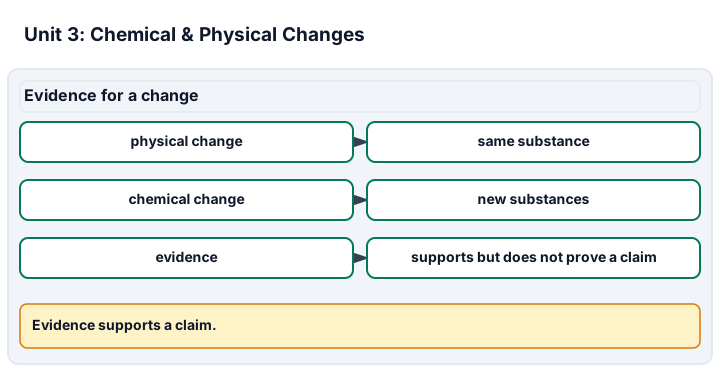
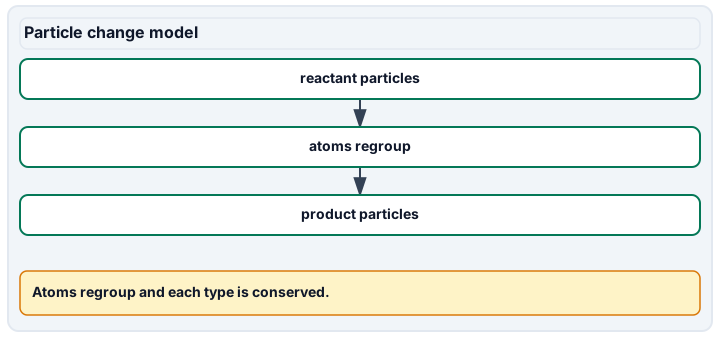
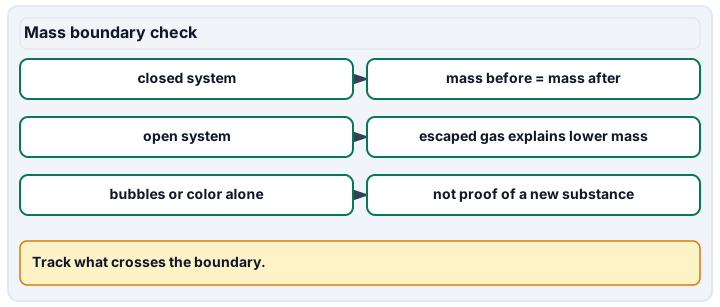
Diagram description
Evidence for a change distinguishes physical change, chemical change, and evidence as support rather than proof. Particle change model shows reactant particles becoming product particles when atoms regroup, while conserving each atom type. Mass boundary check compares closed and open systems and warns that bubbles or color alone do not prove a new substance.
Data, provenance, and assumptions
| Quantity | Value | Unit / meaning |
|---|---|---|
| H2 | 6 | initial groups, two H atoms each |
| O2 | 4 | initial groups, two O atoms each |
| System | Before (g) | Remaining after (g) | Escaped gas (g) |
|---|---|---|---|
| Closed | 100 | 100.01 | 0 |
| Open container | 100 | 98.4 | 1.6 |
| Case | Supplied identity information | Observation limit |
|---|---|---|
| Boiling model | H2O before and after, different states | Bubbles can occur without a new substance |
| Torn-paper model | Same paper substances in smaller pieces | Changed shape does not establish new identity |
| Particle reaction | Given H2/O2 groupings form H2O groupings | This is a symbolic identity model, not a performed assay |
| Quantity | Value | Unit / meaning |
|---|---|---|
| mass | 100 | g water |
| c | 4.18 | J/(g degree C) |
| start | 20 | degrees C |
| temperatureBound | 0.1 | degrees C per reading |
| required | 1000 | J minimum absorbed from bath |
| budget | 3 | maximum model cost |
| Design | Model cost | Final bath temperature (C) |
|---|---|---|
| A | 1 | 23 |
| B | 2 | 17.5 |
| C | 4 | 16 |
| D | 2.5 | 17.2 |
Paper investigation sequence and evidence record
Scope and safety: All new records are supplied-data or reference-model work, not laboratory procedures. Do not improvise chemical mixtures, heating, impacts, laser or solar viewing, pressure systems, mains electricity or unreviewed wiring. An instructor must approve any real activity, equipment and accessible alternative separately. Paper calculations do not certify unobserved measuring or building skills; public solutions are nonsecure practice.
Materials and preparation
- [reaction-ledgers] Use the supplied reaction-particles, mass-boundaries, change-evidence records, assigned source sections, calculator and an accessible graph or diagram. No physical apparatus is required.
- [chemical-energy-design] Use the supplied device-conditions, device-thermal-records records, assigned source sections, calculator and an accessible graph or diagram. No physical apparatus is required.
Procedure and schedule
- [reaction-ledgers] Question: How can a container lose mass while a complete particle and material account remains consistent? Prerequisites: Count grouped particles, add masses, subtract readings and distinguish observation from supplied identity evidence.
- [reaction-ledgers] Variables: Compare a closed versus open measurement boundary and change starting particle counts in the transfer. Controls: Keep the regrouping rule, atom identities, measurement units and stated bounds explicit; never invent escaped material without evidence. Replication: These are reference ledgers, not repeated student trials; real measurements need repeated controls and product/escape evidence.
- [reaction-ledgers] Analysis: Draw before/after groupings, count each atom type, compare mass with its bound and test whether the stated observations uniquely identify a change. Review: An educator reviews prerequisites, source interpretation, reasoning and accessibility before assessment. A paper response does not certify unobserved practical technique; approved hands-on work requires a separate record.
- [chemical-energy-design] Question: Which fictional cooling design meets an agreed requirement even after the stated measurement bounds are considered? Prerequisites: Use signed temperature changes, multiplication with units, a budget threshold and conservative bounds.
- [chemical-energy-design] Variables: Compare the complete device configurations under one bath model; examine a separate changed-mass record in the transfer. Controls: Keep bath type, starting temperature, heat-capacity assumptions, reading bounds and acceptance criteria fixed for the main comparison. Replication: The single fictional record per design is not validation of reliability; repeated independent trials would be required for a real decision.
- [chemical-energy-design] Analysis: Compute bath and device energy signs, screen costs, apply bounds, compare the revision and list the missing actual construction/safety evidence. Review: An educator reviews prerequisites, source interpretation, reasoning and accessibility before assessment. A paper response does not certify unobserved practical technique; approved hands-on work requires a separate record.
Record: Retain reaction-ledgers, the selected level, original inputs and first attempt, source/date, system and axes, units, assumptions, calculation/graph, uncertainty, correction and fresh transfer. Link only to the stated science criteria. Retain chemical-energy-design, the selected level, original inputs and first attempt, source/date, system and axes, units, assumptions, calculation/graph, uncertainty, correction and fresh transfer. Link only to the stated science criteria.
Worked model
[reaction-ledgers] Initial counts are 12 H and 8 O atoms. Six H2 groups can use three O2 groups to form six H2O groups, leaving one O2 group. The products still contain 12 H and 8 O atoms. The closed mass change is +0.01 g, within the 0.04 g combined worst-case difference bound. For the open record, 98.4 + 1.6 = 100 g when the escaped gas is counted. [chemical-energy-design] A warms the bath by 3 C, adding 1254 J to it, so it does not meet the cooling goal. B absorbs nominally 1045 J, but its conservative lower bound is 961.4 J after allowing a 0.2 C difference bound. C cools more but exceeds the budget. D absorbs 1170.4 J with lower bound 1086.8 J and cost 2.5, so it meets the stated modeled bounds; it is not a certified device.
Numerical calibration
- 12 H atoms
- 8 O atoms
- 6 H2O model groups
- 1 O2 model group
- 0.01 g
- 100 g including escaped gas
- 2 H2O groups in the changed model
- 1254 J gained by bath
- 1045 J nominally absorbed from bath
- 1170.4 J nominally absorbed from bath
- 1086.8 J conservative lower bound
- 522.5 J inferred in a different bath record
Attempt the assigned level
Try the tasks before reading the calibration. These are practice answers, not a secure examination; use a new dataset or changed assumption for the assessed transfer.
Foundation: typically grades 7-8, guided physical-science concepts
- [reaction-ledgers] Use the supplied token rule to regroup the particles and count both atom types before and after. Classify the boiling and torn-paper examples using their given identities.
- [chemical-energy-design] Identify which designs warm or cool the bath and explain why a temperature change alone cannot prove new substances. Name the energy and cost conditions before choosing a design.
Check after your attempt
- [reaction-ledgers] The reaction model makes six water groups with one oxygen group left. H and O counts remain 12 and 8. Boiling and tearing preserve the given substance identities; a changed appearance or bubbles alone does not decide whether a chemical change occurred.
- [chemical-energy-design] A warms the bath; B, C and D cool it in the supplied records. A state change could also affect temperature, so chemical identity needs separate evidence. The goal is at least 1000 J absorbed within cost 3, not simply the coldest final bath.
Core: survey / bridge core with independent models and basic calculations
- [reaction-ledgers] Explain the closed mass difference using the given reading bounds and close the open-system matter ledger. State why the smaller mass remaining in the open container is not atom destruction.
- [chemical-energy-design] Calculate A’s bath energy and B/D’s absorbed energies. Compare nominal performance and cost, then explain why C is not automatically the best choice.
Check after your attempt
- [reaction-ledgers] The +0.01 g difference is inside a plus/minus 0.04 g worst-case difference bound from the two readings. The open account is 98.4 g remaining plus 1.6 g escaped, totaling 100 g. The boundary changed what the balance includes, not the existence of the atoms.
- [chemical-energy-design] A adds 1254 J to the bath; B and D absorb 1045 and 1170.4 J. C’s larger nominal cooling exceeds the cost constraint. D is within cost, but the uncertainty check is still needed before calling the model robust against the stated bounds.
Honors extension: extra reasoning, not an AP course
- [reaction-ledgers] Critique a report that treats bubbles plus a lower container mass as proof of a particular chemical product. Specify additional evidence and distinguish compatibility with conservation from perfect empirical proof.
- [chemical-energy-design] Apply the two-reading uncertainty bound to B and D. Select the model that still meets the energy goal and explain which evidence would remain missing before actual use.
Check after your attempt
- [reaction-ledgers] Bubbles can be vapor or a reaction product, and loss from a container does not identify the lost substance. A justified product/property record and a complete system boundary are needed. Agreement within uncertainty supports the ledger; it is not proof of zero measurement error or a unique mechanism.
- [chemical-energy-design] The energy bound is 100(4.18)(0.2) = 83.6 J. B’s lower limit is 961.4 J, below the goal, so B is not robustly verified. D’s lower limit is 1086.8 J. Real safety, component behavior, independent repeated tests and practical approval remain missing despite D passing this paper check.
History, reading, and writing connection
Use the Science History account to explain why careful measurement and collaboration mattered to changing chemical explanations. Compare that account with the supplied closed/open system ledgers, retaining uncertainty and source limits. Write your own evidence-based response rather than treating a temperature change or textbook statement as proof of a unique reaction.
Write in your own words or use an approved accessible equivalent. Cite a specific assigned section or figure, identify its evidence, and state one limitation or counterargument. Use the AI practice contract only for permitted coaching, never to invent observations or write the assessed response.
Transfer to a new case
[reaction-ledgers] Change the starting token counts to four H2 groups and one O2 group, retaining the same supplied regrouping rule. How many H2O groups form, what remains, and are both atom types conserved? [chemical-energy-design] A separate fictional trial reports a 2.5 C decrease in only 50 g of water, with the same given specific heat and negligible other heat capacities. What energy is inferred, and does the same temperature drop establish the original cooling capacity?
Calibration: [reaction-ledgers] The one O2 group supports two H2O groups, using two of the four H2 groups. Two H2 groups remain. The initial eight H and two O atoms are still present: four H in water plus four in leftover H2, with both O atoms in water. [chemical-energy-design] The inferred absorbed energy is 50(4.18)(2.5) = 522.5 J, below 1000 J. Equal temperature drops in different amounts of material do not imply equal energy transfers. This is a new supplied trial, not a prediction that the original device must produce the same drop in a smaller bath.
Evidence to retain
[reaction-ledgers] Science criteria 1-4: identity-based classification, a particle model, a bounded mass ledger and a qualified explanation. The supplied data do not certify an observed change investigation. [chemical-energy-design] Science criteria 1, 2 and 4: distinguish identity evidence from a thermal sign, calculate a bounded energy transfer and justify a design decision. No observed chemistry or device-construction skill is awarded from these records.
Record units, calculations, source/date, uncertainty, and what is measured versus inferred. A simulation or supplied dataset must stay labeled as such. All new records are supplied-data or reference-model work, not laboratory procedures. Do not improvise chemical mixtures, heating, impacts, laser or solar viewing, pressure systems, mains electricity or unreviewed wiring. An instructor must approve any real activity, equipment and accessible alternative separately. Paper calculations do not certify unobserved measuring or building skills; public solutions are nonsecure practice.
Return to all eight learning pathways. Print this unit page for the student lessons; the linked five-page packet remains the separate assessment companion.
What work supports these criteria?
Integration is reported separately and cannot lower the science grade or block a science demonstration pass. Science and practical criteria determine that pass. Use the learner's own reasoning and an instructor-selected fresh variation. A supplied-data calculation covers only the stated analytical part of a criterion, not an unobserved measurement or build.
- Particles rearrange; the system boundary matters: science criteria 1, 2, 3, 4.
- A cooling-device decision with evidence and limits: science criteria 1, 2, 4.
Unit mastery rubric
| Criterion | Developing | Proficient | Mastery |
|---|---|---|---|
| Physical vs. chemical change | Calls every change the same kind — all physical or all chemical. | Defines each kind but cannot sort real examples. | Classifies changes by whether substance identity changes, explaining physical examples such as melting, tearing, and dissolving sugar. |
| Signs of a chemical change | Cannot name a clue that a new substance formed. | Names a sign but does not yet check it with property evidence. | Uses observations and property checks as evidence of a new substance; a color change or bubbles alone are not proof. |
| Conservation of mass | Thinks matter disappears when something burns or dissolves. | States that mass is conserved but cannot show it. | Predicts and checks mass conservation within measurement uncertainty, accounting for gas that enters or leaves the measured system. |
| Evidence & explanation | Guesses without pointing to what was observed. | Describes what happened but cannot tie it to a new substance. | Uses identity evidence, particle and energy records to explain a change or design decision, with system boundaries and uncertainty. |
| Lab technique (change investigation) | Mixes samples with no plan and no measurement. | Runs the change but records observations loosely. | Runs a controlled change, measures mass before and after, and records every clue carefully. |
| Integration (cross-domain) | Makes no supported connection between the source and the science. | Uses the source but needs help connecting evidence, writing, or limitations to the science. | Independently connects History, Reading, and Writing using a cited source, appropriate evidence, a limitation, and a scientific explanation. |
Integration is reported separately and cannot lower the science grade or block a science demonstration pass. Science and practical criteria determine that pass. Use the integration guide's evidence checklist for the separately reported criterion.
“The given reaction model retains twelve H and eight O atoms after regrouping. Bubbles can also be vapor, so fizzing alone does not identify a new substance. In the open mass record, 98.4 g remaining plus 1.6 g escaped closes the 100 g account; the values are supplied practice, not my performed experiment.”
“It bubbled, so something happened. It felt lighter after, so maybe some mass disappeared? I think it’s a chemical change but I’m not sure why.”
You demonstrate this unit through a hands-on change investigation — running a physical change and a chemical change, weighing before and after, and reading the evidence aloud — not a multiple-choice test. A criterion counts as mastered only when you can both produce the change and explain what the clues tell you. Mastery is demonstrated, not awarded.
A 5-page clipboard packet — unit overview, key terms, the mastery rubric, anchor examples, and a score sheet you can print and grade against.