Unit 04 · Forces & Motion
This unit gets things moving and asks why. You measure speed as distance over time, read motion off a distance–time graph, and learn what a force really does — a push or a pull that can start, stop, speed up, or turn an object. When the forces on something are balanced, its motion doesn’t change; when they’re unbalanced, it does. Newton’s three laws tie it all together. Mastery means you can measure motion at the bench and explain it with the forces behind it.
Student learning: Forces & Motion
Choose the level by readiness, not age alone, and record it before instruction. Foundation, core, and honors tasks are study pathways, not an AP course or a promise of college credit. The instructor retains practical assessment and the published science rubric; integration is reported separately.
Prerequisites: [motion-interactions] Use signed differences, distances, ratios, a one-dimensional force sum and a defined system boundary. [noncontact-models] Distinguish force from motion, identify a pair of interacting objects and read ratios with a stated reference.
Suggested sequence: read and discuss the explanation; attempt the worked model; analyze the data at your selected level; check the answers; then complete the source-linked response and a fresh transfer question. These activities supplement, not replace, supervised practical work and the full-year schedule.
Assigned reading and focus
- OpenStax College Physics 2e 2.1: Displacement. [motion-interactions] Read position and displacement versus total distance. Positive and negative positions belong to a chosen reference, not to a negative traveled distance.
- OpenStax College Physics 2e 4.3: Newton’s Second Law and Systems. [motion-interactions] Read the system and net-force explanations. Use the provided one-dimensional forces rather than assuming that motion requires a continuing unbalanced force.
- OpenStax College Physics 2e 4.4: Newton’s Third Law. [motion-interactions] Read which objects receive an interaction pair. Equal and opposite forces act on different bodies; they do not cancel on one body’s diagram.
- OpenStax College Physics 2e 18.3: Coulomb’s Law. [noncontact-models] Read how charge signs and distance affect an ideal electric interaction. The optional ratio calculation is a supplied model, not a required middle-school force-law derivation.
- OpenStax College Physics 2e 6.5: Universal Gravitation. [noncontact-models] Read the attraction between masses and the distinction between force and acceleration. Keep the simple model separate from magnetic geometry.
- OpenStax College Physics 2e 22.3: Magnetic Fields and Field Lines. [noncontact-models] Read field representations and compass/dipole direction. A field drawing is a model of an interaction, not a material thread joining objects.
- MacTutor, University of St Andrews: Galileo Galilei. Read the account of Galileo’s investigations of motion. Distinguish retrospective history from our synthetic track and force records; keep the model’s initial conditions explicit.
Learn the science
Physical Science remains a grades 7-9 survey and early-high-school bridge, not a full AP Chemistry or Physics course. Choose guided Foundation, independent survey/bridge work, or optional higher-challenge reasoning by readiness. Use only the assigned textbook sections and focus; extra equations or probability work are not automatically NGSS middle-school assessment requirements. Paper evidence and approved observed practical work remain separate.
[motion-interactions] Describe the motion before explaining its forces. A position record can increase or decrease, while total distance traveled accumulates. Average speed uses distance/time; average velocity uses signed displacement/time. A net force changes motion, while balanced forces allow rest or constant velocity. An interaction pair acts on two different objects. In a collision model with a fixed momentum change, a longer contact time reduces average force, but the peak still depends on the force-time pattern.
[motion-interactions] Assumptions: The track, force-balance example and two collision-duration records are separate synthetic situations, not one experiment. The track positions are joined by straight motion segments in the stated right-positive frame. The force example is a 2 kg model body with only the specified horizontal push and opposition. Collision comparisons use the given mass and velocity change; average force is m times velocity change divided by duration.
[motion-interactions] Uncertainty: Sparse positions do not reveal detailed motion between samples unless interpolation is specified. Collision duration and endpoint velocities do not determine every instantaneous force. Real measurement requires calibration, repeats and a defined reference frame. No rolling, impacts, launches or force measurements are assigned by these paper records.
[noncontact-models] Forces can act across a gap. Electric, magnetic and gravitational interactions can occur without direct contact. Charge sign and magnet orientation can change attraction to repulsion, whereas ordinary gravitational interactions between masses are attractive. A field model helps describe how an interaction depends on location. A probe held still can have a nonzero interaction force balanced by a holder; rest does not show that the field is absent. Optional ratios below belong to the explicitly supplied ideal models, not a law for every magnet.
[noncontact-models] Assumptions: Electric distances and forces are normalized to a reference r0 and F0 for fixed ideal point charges. Gravity uses the supplied relative model F/F0 = m1 m2/r^2 with all entries in reference-unit multiples. The separate magnetic comparison keeps a permanent probe’s orientation and geometry fixed while changing current; its straight trend is a fictional local model, not a general electromagnet formula. No electrical or magnetic apparatus is assigned.
[noncontact-models] Uncertainty: Extended objects, alignment, induced magnetization, charge leakage and external fields can change actual patterns. Three synthetic points cannot prove a universal distance law. A real field investigation needs a measurement method, controls and repeated observations, and an approved practical remains separate from a model explanation.

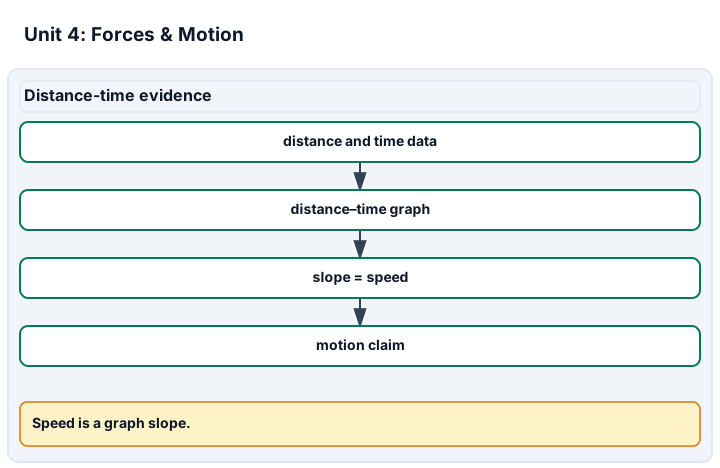
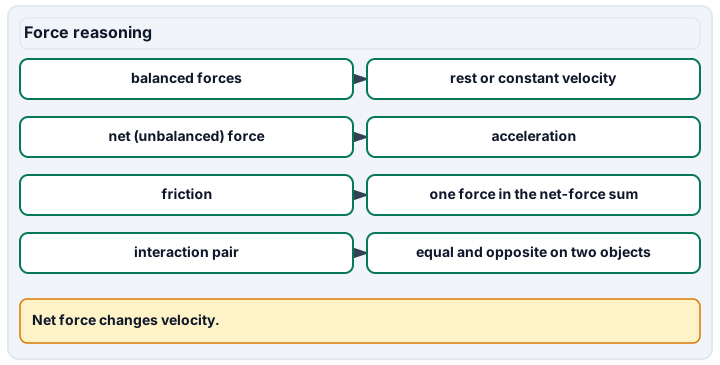
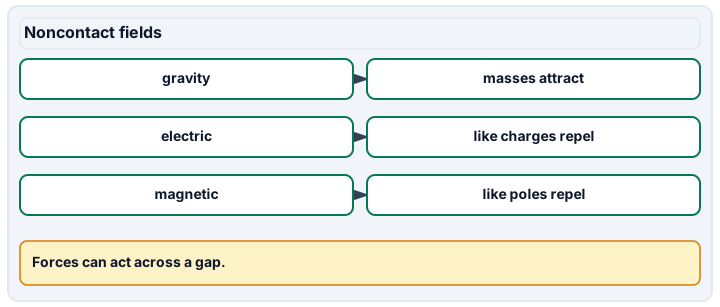
Diagram description
Distance-time evidence turns distance and time data into a graph, the graph into a slope, and the slope into a motion claim. Force reasoning states that balanced forces allow rest or constant velocity, net force causes acceleration, friction is one force in the sum, and interaction pairs act on two objects. Noncontact fields shows gravity, electric and magnetic examples.
Data, provenance, and assumptions
| Time (s) | Position (m) |
|---|---|
| 0 | 0 |
| 1 | 1 |
| 2 | 3 |
| 3 | 2 |
| 4 | 0 |
| Quantity | Value | Unit / meaning |
|---|---|---|
| mass | 2 | kg |
| push | 8 | N rightward |
| friction | 2 | N leftward |
| Model | Mass (kg) | Initial velocity (m/s) | Final velocity (m/s) | Contact time (s) |
|---|---|---|---|---|
| A | 1 | 2 | 0 | 0.1 |
| B | 1 | 2 | 0 | 0.4 |
| r / r0 | Force / F0 |
|---|---|
| 1 | 1 |
| 2 | 0.25 |
| 4 | 0.0625 |
| Configuration | m1 / m0 | m2 / m0 | r / r0 |
|---|---|---|---|
| Reference | 1 | 1 | 1 |
| Double one mass | 2 | 1 | 1 |
| Double separation | 1 | 1 | 2 |
| Current (A) | Interaction force (N) |
|---|---|
| 0 | 0 |
| 0.1 | 0.04 |
| 0.2 | 0.08 |
| 0.3 | 0.12 |
| Interaction | Given direction relation |
|---|---|
| Like electric charges | Repel |
| Unlike electric charges | Attract |
| Two ordinary masses | Attract |
| Aligned magnet north facing north | Repel |
| Aligned magnet north facing south | Attract |
Paper investigation sequence and evidence record
Scope and safety: All new records are supplied-data or reference-model work, not laboratory procedures. Do not improvise chemical mixtures, heating, impacts, laser or solar viewing, pressure systems, mains electricity or unreviewed wiring. An instructor must approve any real activity, equipment and accessible alternative separately. Paper calculations do not certify unobserved measuring or building skills; public solutions are nonsecure practice.
Materials and preparation
- [motion-interactions] Use the supplied motion-track, force-balance, collision-duration records, assigned source sections, calculator and an accessible graph or diagram. No physical apparatus is required.
- [noncontact-models] Use the supplied electric-force-model, gravity-model, magnet-current-model, field-direction-cards records, assigned source sections, calculator and an accessible graph or diagram. No physical apparatus is required.
Procedure and schedule
- [motion-interactions] Question: Which motion and force claims are supported by positions, endpoints and a stated time interval, and which need more measurements? Prerequisites: Use signed differences, distances, ratios, a one-dimensional force sum and a defined system boundary.
- [motion-interactions] Variables: Compare frame-dependent position changes, an independent force model and fixed-endpoint stopping durations without combining unlike records. Controls: Retain the supplied interpolation, axis, masses and velocity endpoints in the appropriate situation. Replication: Calculating slopes twice does not create repeated physical trials; a real investigation must specify actual independent measurements.
- [motion-interactions] Analysis: Separate distance from displacement, draw the relevant force diagrams, compute allowed averages and state why an unmeasured peak remains unknown. Review: An educator reviews prerequisites, source interpretation, reasoning and accessibility before assessment. A paper response does not certify unobserved practical technique; approved hands-on work requires a separate record.
- [noncontact-models] Question: What controlled evidence could distinguish a noncontact interaction from a claim based only on appearance or proximity? Prerequisites: Distinguish force from motion, identify a pair of interacting objects and read ratios with a stated reference.
- [noncontact-models] Variables: Vary only the declared distance, mass or current in its own model, retaining sign/orientation where relevant. Controls: Name the held geometry, background, probe orientation and reference units before comparing patterns. Replication: The records are model inputs rather than repeated observations; actual claims need independent repeat readings and checks for other influences.
- [noncontact-models] Analysis: Draw the interacting pair and balancing forces, describe the pattern first, apply only its supplied ratio rule and propose a discriminating follow-up. Review: An educator reviews prerequisites, source interpretation, reasoning and accessibility before assessment. A paper response does not certify unobserved practical technique; approved hands-on work requires a separate record.
Record: Retain motion-interactions, the selected level, original inputs and first attempt, source/date, system and axes, units, assumptions, calculation/graph, uncertainty, correction and fresh transfer. Link only to the stated science criteria. Retain noncontact-models, the selected level, original inputs and first attempt, source/date, system and axes, units, assumptions, calculation/graph, uncertainty, correction and fresh transfer. Link only to the stated science criteria.
Worked model
[motion-interactions] Successive position changes are +1, +2, -1 and -2 m. Displacement is zero, distance is 6 m and average speed is 6/4 = 1.5 m/s. The separate force example has net force 8 - 2 = 6 N and acceleration 3 m/s^2. Collision averages are -20 N for A and -5 N for B; both give the same -2 N s momentum change. [noncontact-models] In the stated electric model, doubling separation gives one quarter of the force. The normalized gravity entries give relative forces 1, 2 and 0.25. The magnetic comparison slope is (0.12 - 0)/(0.3 - 0) = 0.4 N/A under its fixed conditions. These results describe different supplied models; none licenses applying the electric inverse-square rule to every magnetic object.
Numerical calibration
- 6 m
- 0 m
- 1.5 m/s
- 6 N rightward
- 3 m/s^2 rightward
- -20 N
- -5 N
- -10 N average stopping force
- 0.25 relative force
- 2 relative force ratio
- 0.25 relative force ratio
- 0.4 N/A in the local synthetic model
- 0.111111111111 electric force/F0 at 3 r0
Attempt the assigned level
Try the tasks before reading the calibration. These are practice answers, not a secure examination; use a new dataset or changed assumption for the assessed transfer.
Foundation: typically grades 7-8, guided physical-science concepts
- [motion-interactions] Sketch the position record, identify forward and return segments, and explain why the trip can end where it began without having traveled zero distance.
- [noncontact-models] Use the direction cards to distinguish attraction and repulsion. Explain why a stationary, held probe can still provide evidence of a noncontact interaction.
Check after your attempt
- [motion-interactions] The first two segments move right and the last two left. Their signed changes cancel, giving zero displacement, but the lengths add to 6 m. A position-time slope carries direction; a total-distance-time slope describes speed rather than signed velocity.
- [noncontact-models] Like charges or like aligned magnetic poles repel; unlike charges/poles attract in the given cases. Ordinary masses attract gravitationally. A holder can balance a nonzero interaction force, leaving the probe at rest without eliminating the interaction.
Core: survey / bridge core with independent models and basic calculations
- [motion-interactions] Calculate average speed and the separate model’s net force/acceleration. Draw an interaction pair on two different objects and explain why balanced forces do not always mean an object is at rest.
- [noncontact-models] Describe the mass/distance/current patterns and propose a controlled question for investigating one of them. Identify a condition that must not change at the same time.
Check after your attempt
- [motion-interactions] Average speed is 1.5 m/s. Net force in the separate example is 6 N, giving 3 m/s^2. The interaction forces belong on different object diagrams; only a selected combined system can cancel internal forces. Zero net force allows constant velocity as well as rest.
- [noncontact-models] The supplied gravity model increases force with mass and decreases it with separation. The magnetic reading rises with current only in the fixed setup. A controlled question could vary current while retaining probe orientation and distance; changing those together would make the comparison ambiguous.
Honors extension: extra reasoning, not an AP course
- [motion-interactions] Use the stopping records to compare average forces and evaluate a design claim that quadrupling duration must reduce every peak force by exactly four.
- [noncontact-models] Calculate the supplied electric/gravity ratios and magnetic slope, then critique an attempt to use those arithmetic results as a universal force rule or proof of an observed field experiment.
Check after your attempt
- [motion-interactions] Averages are -20 and -5 N for the same -2 N s change. The magnitude of the average is one quarter, but peak force is not determined by duration and endpoint velocities alone. A force-time record and a stated design criterion are needed before judging peak loads or safety.
- [noncontact-models] The requested ratios are 0.25, 2 and 0.25, and the local magnetic slope is 0.4 N/A. The electric ratio is not a universal rule for every magnet. These given reference/synthetic records support a model exercise, not a performed investigation or identification of every possible mechanism.
History, reading, and writing connection
Use the Galileo biography to discuss a historical motion question and the evidence the source actually describes. Compare it with a stated model using our track or force records. Explain why an assumed interpolation or a single trial is not a universal proof, and do not invent timing records or historical motives.
Write in your own words or use an approved accessible equivalent. Cite a specific assigned section or figure, identify its evidence, and state one limitation or counterargument. Use the AI practice contract only for permitted coaching, never to invent observations or write the assessed response.
Transfer to a new case
[motion-interactions] A separate stopping model now has mass 2 kg, initial velocity +2 m/s, final velocity zero and contact time 0.4 s. Calculate signed average force and explain why keeping the old -5 N answer would be wrong. [noncontact-models] For the same ideal electric pair, use a new separation of 3 r0 while holding the charges fixed. Predict force relative to F0, and state whether the same numerical rule can automatically be used for the magnetic probe.
Calibration: [motion-interactions] Average force is 2(0 - 2)/0.4 = -10 N, leftward. Doubling mass doubles the momentum change for the same velocities, so the unchanged duration no longer gives the earlier force. This does not establish the peak or validate a real collision design. [noncontact-models] The supplied inverse-square model gives F/F0 = 1/3^2 = 1/9, about 0.111111. The magnetic probe has different geometry and interaction assumptions; the electric rule cannot automatically replace its own justified model or measurements.
Evidence to retain
[motion-interactions] Science criteria 1, 3 and 4: the graph/calculation part of motion evidence, net-force reasoning and different-body interaction pairs. Actual timing, distance measurement or ramp technique needs its own observed record. [noncontact-models] Science criteria 2-4: contact/noncontact identification, force balance and interaction-model reasoning. The analytical part of a force criterion is not proof that a learner measured with a spring scale or conducted a field practical.
Record units, calculations, source/date, uncertainty, and what is measured versus inferred. A simulation or supplied dataset must stay labeled as such. All new records are supplied-data or reference-model work, not laboratory procedures. Do not improvise chemical mixtures, heating, impacts, laser or solar viewing, pressure systems, mains electricity or unreviewed wiring. An instructor must approve any real activity, equipment and accessible alternative separately. Paper calculations do not certify unobserved measuring or building skills; public solutions are nonsecure practice.
Return to all eight learning pathways. Print this unit page for the student lessons; the linked five-page packet remains the separate assessment companion.
What work supports these criteria?
Integration is reported separately and cannot lower the science grade or block a science demonstration pass. Science and practical criteria determine that pass. Use the learner's own reasoning and an instructor-selected fresh variation. A supplied-data calculation covers only the stated analytical part of a criterion, not an unobserved measurement or build.
- Describe the motion before explaining its forces: science criteria 1, 3, 4.
- Forces can act across a gap: science criteria 2, 3, 4.
Unit mastery rubric
| Criterion | Developing | Proficient | Mastery |
|---|---|---|---|
| Speed & distance–time | Confuses speed with distance or with time. | Measures speed but mixes up the units. | Uses measured distance and time to calculate speed; distinguishes signed position changes and graph slopes in a stated reference frame. |
| Forces: pushes & pulls | Cannot say what a force does. | Calls a force a push or pull but cannot spot one acting. | Identifies contact/noncontact forces, directions and field models; separately measures an approved force with a spring scale or equivalent and correct units. |
| Balanced vs. unbalanced forces | Thinks a still object has no forces on it. | Defines balanced forces but cannot predict the motion. | Predicts changing motion from a net force; explains that balanced forces allow rest or constant velocity. |
| Newton's three laws | Cannot state a law of motion; thinks a moving thing needs a constant push to keep going. | Recites a law but cannot give a real example. | Explains each of Newton's three laws with a real example from the ramp or the bench. |
| Lab technique (motion on a ramp) | Releases the cart carelessly or mistimes the run. | Collects times but with inconsistent starts. | Rolls a cart down a ramp, times it cleanly, and links the measured motion to the force behind it. |
| Integration (cross-domain) | Makes no supported connection between the source and the science. | Uses the source but needs help connecting evidence, writing, or limitations to the science. | Independently connects History, Reading, and Writing using a cited source, appropriate evidence, a limitation, and a scientific explanation. |
Integration is reported separately and cannot lower the science grade or block a science demonstration pass. Science and practical criteria determine that pass. Use the integration guide's evidence checklist for the separately reported criterion.
“The supplied track has six meters of travel but zero displacement. In the separate force model, eight newtons right minus two left gives six newtons on two kilograms, so acceleration is three meters per second squared. Interaction forces act on different bodies; this analysis does not certify timing or force-measurement technique.”
“The cart went faster because… it wanted to? It stopped on the table because it ran out of speed. Heavier carts fall faster, right?”
You demonstrate this unit through hands-on measurement — timing a cart on a ramp, reading its speed off your data, and measuring forces with a spring scale — plus short oral checks where you explain the motion aloud, not a multiple-choice test. A criterion counts as mastered only when you can both take the measurement and explain it with a force. Mastery is demonstrated, not awarded.
A 5-page clipboard packet — unit overview, key terms, the mastery rubric, anchor examples, and a score sheet you can print and grade against.