Unit 05 · Energy & Its Forms
Energy is what makes things happen, and it never simply vanishes — it changes form. This unit covers the energy of motion (kinetic) and the stored energy of position (potential), how one turns into the other as a pendulum swings or a cart rolls down a track, and the big rule underneath it all: energy is conserved. Mastery means you can follow energy as it moves and transforms through a setup without ever losing count of it.
Student learning: Energy & Its Forms
Choose the level by readiness, not age alone, and record it before instruction. Foundation, core, and honors tasks are study pathways, not an AP course or a promise of college credit. The instructor retains practical assessment and the published science rubric; integration is reported separately.
Prerequisites: [energy-transfers] Compare squares and ratios, add energy accounts, state a system boundary and keep separate examples separate.
Suggested sequence: read and discuss the explanation; attempt the worked model; analyze the data at your selected level; check the answers; then complete the source-linked response and a fresh transfer question. These activities supplement, not replace, supervised practical work and the full-year schedule.
Assigned reading and focus
- OpenStax College Physics 2e 7.6: Conservation of Energy. [energy-transfers] Read energy accounting with kinetic, potential and internal energy. Foundation uses relative amounts and energy bars; equations are provided bridge tools, not every NGSS assessment requirement.
- OpenStax University Physics Volume 2 1.4: Mechanical Equivalent of Heat. [energy-transfers] Read the Mechanical Equivalent of Heat section and the distinction between work, heat transfer and internal energy. Do not turn the historical description into a new experiment.
- OpenStax University Physics Volume 2 1.4: Mechanical Equivalent of Heat. Read Mechanical Equivalent of Heat and its historical apparatus explanation. Our cart ledger is fictional and does not recreate Joule’s measurement.
Learn the science
Physical Science remains a grades 7-9 survey and early-high-school bridge, not a full AP Chemistry or Physics course. Choose guided Foundation, independent survey/bridge work, or optional higher-challenge reasoning by readiness. Use only the assigned textbook sections and focus; extra equations or probability work are not automatically NGSS middle-school assessment requirements. Paper evidence and approved observed practical work remain separate.
[energy-transfers] Follow energy through a defined system. Kinetic energy depends on mass and grows with the square of speed in the stated model. Potential energy belongs to a system of interacting objects and depends on their arrangement. A cart-Earth-track ledger can include kinetic, gravitational and internal thermal energy. Friction does not destroy energy: it can increase internal energy. Heat means energy transferred because of a temperature difference, not a substance stored in an object.
[energy-transfers] Assumptions: The speed comparisons use the supplied expression K = m v^2/2. The separate cart starts from rest at height 1 m and ends at height zero; use deliberately rounded teaching g = 10 m/s^2, with 2 J converted to internal energy and no other transfers. The charge-pair table supplies two potential-energy states relative to the same zero; the values are given, not derived from an actual electric apparatus.
[energy-transfers] Uncertainty: Actual losses, deformation, motion of other parts and measurement limits require a larger ledger. The simplified g value is not a high-precision local measurement. Two supplied energy states do not establish a complete force-distance law, and energy conservation does not mean kinetic energy alone stays fixed.

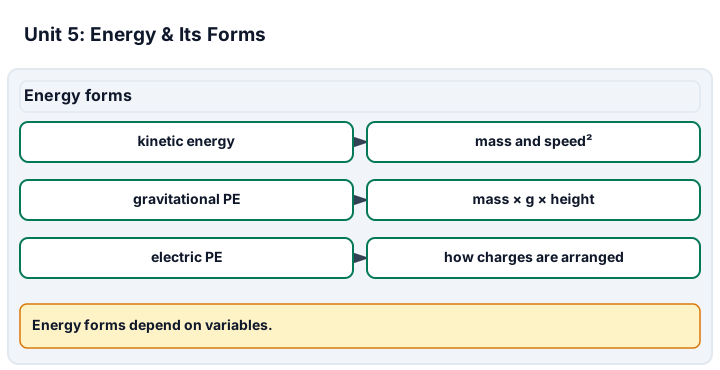
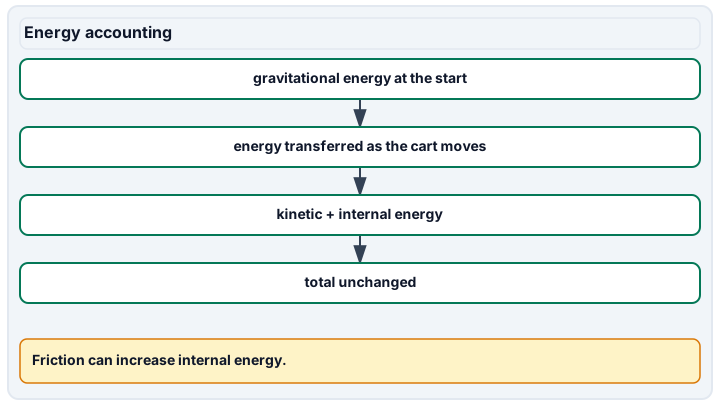
Diagram description
Energy forms pairs kinetic energy with mass and speed squared, gravitational potential energy with mass, g and height, and electric potential energy with charge arrangement. Energy accounting follows gravitational energy into transfer during motion, then into kinetic plus internal thermal energy while the total stays unchanged.
Data, provenance, and assumptions
| Case | Mass (kg) | Speed (m/s) |
|---|---|---|
| A | 1 | 1 |
| B | 1 | 2 |
| C | 2 | 2 |
| Quantity | Value | Unit / meaning |
|---|---|---|
| mass | 1 | kg |
| g | 10 | m/s^2 rounded model value |
| height | 1 | m initial height above final level |
| thermal | 2 | J increase in internal energy |
| Arrangement | Potential energy (J) |
|---|---|
| Closer | 8 |
| Farther apart | 2 |
Paper investigation sequence and evidence record
Scope and safety: All new records are supplied-data or reference-model work, not laboratory procedures. Do not improvise chemical mixtures, heating, impacts, laser or solar viewing, pressure systems, mains electricity or unreviewed wiring. An instructor must approve any real activity, equipment and accessible alternative separately. Paper calculations do not certify unobserved measuring or building skills; public solutions are nonsecure practice.
Materials and preparation
- [energy-transfers] Use the supplied speed-energy, energy-path, interaction-energy records, assigned source sections, calculator and an accessible graph or diagram. No physical apparatus is required.
Procedure and schedule
- [energy-transfers] Question: How can the same total energy be divided differently among motion, arrangement and internal energy? Prerequisites: Compare squares and ratios, add energy accounts, state a system boundary and keep separate examples separate.
- [energy-transfers] Variables: Change mass or speed one at a time, then compare the separate cart’s internal-energy allocation. Controls: Retain the defined energy zero, the rounded gravity convention and the absence of unspecified external transfers. Replication: Recomputing the ledger is an analytical check, not another physical trial or a measured efficiency result.
- [energy-transfers] Analysis: Use energy bars before equations, calculate compatible accounts, check their total and identify what the supplied states leave unknown. Review: An educator reviews prerequisites, source interpretation, reasoning and accessibility before assessment. A paper response does not certify unobserved practical technique; approved hands-on work requires a separate record.
Record: Retain energy-transfers, the selected level, original inputs and first attempt, source/date, system and axes, units, assumptions, calculation/graph, uncertainty, correction and fresh transfer. Link only to the stated science criteria.
Worked model
[energy-transfers] The speed records give 0.5, 2 and 4 J. Doubling speed at fixed mass quadruples K; doubling mass at fixed speed doubles it. The cart begins with 10 J gravitational energy, ending with 8 J kinetic and 2 J internal energy, so speed is 4 m/s. In the separate charge-pair model, an 8-to-2 J potential decrease could provide 6 J total kinetic increase if no other transfer occurs.
Numerical calibration
- 2 J
- 4 J
- 8 J
- 4 m/s
- 6 J available in the stated two-object model
- 6 J kinetic in the changed cart ledger
Attempt the assigned level
Try the tasks before reading the calibration. These are practice answers, not a secure examination; use a new dataset or changed assumption for the assessed transfer.
Foundation: typically grades 7-8, guided physical-science concepts
- [energy-transfers] Draw energy bars for the cart before and after its descent and compare the relative mass/speed effects. Explain why the thermal part is not missing energy.
Check after your attempt
- [energy-transfers] The cart starts with 10 J in the gravitational account and ends with 8 J kinetic plus 2 J internal energy. The total remains 10 J. At fixed mass, doubling speed gives four times the modeled kinetic energy; at fixed speed, doubling mass gives twice as much.
Core: survey / bridge core with independent models and basic calculations
- [energy-transfers] Compute the supplied kinetic-energy comparisons and cart result, then use the given charge-pair states to explain why arrangement belongs in a system energy description.
Check after your attempt
- [energy-transfers] The speed records yield 0.5, 2 and 4 J. The cart ends at 8 J kinetic and 4 m/s. Changing the two-charge arrangement reduces the supplied potential account by 6 J; that energy belongs to the interacting system, not just an intrinsic label on one object.
Honors extension: extra reasoning, not an AP course
- [energy-transfers] State the condition needed to turn the charge-pair potential decrease into a kinetic increase, then critique the claim that the cart’s lower kinetic energy proves energy was destroyed.
Check after your attempt
- [energy-transfers] A 6 J kinetic increase follows only if no other energy account or external transfer changes. In the cart model, internal energy increases by 2 J, so the lower mechanical amount is consistent with the complete 10 J ledger. Additional real effects would need explicit terms rather than being hidden as an unexplained loss.
History, reading, and writing connection
Explain how the assigned Joule account connects mechanical work and internal energy. Cite the passage and contrast the described historical evidence with our model’s kinetic, potential and internal-energy entries. Do not label the synthetic energy loss as a performed experiment or claim that one simple ledger validates every device.
Write in your own words or use an approved accessible equivalent. Cite a specific assigned section or figure, identify its evidence, and state one limitation or counterargument. Use the AI practice contract only for permitted coaching, never to invent observations or write the assessed response.
Transfer to a new case
[energy-transfers] Keep the original cart’s mass, height and rounded gravity, but let 4 J become internal energy instead of 2 J. Find its final kinetic energy and explain whether the complete energy total changes.
Calibration: [energy-transfers] The initial account remains 10 J. With 4 J internal energy, final kinetic energy is 6 J. The total is still 10 J under the stated closed accounting; changing the split does not create or destroy energy.
Evidence to retain
[energy-transfers] Science criteria 1-4: relative energy patterns, system/arrangement models, an explicit transformation ledger and a changed-case explanation. Formula work is not an observed ramp or energy-transfer practical.
Record units, calculations, source/date, uncertainty, and what is measured versus inferred. A simulation or supplied dataset must stay labeled as such. All new records are supplied-data or reference-model work, not laboratory procedures. Do not improvise chemical mixtures, heating, impacts, laser or solar viewing, pressure systems, mains electricity or unreviewed wiring. An instructor must approve any real activity, equipment and accessible alternative separately. Paper calculations do not certify unobserved measuring or building skills; public solutions are nonsecure practice.
Return to all eight learning pathways. Print this unit page for the student lessons; the linked five-page packet remains the separate assessment companion.
What work supports these criteria?
Integration is reported separately and cannot lower the science grade or block a science demonstration pass. Science and practical criteria determine that pass. Use the learner's own reasoning and an instructor-selected fresh variation. A supplied-data calculation covers only the stated analytical part of a criterion, not an unobserved measurement or build.
- Follow energy through a defined system: science criteria 1, 2, 3, 4.
Unit mastery rubric
| Criterion | Developing | Proficient | Mastery |
|---|---|---|---|
| Kinetic vs. potential energy | Cannot tell energy of motion from stored energy. | Defines each but cannot spot them in a real setup. | Identifies kinetic and potential energy in a moving system and says where each one is greatest. |
| Energy transformations | Thinks energy is used up and gone for good. | Names a transformation but skips the steps between. | Traces energy as it changes form through a pendulum swing or a roller-coaster drop. |
| Conservation of energy | Believes energy disappears at the bottom of a hill. | States that energy is conserved but cannot account for it. | Accounts for kinetic, potential and internal energy and transfers in a stated system; reduced motion does not mean energy was destroyed. |
| Reading an energy setup | Cannot say where energy is stored or moving. | Reads one point but not the whole path. | Reads a pendulum or track at any point and describes how the energy is split there. |
| Lab technique (energy transfer) | Releases the pendulum carelessly or takes no measurement. | Measures height or motion, but not both. | Measures height and motion in an energy-transfer setup and links the two through conservation. |
| Integration (cross-domain) | Makes no supported connection between the source and the science. | Uses the source but needs help connecting evidence, writing, or limitations to the science. | Independently connects History, Reading, and Writing using a cited source, appropriate evidence, a limitation, and a scientific explanation. |
Integration is reported separately and cannot lower the science grade or block a science demonstration pass. Science and practical criteria determine that pass. Use the integration guide's evidence checklist for the separately reported criterion.
“Our cart-Earth-track model starts with ten joules in the gravitational account and ends with eight joules kinetic plus two joules internal energy. Reduced motion is not destroyed energy. A different boundary or an external transfer would require additional terms in the account.”
“The pendulum has energy at the top and speed at the bottom. It slows down because the energy just runs out, I think.”
You demonstrate this unit through hands-on energy setups — a pendulum, a cart on a track — measuring height and motion and explaining the energy story aloud, not a multiple-choice test. A criterion counts as mastered only when you can both take the measurement and trace the energy without losing count of it. Mastery is demonstrated, not awarded.
A 5-page clipboard packet — unit overview, key terms, the mastery rubric, anchor examples, and a score sheet you can print and grade against.