Unit 06 · Heat & Thermal Energy
Heat and temperature feel like the same thing, but they aren’t — and this unit is where that difference finally clicks. Temperature tells you how hot something is; heat is energy moving from a warmer thing to a cooler one. You’ll follow that energy as it travels three ways — conduction through a metal spoon, convection in a pot of water, radiation from a warm lamp — and watch thermal energy spread until two things reach the same temperature. Mastery means you can tell heat apart from temperature and explain how energy gets from one place to another.
Student learning: Heat & Thermal Energy
Choose the level by readiness, not age alone, and record it before instruction. Foundation, core, and honors tasks are study pathways, not an AP course or a promise of college credit. The instructor retains practical assessment and the published science rubric; integration is reported separately.
Prerequisites: [thermal-particle-models] Read cumulative graph axes, subtract intervals, use a weighted mean and distinguish temperature from energy transfer. [insulation-design] Read repeated temperatures, calculate means and percentages, and distinguish a success criterion from a practical constraint.
Suggested sequence: read and discuss the explanation; attempt the worked model; analyze the data at your selected level; check the answers; then complete the source-linked response and a fresh transfer question. These activities supplement, not replace, supervised practical work and the full-year schedule.
Assigned reading and focus
- OpenStax College Physics 2e 14.3: Phase Change and Latent Heat. [thermal-particle-models] Read the heating-curve explanation and the difference between a temperature change and a change of state. Foundation uses particle sketches; the supplied energy differences are optional quantitative support.
- OpenStax College Physics 2e 14.2: Temperature Change and Heat Capacity. [thermal-particle-models] Read how amount and type of matter affect temperature change. Use q = m c change in temperature only under the stated no-phase-change assumptions.
- OpenStax College Physics 2e 14.4: Heat Transfer Methods. [thermal-particle-models] Read conduction, convection and radiation. Distinguish local microscopic motion, bulk fluid movement and energy carried by electromagnetic radiation.
- TeachEngineering: Engineering Design Process. [insulation-design] Read how engineers define a problem, requirements and limitations before choosing a design. Use the supplied iteration rather than assuming one successful-looking object is a completed design process.
- OpenStax College Physics 2e 14.4: Heat Transfer Methods. [insulation-design] Connect possible insulation changes to conduction, convection or radiation. Do not claim that one temperature record isolates a single heat-transfer mechanism.
- OpenStax University Physics Volume 2 1.4: Mechanical Equivalent of Heat. Revisit the specific Mechanical Equivalent of Heat passage, focusing this time on the distinction between work, heat transfer and internal energy, not a new historical experiment.
Learn the science
Physical Science remains a grades 7-9 survey and early-high-school bridge, not a full AP Chemistry or Physics course. Choose guided Foundation, independent survey/bridge work, or optional higher-challenge reasoning by readiness. Use only the assigned textbook sections and focus; extra equations or probability work are not automatically NGSS middle-school assessment requirements. Paper evidence and approved observed practical work remain separate.
[thermal-particle-models] Warmer particles are not bigger particles. Heating can change particle motion, spacing and interactions; molecules do not simply grow larger or change identity during melting and boiling. Temperature is related to microscopic motion and interactions, not a direct reading of the total energy in every-sized sample. During a pure-substance phase change at the stated pressure, added energy can change arrangement while temperature stays nearly constant. Net heat transfers spontaneously from warmer to cooler regions, while externally powered devices can move energy the other way by doing work.
[thermal-particle-models] Assumptions: The reference heating curve models 10 g of water at a stated constant pressure, with no heat loss and equilibrium phase changes. The listed energy values are cumulative, so plot the unequal horizontal intervals honestly. The separate mixing problem combines the same liquid with constant c = 4.18 J/(g C), no phase change, negligible container heat capacity and no external loss or work. It is not the heating-curve experiment.
[thermal-particle-models] Uncertainty: Real phase intervals, purity, pressure, heat loss and sensor limits can change a heating record. Equal sample temperatures do not mean equal amounts of matter or identical total internal energy. The computed mixing temperature is conditional on equal material properties and insulation, not a measured result or a recipe for heating liquids.
[insulation-design] Choose and improve a design against agreed requirements. A design needs a purpose, measurable success criteria and constraints agreed before testing. Here the model must retain temperature while meeting cost and mass limits. Compare all requirements, not just the warmest final reading or an unexplained weighted score. Repeat records reveal variation, and a conservative bound can change a decision. A revision should be evaluated against the same criteria before being described as an improvement.
[insulation-design] Assumptions: All configurations start with the same water mass at 40 C, in the same 20 C environment for 20 minutes. Each reported final temperature has an absolute bound of plus/minus 0.5 C. The requirement is a lower-bound final temperature of at least 31 C on every supplied trial, with cost no more than 10 model units and mass no more than 200 g. Energy estimates count water alone with constant c; cost units are fictional, not actual prices.
[insulation-design] Uncertainty: Three synthetic records do not validate a real container, safety or service life. Container capacity and heat loss paths would need more detailed evidence for an energy audit. D changes a whole configuration, so a better result does not uniquely establish which feature caused it. A real project needs an approved build, actual tests and further revision; the supplied-data case covers planning and evaluation, not performed construction.

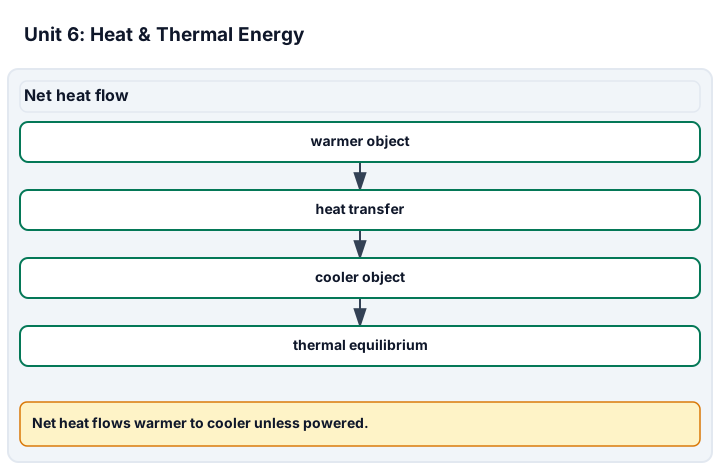
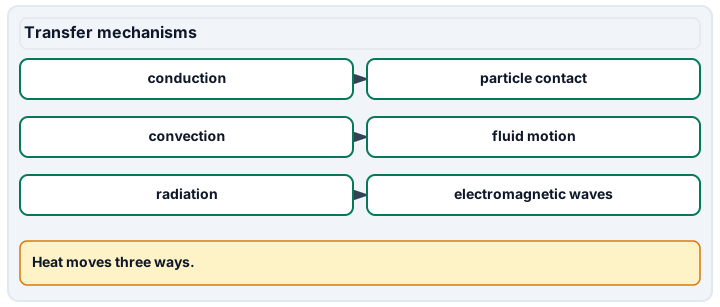
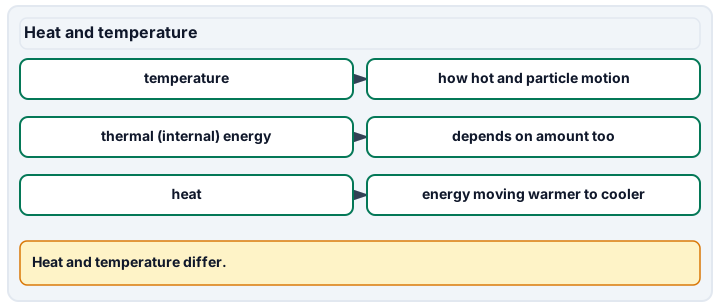
Diagram description
Net heat flow moves from warmer object to heat transfer, cooler object, and thermal equilibrium. Transfer mechanisms pairs conduction, convection and radiation with particle contact, fluid motion and electromagnetic waves. Heat and temperature distinguishes temperature, internal energy and heat.
Data, provenance, and assumptions
| Energy supplied (J) | Temperature (C) | Reference endpoint |
|---|---|---|
| 0 | -10 | Ice |
| 210 | 0 | Melting begins |
| 3550 | 0 | Melting complete |
| 7730 | 100 | Boiling begins |
| 30330 | 100 | Boiling complete |
| 30530 | 110 | Water vapor |
| Sample | Mass (g) | Initial temperature (C) |
|---|---|---|
| Warmer water | 100 | 40 |
| Cooler water | 200 | 20 |
| Model sample | Mass (g) | Specific heat (J/g C) | Energy received (J) |
|---|---|---|---|
| Water A | 100 | 4.18 | 1000 |
| Water B | 200 | 4.18 | 1000 |
| Aluminium C | 100 | 0.9 | 1000 |
| Scenario | Given behavior |
|---|---|
| Solid contact | Energy passes through neighboring material without bulk flow |
| Circulating fluid | Moving fluid carries energy between regions |
| Radiation across a gap | Electromagnetic energy travels even across a vacuum |
| Quantity | Value | Unit / meaning |
|---|---|---|
| budget | 10 | maximum model cost |
| maximumMass | 200 | g maximum design mass |
| minimumTemperature | 31 | degrees C minimum lower-bound final value |
| temperatureBound | 0.5 | degrees C per final reading |
| waterMass | 100 | g |
| c | 4.18 | J/(g C) |
| start | 40 | degrees C |
| ambient | 20 | degrees C |
| duration | 20 | minutes |
| Design | Model cost | Mass (g) | Final T1 (C) | Final T2 (C) | Final T3 (C) |
|---|---|---|---|---|---|
| A | 5 | 120 | 28 | 29 | 30 |
| B | 8 | 180 | 32 | 33 | 34 |
| C | 12 | 160 | 35 | 36 | 37 |
| D | 9 | 190 | 34 | 34.5 | 35 |
Paper investigation sequence and evidence record
Scope and safety: All new records are supplied-data or reference-model work, not laboratory procedures. Do not improvise chemical mixtures, heating, impacts, laser or solar viewing, pressure systems, mains electricity or unreviewed wiring. An instructor must approve any real activity, equipment and accessible alternative separately. Paper calculations do not certify unobserved measuring or building skills; public solutions are nonsecure practice.
Materials and preparation
- [thermal-particle-models] Use the supplied heating-curve, thermal-balance, thermal-capacity-models, transfer-mechanisms records, assigned source sections, calculator and an accessible graph or diagram. No physical apparatus is required.
- [insulation-design] Use the supplied insulation-constraints, insulation-trials records, assigned source sections, calculator and an accessible graph or diagram. No physical apparatus is required.
Procedure and schedule
- [thermal-particle-models] Question: How do amount of matter, particle state and the chosen system affect the interpretation of temperature changes? Prerequisites: Read cumulative graph axes, subtract intervals, use a weighted mean and distinguish temperature from energy transfer.
- [thermal-particle-models] Variables: Compare phase intervals, unequal sample masses and a changed ice amount as separate stated models. Controls: Keep pressure, material identity and heat-capacity assumptions explicit; do not carry an insulation assumption into an uncontrolled real setup. Replication: These model points and mixing inputs are not repeated measurements; real investigations need calibrated sensors and independent trials.
- [thermal-particle-models] Analysis: Label state and energy intervals, draw particle models, balance the separate heat accounts and name which assumptions limit each prediction. Review: An educator reviews prerequisites, source interpretation, reasoning and accessibility before assessment. A paper response does not certify unobserved practical technique; approved hands-on work requires a separate record.
- [insulation-design] Question: Which configuration meets agreed constraints, and how can a revision improve a margin without proving its individual cause? Prerequisites: Read repeated temperatures, calculate means and percentages, and distinguish a success criterion from a practical constraint.
- [insulation-design] Variables: Compare complete configurations and then vary the uncertainty bound without changing the observed-model readings. Controls: Retain water amount, starting/ambient temperatures, duration and the original acceptance rules across comparisons. Replication: The three fictional trials illustrate independent repeats for each configuration, not observed learner work or a full reliability study.
- [insulation-design] Analysis: Screen all constraints, apply worst-case bounds, calculate interpretable energy comparisons, evaluate D and propose the next controlled test. Review: An educator reviews prerequisites, source interpretation, reasoning and accessibility before assessment. A paper response does not certify unobserved practical technique; approved hands-on work requires a separate record.
Record: Retain thermal-particle-models, the selected level, original inputs and first attempt, source/date, system and axes, units, assumptions, calculation/graph, uncertainty, correction and fresh transfer. Link only to the stated science criteria. Retain insulation-design, the selected level, original inputs and first attempt, source/date, system and axes, units, assumptions, calculation/graph, uncertainty, correction and fresh transfer. Link only to the stated science criteria.
Worked model
[thermal-particle-models] Melting uses 3550 - 210 = 3340 J; boiling uses 30330 - 7730 = 22600 J in the given 10 g model. The temperature plateaus do not mean no energy enters. Separately, the insulated water balance gives final temperature (100 x 40 + 200 x 20)/300 = 26.66666667 C. About 5573.333333 J leaves the warmer portion and enters the cooler one under the stated assumptions. [insulation-design] B meets all stated limits: its lowest reading minus the bound is 31.5 C, cost 8 and mass 180 g. C is warmest but over budget; A misses the temperature goal. B’s mean 33 C gives modeled water energy loss 2926 J. D’s mean 34.5 C gives 2299 J, a 21.428571% reduction in this estimate. D’s worst lower bound is 33.5 C, with cost 9 and mass 190 g.
Numerical calibration
- 3340 J in the reference model
- 22600 J in the reference model
- 26.666666666667 degrees C
- 5573.333333333 J
- 2.392344497608 degrees C
- 1.196172248804 degrees C
- 11.111111111111 degrees C
- 6680 J for the changed ice amount
- 33 degrees C
- 2926 J in the water-only estimate
- 2299 J in the water-only estimate
- 21.428571428571 percent relative to B
- 33.5 degrees C
- 32.5 degrees C with the larger uncertainty bound
Attempt the assigned level
Try the tasks before reading the calibration. These are practice answers, not a secure examination; use a new dataset or changed assumption for the assessed transfer.
Foundation: typically grades 7-8, guided physical-science concepts
- [thermal-particle-models] Sketch particle arrangements for ice, liquid and vapor, then explain why a horizontal part of the temperature graph need not mean that the sample receives no energy. Classify the three transfer scenarios.
- [insulation-design] List the temperature, cost and mass requirements before choosing a design. Explain why the warmest result is not automatically the winner and identify a plausible heat-transfer path to investigate.
Check after your attempt
- [thermal-particle-models] The H2O identity remains while motion, spacing and interactions change; the molecules are not growing into different molecules. At the supplied phase-change intervals, energy changes the arrangement without raising temperature. The scenarios represent conduction, convection and radiation respectively.
- [insulation-design] The design must meet all three constraints, including the lower temperature bound. C is warmest but costs too much; A is too cool. Conduction through a wall, air movement or radiation could matter, but these records alone do not isolate one path.
Core: survey / bridge core with independent models and basic calculations
- [thermal-particle-models] Read the melting and boiling energy intervals and calculate the separate mixing temperature. Explain why simply averaging 40 and 20 C gives the wrong answer for these unequal masses.
- [insulation-design] Check B and D against every bound, calculate their mean final temperatures and water-only energy losses, and explain what the revision changes in the decision.
Check after your attempt
- [thermal-particle-models] The phase intervals use 3340 and 22600 J. Mixing gives about 26.67 C, closer to the larger cooler sample’s initial temperature. An unweighted average ignores the different amounts of the same material and would not close the heat balance.
- [insulation-design] B has mean 33 C, lower bound 31.5 C and estimated loss 2926 J. D has mean 34.5 C, lower bound 33.5 C and loss 2299 J. Both meet cost/mass limits; D offers a larger temperature margin within the modeled requirements.
Honors extension: extra reasoning, not an AP course
- [thermal-particle-models] Calculate the mixing energy and compare temperature rises in the separate capacity models using change in temperature = energy/(mass times specific heat). Identify the one changed factor in A/B and A/C, and explain why a powered refrigerator is a different system.
- [insulation-design] Calculate the relative reduction in the water-only loss estimate and evaluate a claim that D proves one particular material layer caused the improvement.
Check after your attempt
- [thermal-particle-models] Mixing transfers about 5573.33 J each way. The capacity-model rises are 2.3923445 C, 1.19617225 C and 11.11111111 C. A/B changes mass alone; A/C changes material at fixed mass and input energy. Loss, container capacity or a phase change would alter these results. A refrigerator adds external work, so it is not the unpowered spontaneous-transfer model.
- [insulation-design] The reduction is (2926 - 2299)/2926 x 100 = about 21.43%. The configuration comparison does not isolate a single cause, because several features may differ. It supports evaluating the whole modeled design, not universal material superiority or a real product certification.
History, reading, and writing connection
Use the assigned historical Joule passage to distinguish energy transfer from a material substance called heat. Compare the source’s described apparatus with the assumptions of our thermal and insulation records. Cite evidence, explain a limitation and evaluate a design choice without inventing historical numbers or claiming a classroom pilot has occurred.
Write in your own words or use an approved accessible equivalent. Cite a specific assigned section or figure, identify its evidence, and state one limitation or counterargument. Use the AI practice contract only for permitted coaching, never to invent observations or write the assessed response.
Transfer to a new case
[thermal-particle-models] A separate reference sample contains 20 g of ice already at 0 C. Using the same per-gram melting energy represented by the 10 g plateau, how much energy is required to finish melting it without changing temperature? [insulation-design] Keep the same trial readings but widen the per-reading bound to plus/minus 1.5 C. Find D’s worst lower bound and compare B’s status under the same 31 C requirement.
Calibration: [thermal-particle-models] The given plateau corresponds to 3340/10 = 334 J/g. Twenty grams therefore require 6680 J for melting alone. This starting sample is already at 0 C, so the earlier warming-from-minus-10-C energy must not be added again. [insulation-design] D’s lower bound becomes 34 - 1.5 = 32.5 C and still exceeds 31 C. B’s becomes 32 - 1.5 = 30.5 C and no longer clears the requirement. Larger uncertainty changes the justified decision without changing the central readings.
Evidence to retain
[thermal-particle-models] Science criteria 1-4: particle/temperature distinctions, transfer mechanisms, a correctly scaled heating curve and a conditional heat balance. Supplied values do not certify actual thermometer technique. [insulation-design] Science criteria 2-4: plausible transfer mechanisms, prediction under common conditions and an evidence-based design comparison. The paper record does not count as actual construction or thermometer skill.
Record units, calculations, source/date, uncertainty, and what is measured versus inferred. A simulation or supplied dataset must stay labeled as such. All new records are supplied-data or reference-model work, not laboratory procedures. Do not improvise chemical mixtures, heating, impacts, laser or solar viewing, pressure systems, mains electricity or unreviewed wiring. An instructor must approve any real activity, equipment and accessible alternative separately. Paper calculations do not certify unobserved measuring or building skills; public solutions are nonsecure practice.
Return to all eight learning pathways. Print this unit page for the student lessons; the linked five-page packet remains the separate assessment companion.
What work supports these criteria?
Integration is reported separately and cannot lower the science grade or block a science demonstration pass. Science and practical criteria determine that pass. Use the learner's own reasoning and an instructor-selected fresh variation. A supplied-data calculation covers only the stated analytical part of a criterion, not an unobserved measurement or build.
- Warmer particles are not bigger particles: science criteria 1, 2, 3, 4.
- Choose and improve a design against agreed requirements: science criteria 2, 3, 4.
Unit mastery rubric
| Criterion | Developing | Proficient | Mastery |
|---|---|---|---|
| Temperature vs. heat | Uses “heat” and “temperature” to mean the same thing. | Defines each but confuses them in an example. | Distinguishes temperature, amount-dependent internal energy and heat transfer; uses an appropriate particle model and material conditions. |
| Conduction, convection & radiation | Cannot name a way that heat travels. | Names the three ways but cannot match them to real cases. | Identifies conduction, convection, and radiation in everyday situations and explains each one. |
| Thermal energy & heat flow | Thinks cold moves into warm things. | Knows heat flows but not which direction. | Explains net spontaneous heat transfer from warmer to cooler regions and distinguishes externally powered transfer from that unpowered model. |
| Predicting heat transfer | Cannot say what will warm up or cool down. | Predicts a direction but not a reason. | Predicts transfer paths and evaluates a thermal design using stated requirements, constraints, controls, uncertainty and revision evidence. |
| Lab technique (heat transfer) | Misreads the thermometer or ignores the reading. | Records temperatures but at uneven times. | Measures temperature change over time cleanly and links it to how the heat traveled. |
| Integration (cross-domain) | Makes no supported connection between the source and the science. | Uses the source but needs help connecting evidence, writing, or limitations to the science. | Independently connects History, Reading, and Writing using a cited source, appropriate evidence, a limitation, and a scientific explanation. |
Integration is reported separately and cannot lower the science grade or block a science demonstration pass. Science and practical criteria determine that pass. Use the integration guide's evidence checklist for the separately reported criterion.
“In the supplied same-water model, 100 g at 40 C and 200 g at 20 C reach about 26.67 C, not an unweighted 30 C. Material, phase and insulation assumptions matter. Net spontaneous heat transfer is warmer to cooler; an externally powered refrigerator requires a different energy account.”
“The metal spoon is colder than the wooden one — you can feel it. Cold moves into your hand from the metal, I think.”
You demonstrate this unit through hands-on heat-transfer setups — a warming spoon, a beaker on a hot plate — measuring temperature over time and explaining how the energy traveled aloud, not a multiple-choice test. A criterion counts as mastered only when you can both take the reading and tell heat apart from temperature. Mastery is demonstrated, not awarded.
A 5-page clipboard packet — unit overview, key terms, the mastery rubric, anchor examples, and a score sheet you can print and grade against.