Unit 07 · Waves, Sound & Light
A wave is a pattern that carries energy without carrying the stuff it moves through. This unit measures waves you can make in a stretched spring — their wavelength, their frequency, their amplitude — then connects those ideas to the sound you hear and the light you see. You’ll meet the electromagnetic spectrum, from radio waves to visible light, and watch a wave bounce back as reflection. Mastery means you can describe a wave by its measurements and explain how sound and light behave as waves.
Student learning: Waves, Sound & Light
Choose the level by readiness, not age alone, and record it before instruction. Foundation, core, and honors tasks are study pathways, not an AP course or a promise of college credit. The instructor retains practical assessment and the published science rubric; integration is reported separately.
Prerequisites: [wave-interactions] Read cycles per second, distances, amplitude ratios, simple energy balances and an angle measured from a normal. [digital-signals] Read two symbols, compare values with a threshold and use majority voting; probability multiplication is optional extension work.
Suggested sequence: read and discuss the explanation; attempt the worked model; analyze the data at your selected level; check the answers; then complete the source-linked response and a fresh transfer question. These activities supplement, not replace, supervised practical work and the full-year schedule.
Assigned reading and focus
- OpenStax College Physics 2e 16.9: Waves. [wave-interactions] Read wavelength, frequency, amplitude and propagation. Distinguish local motion of a material medium from travel of the disturbance.
- OpenStax College Physics 2e 16.11: Energy in Waves and Intensity. [wave-interactions] Read amplitude and energy/intensity relationships. Compare amplitude only while the other relevant wave conditions are fixed.
- NASA: Wave Behaviors. [wave-interactions] Read reflection, transmission and absorption as different interactions. Use only the supplied diagrams/data; no laser, solar-viewing or light-source practical is assigned.
- CS Unplugged: Binary Numbers, introductory explanation. [digital-signals] Read the opening explanation of bits as two distinguishable physical states sent by light, voltage or sound. Binary counting is not required for this middle-school connection.
- Computer Science Field Guide: Error Control, What’s the Big Picture?. [digital-signals] Read the difference between detecting and correcting errors. Compare that general idea with our supplied three-copy toy code, not with the full mechanism of a real device.
- MacTutor, University of St Andrews: Isaac Newton. Read the biography’s account of Newton’s optics and publications. Compare the historical source with our modern wave/communication models; Newton did not collect our digital signal table.
Learn the science
Physical Science remains a grades 7-9 survey and early-high-school bridge, not a full AP Chemistry or Physics course. Choose guided Foundation, independent survey/bridge work, or optional higher-challenge reasoning by readiness. Use only the assigned textbook sections and focus; extra equations or probability work are not automatically NGSS middle-school assessment requirements. Paper evidence and approved observed practical work remain separate.
[wave-interactions] What moves with a wave, and where its energy goes. A mechanical wave transfers energy while the medium moves locally about its reference position in the ideal model; it does not require each particle to travel with the disturbance. Electromagnetic waves do not require a material medium. Frequency and wavelength relate to propagation speed by v = f lambda. Amplitude can affect intensity, but comparisons need stated conditions. Reflection redirects energy, transmission carries it through, and absorption transfers it into the receiving system.
[wave-interactions] Assumptions: The sound records share one ideal nondispersive medium with propagation speed 340 m/s. Amplitudes are displacement amplitudes. Use intensity proportional to amplitude squared only for the same frequency, medium and comparison geometry, so compare A with C, not A with B. The separate light ledger accounts for all outgoing reflected/transmitted energy, with no other escape, storage or emission term. Reflection angles are measured from the normal.
[wave-interactions] Uncertainty: Actual waves can disperse, attenuate or change waveform. Perceived loudness and brightness are not direct universal measures of amplitude. If scattering or other unmeasured energy paths exist, missing light energy cannot automatically be labeled absorption. A simplified water-wave picture also does not describe every real current or net drift.
[digital-signals] Why a digital message can survive some noise. Information can be represented by varying a physical wave signal. An analog model preserves a range of amplitudes; a binary digital model assigns two symbols to defined signal ranges. A threshold can recover the same bit after small disturbances, but sufficiently large noise can cross it. Added checking or repeated symbols can help detect or correct some errors at a cost in transmitted symbols. Digital does not mean noise-free, infinite precision or automatically true information.
[digital-signals] Assumptions: The voltage example uses nominal 0/1 levels and decodes values at or above 0.5 V as 1. Each three-copy group uses majority voting. The extension assumes independent bit flips with probability p and supplies the failure rule 3p^2(1-p) + p^3 for two or three flips. That probability model and arithmetic are optional extensions beyond the NGSS qualitative information-transfer boundary; no binary-number conversion or device circuit is required.
[digital-signals] Uncertainty: A deliberately chosen four-bit example does not estimate a real channel error rate. Burst errors can violate independence and defeat the three-copy code. Sampling and quantization can lose detail, and redundancy costs capacity and resources. Error correction cannot repair biased source measurements or guarantee correctness of every message.

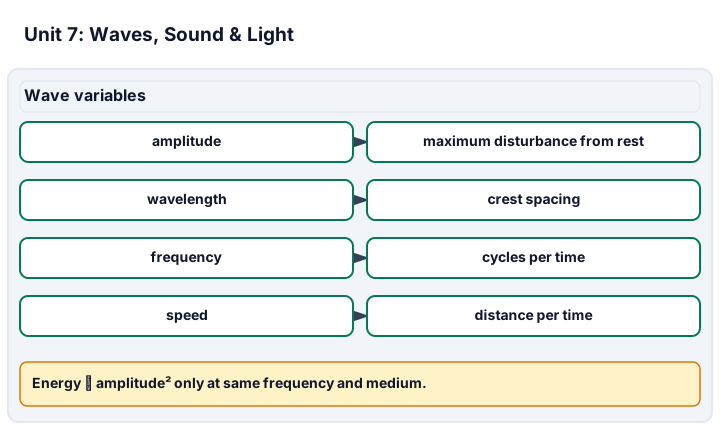
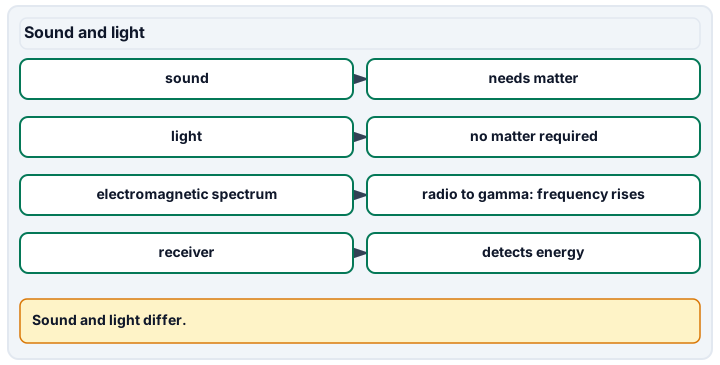
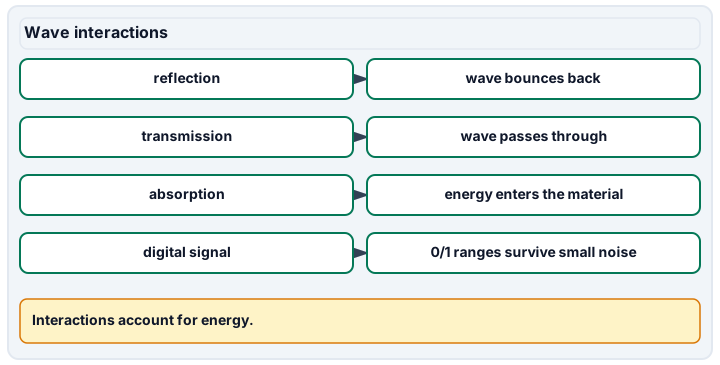
Diagram description
Wave variables defines amplitude, wavelength, frequency and speed. Sound and light states that sound needs matter, light does not, the electromagnetic spectrum runs radio to gamma with rising frequency, and receivers detect energy. Wave interactions distinguishes reflection, transmission, absorption and digital signal ranges surviving small noise.
Data, provenance, and assumptions
| Wave | Frequency (Hz) | Wavelength (m) | Displacement amplitude (mm) |
|---|---|---|---|
| A | 200 | 1.7 | 0.5 |
| B | 400 | 0.85 | 0.5 |
| C | 200 | 1.7 | 1 |
| Panel | Incident (mJ) | Reflected (mJ) | Transmitted (mJ) |
|---|---|---|---|
| A | 100 | 10 | 80 |
| B | 100 | 30 | 0 |
| C | 100 | 85 | 5 |
| Order in this reference | Region |
|---|---|
| 1 | Radio |
| 2 | Microwave |
| 3 | Infrared |
| 4 | Visible |
| 5 | Ultraviolet |
| 6 | X-ray |
| 7 | Gamma-ray |
| Position | Sent bit | Received voltage (V) |
|---|---|---|
| 1 | 1 | 0.92 |
| 2 | 0 | 0.08 |
| 3 | 1 | 0.63 |
| 4 | 1 | 0.41 |
| Position | Received three-copy group |
|---|---|
| 1 | 101 |
| 2 | 000 |
| 3 | 110 |
| 4 | 011 |
| Sample | Original amplitude (V) | Received amplitude (V) |
|---|---|---|
| 1 | 0.2 | 0.23 |
| 2 | 0.4 | 0.36 |
| 3 | 0.6 | 0.68 |
| 4 | 0.8 | 0.78 |
Paper investigation sequence and evidence record
Scope and safety: All new records are supplied-data or reference-model work, not laboratory procedures. Do not improvise chemical mixtures, heating, impacts, laser or solar viewing, pressure systems, mains electricity or unreviewed wiring. An instructor must approve any real activity, equipment and accessible alternative separately. Paper calculations do not certify unobserved measuring or building skills; public solutions are nonsecure practice.
Materials and preparation
- [wave-interactions] Use the supplied wave-records, wave-energy-ledger, spectrum-reference records, assigned source sections, calculator and an accessible graph or diagram. No physical apparatus is required.
- [digital-signals] Use the supplied signal-samples, repetition-groups, analog-samples records, assigned source sections, calculator and an accessible graph or diagram. No physical apparatus is required.
Procedure and schedule
- [wave-interactions] Question: Which wave properties and interaction pathways must be held fixed before comparing speed or energy? Prerequisites: Read cycles per second, distances, amplitude ratios, simple energy balances and an angle measured from a normal.
- [wave-interactions] Variables: Compare frequency and amplitude in the stated sound medium, then treat the light panels as a separate fixed-boundary energy account. Controls: Use A/C for the matched-frequency amplitude comparison and retain the complete reflection/transmission/absorption assumption. Replication: The model rows are constructed comparisons, not repeated sound or light measurements or empirical proof of material behavior.
- [wave-interactions] Analysis: Sketch the disturbance and local motion, calculate f lambda, choose a valid ratio comparison and test the completeness of the energy ledger. Review: An educator reviews prerequisites, source interpretation, reasoning and accessibility before assessment. A paper response does not certify unobserved practical technique; approved hands-on work requires a separate record.
- [digital-signals] Question: What information about the signal and noise is needed before claiming a more reliable message? Prerequisites: Read two symbols, compare values with a threshold and use majority voting; probability multiplication is optional extension work.
- [digital-signals] Variables: Compare stated decoding rules and then change only p in the separate independent-error model. Controls: Keep nominal levels, threshold, group boundaries and the known sent practice message explicit; do not mix unlike examples as repeated trials. Replication: One designed example demonstrates a method, not its real reliability; actual error-rate estimates need appropriate repeated independent records.
- [digital-signals] Analysis: Decode before checking, count the explicit discrepancies and redundancy, distinguish detection from correction and test the model against burst errors. Review: An educator reviews prerequisites, source interpretation, reasoning and accessibility before assessment. A paper response does not certify unobserved practical technique; approved hands-on work requires a separate record.
Record: Retain wave-interactions, the selected level, original inputs and first attempt, source/date, system and axes, units, assumptions, calculation/graph, uncertainty, correction and fresh transfer. Link only to the stated science criteria. Retain digital-signals, the selected level, original inputs and first attempt, source/date, system and axes, units, assumptions, calculation/graph, uncertainty, correction and fresh transfer. Link only to the stated science criteria.
Worked model
[wave-interactions] Each wave record gives f lambda = 340 m/s. C has twice A’s displacement amplitude at the same frequency, giving four times the modeled intensity. The panel absorption residuals are 10, 70 and 10 mJ. For an ideal reflection example with an incoming ray 30 degrees from the normal, the reflected ray is also 30 degrees from the normal, not from the surface. [digital-signals] Thresholding the four voltages gives 1010 instead of the supplied 1011: one bit differs. Majority decoding the separate repeated groups recovers 1011, using 12 transmitted bits for 4 information bits, a factor of three. The analog sample mean absolute error is 0.0425 V. Under the separate independent-error model at p = 0.10, majority failure is 0.028, or 2.8%; the chosen message is not an estimate of that probability.
Numerical calibration
- 340 m/s
- 4 C/A under matched conditions
- 10 mJ
- 70 mJ
- 10 mJ
- 0.68 m wavelength in the changed sound model
- 1 bit in the given record
- 3 transmitted bits per information bit
- 0.028 modeled failure probability
- 0.0425 V
- 0.104 modeled failure probability at the changed p
Attempt the assigned level
Try the tasks before reading the calibration. These are practice answers, not a secure examination; use a new dataset or changed assumption for the assessed transfer.
Foundation: typically grades 7-8, guided physical-science concepts
- [wave-interactions] Label wavelength, frequency and amplitude on a sketch and distinguish reflection, transmission and absorption. Use the spectrum reference to compare visible and microwave frequency without treating the order labels as measured frequencies.
- [digital-signals] Decode the four voltages with the stated threshold and compare with the given sent message. Explain why a discrete symbol can survive some noise but not every possible disturbance.
Check after your attempt
- [wave-interactions] Wavelength is spatial repeat distance, frequency is repeats per second and amplitude is the stated maximum disturbance. Visible light has a higher characteristic frequency than microwaves in the reference order. These are electromagnetic waves, which need no material medium; a panel can reflect, transmit or absorb their energy.
- [digital-signals] The decoded message is 1010, with the fourth bit wrong. Values that remain on the correct side of the threshold preserve the bit, but 0.41 V crosses the rule’s boundary for a sent 1. A threshold is a defined interpretation, not protection against unlimited noise.
Core: survey / bridge core with independent models and basic calculations
- [wave-interactions] Calculate propagation speed for all three sound records and the permitted A/C intensity comparison. Complete the three separate light-energy ledgers and state why the accounting boundary matters.
- [digital-signals] Decode each three-copy group and compare the recovered message and symbol cost with the four-voltage example. Use the readings to explain detection versus correction without claiming all digital transmissions are perfect.
Check after your attempt
- [wave-interactions] All speeds are 340 m/s. The A/C intensity ratio is four under matched frequency and medium. Absorbed amounts are 10, 70 and 10 mJ only under the given complete ledger; an unmeasured scattered path would change what the residual means.
- [digital-signals] Majorities are 1,0,1,1, recovering 1011 in this constructed example. Sending three copies costs three times the symbols. Some methods detect an error and request a new message; others can correct specified error patterns. Neither approach guarantees every possible error is detected or corrected.
Honors extension: extra reasoning, not an AP course
- [wave-interactions] Explain why matching displacement amplitudes in A and B does not justify using amplitude alone to compare their energies, and why a material does not always interact identically with every electromagnetic wavelength.
- [digital-signals] Calculate the mean absolute analog sample error and the supplied majority-failure expression at p = 0.10. Explain why the probability calculation cannot be inferred from just the displayed four-bit examples.
Check after your attempt
- [wave-interactions] A and B differ in frequency, so an amplitude-only comparison holds neither all wave conditions nor the relevant energy relation fixed. Material response depends on wavelength and structure; a visible-light ledger cannot automatically predict every infrared, ultraviolet or radio interaction.
- [digital-signals] The mean absolute amplitude error is (0.03 + 0.04 + 0.08 + 0.02)/4 = 0.0425 V. The independent flip model gives 3(0.1)^2(0.9) + (0.1)^3 = 0.028. Four selected groups do not establish independence, a real error rate or resilience to a burst affecting multiple copies.
History, reading, and writing connection
Use the Newton biography’s optics account to identify a historical scientific question, then connect it to one defined aspect of the wave lesson. Distinguish source-supported history from the modern signal model, compare evidence and limits, and do not attribute binary communication experiments to the historical figure.
Write in your own words or use an approved accessible equivalent. Cite a specific assigned section or figure, identify its evidence, and state one limitation or counterargument. Use the AI practice contract only for permitted coaching, never to invent observations or write the assessed response.
Transfer to a new case
[wave-interactions] Use the same ideal sound medium at 340 m/s but change frequency to 500 Hz. Find wavelength and explain whether a larger frequency automatically means a larger propagation speed in this stated model. [digital-signals] Change the independent bit-flip probability to 0.20 while retaining the three-copy majority rule. Calculate its modeled failure probability and decide whether that number guarantees recovery after a burst that flips two copies in one group.
Calibration: [wave-interactions] Wavelength is 340/500 = 0.68 m. Propagation speed stays 340 m/s in the specified nondispersive medium; frequency and wavelength adjust together. A different or dispersive medium would require its own model. [digital-signals] The expression gives 3(0.2)^2(0.8) + (0.2)^3 = 0.104, or 10.4%. That modeled probability does not guarantee recovery for a particular burst. Two flipped copies can produce the wrong majority, and correlated bursts violate the independence assumption.
Evidence to retain
[wave-interactions] Science criteria 1-4: the analysis component of wave quantities, energy transfer, sound/light distinctions, spectrum context and interaction accounting. A supplied table does not demonstrate producing or measuring waves in a spring. [digital-signals] Science criterion 3, information carried by waves: explain physical signal states, a supported noise comparison and the limits/costs of correction. Binary counting, probability formulas and actual device mechanisms are not required NGSS middle-school assessment targets.
Record units, calculations, source/date, uncertainty, and what is measured versus inferred. A simulation or supplied dataset must stay labeled as such. All new records are supplied-data or reference-model work, not laboratory procedures. Do not improvise chemical mixtures, heating, impacts, laser or solar viewing, pressure systems, mains electricity or unreviewed wiring. An instructor must approve any real activity, equipment and accessible alternative separately. Paper calculations do not certify unobserved measuring or building skills; public solutions are nonsecure practice.
Return to all eight learning pathways. Print this unit page for the student lessons; the linked five-page packet remains the separate assessment companion.
What work supports these criteria?
Integration is reported separately and cannot lower the science grade or block a science demonstration pass. Science and practical criteria determine that pass. Use the learner's own reasoning and an instructor-selected fresh variation. A supplied-data calculation covers only the stated analytical part of a criterion, not an unobserved measurement or build.
- What moves with a wave, and where its energy goes: science criteria 1, 2, 3, 4.
- Why a digital message can survive some noise: science criteria 3.
Unit mastery rubric
| Criterion | Developing | Proficient | Mastery |
|---|---|---|---|
| Wave parts: wavelength, frequency & amplitude | Cannot label the parts of a wave. | Names the parts but measures them wrong. | Measures wavelength, frequency, and amplitude and says what each one controls. |
| Waves carry energy | Thinks a wave carries matter along with it. | Says waves carry energy but cannot show it. | Explains energy propagation while a mechanical medium moves locally; distinguishes electromagnetic waves that need no material medium. |
| Sound, light & information | Treats sound and light as unrelated. | Calls both waves but cannot compare them. | Relates pitch to frequency and intensity to stated wave conditions; explains signal encoding, noise and the limits of digital error control. |
| Wave interactions & electromagnetic spectrum | Cannot place visible light among the other waves. | Names parts of the spectrum but not their order. | Orders common electromagnetic regions and distinguishes reflection, transmission and absorption with a stated energy account. |
| Lab technique (waves in a spring) | Cannot make a steady wave in the spring. | Makes waves but cannot measure them consistently. | Produces steady waves in a spring, measures wavelength and frequency, and shows how they change together. |
| Integration (cross-domain) | Makes no supported connection between the source and the science. | Uses the source but needs help connecting evidence, writing, or limitations to the science. | Independently connects History, Reading, and Writing using a cited source, appropriate evidence, a limitation, and a scientific explanation. |
Integration is reported separately and cannot lower the science grade or block a science demonstration pass. Science and practical criteria determine that pass. Use the integration guide's evidence checklist for the separately reported criterion.
“The sound records both give 340 m/s; higher frequency does not raise speed in this stated medium. Material moves locally in a mechanical wave, while electromagnetic waves need no material medium. The panel ledger assigns absorption only because every other stated energy path has been counted.”
“The wave carried the spring down to the other end. Higher pitch means louder, right? I mixed up frequency and amplitude.”
You demonstrate this unit through hands-on wave setups — waves in a stretched spring, plus sound and light demos — measuring wavelength and frequency and explaining the behavior aloud, not a multiple-choice test. A criterion counts as mastered only when you can both make and measure the wave and explain what its numbers mean. Mastery is demonstrated, not awarded.
A 5-page clipboard packet — unit overview, key terms, the mastery rubric, anchor examples, and a score sheet you can print and grade against.