Unit 08 · Electricity & Magnetism
This unit connects simple circuit models with magnetic effects and Faraday’s induction work. Current describes charge flow; voltage describes energy transfer per charge. A source and conducting path can support sustained current in the stated direct-current model. Current produces a magnetic field, while changing magnetic flux can induce a voltage; moving a magnet is only one example. Use the supplied circuit, field and induction records, then document approved circuit/electromagnet practice separately. A correct calculation does not show that a learner built or measured an actual circuit.
Student learning: Electricity & Magnetism
Choose the level by readiness, not age alone, and record it before instruction. Foundation, core, and honors tasks are study pathways, not an AP course or a promise of college credit. The instructor retains practical assessment and the published science rubric; integration is reported separately.
Prerequisites: [circuits-magnets] Distinguish current, voltage, resistance, energy and charge; identify a stated series versus parallel topology.
Suggested sequence: read and discuss the explanation; attempt the worked model; analyze the data at your selected level; check the answers; then complete the source-linked response and a fresh transfer question. These activities supplement, not replace, supervised practical work and the full-year schedule.
Assigned reading and focus
- OpenStax College Physics 2e 20.1: Current. [circuits-magnets] Read current as a rate of charge flow. Distinguish charge carried through a component from energy transferred there.
- OpenStax College Physics 2e 21.1: Resistors in Series and Parallel. [circuits-magnets] Read the ideal resistor series and parallel relations. These data use resistors, not an assumption that a real glowing bulb has fixed resistance.
- OpenStax College Physics 2e 22.3: Magnetic Fields and Field Lines. [circuits-magnets] Read the role of field direction and reference measurements. Pair this lesson with the preserved induction-practice source and task in this unit.
- Royal Institution: Michael Faraday (1791-1867). Read the Royal Institution’s biography, separating electromagnetic rotations, induction and later field work. It is a retrospective source, not the raw measurements in our supplied coil table.
Learn the science
Physical Science remains a grades 7-9 survey and early-high-school bridge, not a full AP Chemistry or Physics course. Choose guided Foundation, independent survey/bridge work, or optional higher-challenge reasoning by readiness. Use only the assigned textbook sections and focus; extra equations or probability work are not automatically NGSS middle-school assessment requirements. Paper evidence and approved observed practical work remain separate.
[circuits-magnets] Charge keeps moving while energy is transferred. Current is the rate of charge flow; voltage difference describes energy transfer per charge. In a steady series path, current is the same through each component. In a parallel network, branch currents sum at junctions rather than charge being used up. Components can transfer electrical energy to other forms while charge remains accounted for. A current can produce a magnetic field; changing flux can induce voltage, a different relationship explored in the separate retained induction task.
[circuits-magnets] Assumptions: Use ideal steady direct-current resistor models with a fixed 6 V source and negligible wire/source resistance. The series and parallel arrangements are separate configurations. The field table is a separate fixed-geometry air-core current model with a 20 microtesla background component along one stated meter axis. No wiring, current source, mains equipment or magnet build is assigned.
[circuits-magnets] Uncertainty: Real sources and components may be nonideal, and a filament bulb’s resistance can change with temperature. A zero reading of one field component need not mean that every field component is zero. Field readings at different current settings do not by themselves supply a time-dependent flux or an induced current. Practical circuit and electromagnet evidence remains separate.

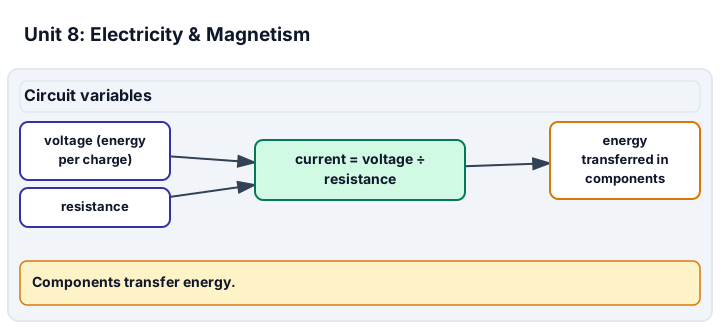
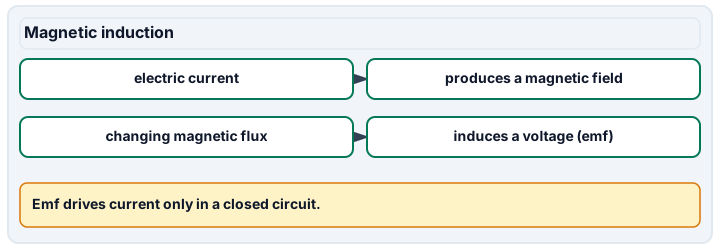
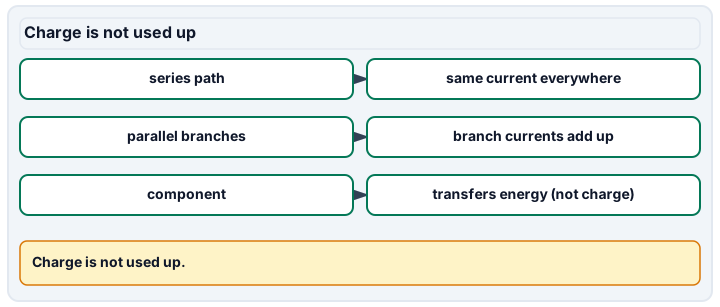
Diagram description
Circuit variables uses voltage as energy per charge and resistance as inputs to current, with energy transferred in components as the output. Magnetic induction states that electric current produces a magnetic field and changing magnetic flux induces voltage, not necessarily current. Charge is not used up explains series current, branch-current sums, and components transferring energy rather than charge.
Data, provenance, and assumptions
| Quantity | Value | Unit / meaning |
|---|---|---|
| V | 6 | V source difference |
| R1 | 10 | ohm |
| R2 | 20 | ohm |
| time | 60 | s for the series energy/charge account |
| Current (A) | Field component (microtesla) |
|---|---|
| -0.2 | 0 |
| 0 | 20 |
| 0.2 | 40 |
Paper investigation sequence and evidence record
Scope and safety: All new records are supplied-data or reference-model work, not laboratory procedures. Do not improvise chemical mixtures, heating, impacts, laser or solar viewing, pressure systems, mains electricity or unreviewed wiring. An instructor must approve any real activity, equipment and accessible alternative separately. Paper calculations do not certify unobserved measuring or building skills; public solutions are nonsecure practice.
Materials and preparation
- [circuits-magnets] Use the supplied circuit-inputs, field-current records, assigned source sections, calculator and an accessible graph or diagram. No physical apparatus is required.
Procedure and schedule
- [circuits-magnets] Question: How can energy be transferred and branch currents differ while charge remains conserved? Prerequisites: Distinguish current, voltage, resistance, energy and charge; identify a stated series versus parallel topology.
- [circuits-magnets] Variables: Compare the two ideal resistor configurations and a separate fixed-axis field model; the transfer changes one series resistance. Controls: Keep steady operation, ideal source, resistor assumptions and the field-axis/background conventions explicit. Replication: These are supplied model states, not repeat electrical measurements or observations of a learner’s practical construction.
- [circuits-magnets] Analysis: Label the configuration first, solve currents/voltage drops, reconcile charge and energy accounts, then relate but do not confuse field and induction records. Review: An educator reviews prerequisites, source interpretation, reasoning and accessibility before assessment. A paper response does not certify unobserved practical technique; approved hands-on work requires a separate record.
Record: Retain circuits-magnets, the selected level, original inputs and first attempt, source/date, system and axes, units, assumptions, calculation/graph, uncertainty, correction and fresh transfer. Link only to the stated science criteria.
Worked model
[circuits-magnets] Series resistance is 30 ohm, giving 0.2 A. Voltage drops are 2 and 4 V, totaling 6 V. In 60 s the source transfers 72 J while 12 C of charge passes through every series element. In the separate parallel configuration, branch currents are 0.6 and 0.3 A, totaling 0.9 A. The field-component slope is 100 microtesla/A with a 20-microtesla offset.
Numerical calibration
- 0.2 A
- 2 V
- 4 V
- 72 J
- 12 C of charge
- 0.9 A
- 100 microtesla/A
- 0.12 A in the changed series model
Attempt the assigned level
Try the tasks before reading the calibration. These are practice answers, not a secure examination; use a new dataset or changed assumption for the assessed transfer.
Foundation: typically grades 7-8, guided physical-science concepts
- [circuits-magnets] Trace charge around a complete series model and explain what a component transfers without consuming the charge. Distinguish a current-produced field from the separate changing-flux induction task.
Check after your attempt
- [circuits-magnets] In a steady series path the current is equal through each component; in parallel circuits, branch currents split and sum at junctions. Each resistor transfers energy; it does not use up charge. A current produces a magnetic field. An induced voltage depends on changing magnetic flux and is not automatically a numerical current measurement.
Core: survey / bridge core with independent models and basic calculations
- [circuits-magnets] Calculate current and voltage drops for the series arrangement, then calculate each current in the separate parallel arrangement. Explain why different branch currents do not imply lost charge.
Check after your attempt
- [circuits-magnets] Series current is 0.2 A with drops 2 and 4 V. Parallel currents are 0.6 and 0.3 A, summing to 0.9 A at the junction. Charge is conserved; equal current applies to the series path, not to every branch of every possible circuit.
Honors extension: extra reasoning, not an AP course
- [circuits-magnets] Compute the series energy and charge accounts and the field-component slope. Explain why a zero field reading in the first row or a static nonzero field cannot be turned into an unsupported induction claim.
Check after your attempt
- [circuits-magnets] Energy transfer is VI time = 72 J and passing charge is I time = 12 C. The field-component slope is 100 microtesla/A with a 20-microtesla background. One component can cancel, and a static field can be nonzero with no changing flux; time, geometry and circuit information are needed for an induction/current prediction.
History, reading, and writing connection
Use the Royal Institution account to connect a specific Faraday contribution with the corresponding modern model. Distinguish current producing a magnetic field from changing flux inducing voltage, cite the source and explain the limits of the synthetic record. Do not invent diary quotations, current values or a claim that motion is the only route to induction.
Write in your own words or use an approved accessible equivalent. Cite a specific assigned section or figure, identify its evidence, and state one limitation or counterargument. Use the AI practice contract only for permitted coaching, never to invent observations or write the assessed response.
Transfer to a new case
[circuits-magnets] In the series configuration only, change R2 to 40 ohm while retaining the 6 V source and 10 ohm R1. Predict the current and explain whether a lower current means the second resistor consumes charge.
Calibration: [circuits-magnets] Total series resistance becomes 50 ohm, so current is 6/50 = 0.12 A throughout the steady series path. The source drives a different rate through the whole configuration; the resistor is not consuming charge or leaving less current on its far side.
Evidence to retain
[circuits-magnets] Science criteria 1, 3 and the analytical part of 4: charge/energy distinctions, series/branch accounting and field-versus-induction reasoning. The complete-circuit and practical-build criteria still require approved observed work.
Record units, calculations, source/date, uncertainty, and what is measured versus inferred. A simulation or supplied dataset must stay labeled as such. All new records are supplied-data or reference-model work, not laboratory procedures. Do not improvise chemical mixtures, heating, impacts, laser or solar viewing, pressure systems, mains electricity or unreviewed wiring. An instructor must approve any real activity, equipment and accessible alternative separately. Paper calculations do not certify unobserved measuring or building skills; public solutions are nonsecure practice.
Return to all eight learning pathways. Print this unit page for the student lessons; the linked five-page packet remains the separate assessment companion.
What work supports these criteria?
Integration is reported separately and cannot lower the science grade or block a science demonstration pass. Science and practical criteria determine that pass. Use the learner's own reasoning and an instructor-selected fresh variation. A supplied-data calculation covers only the stated analytical part of a criterion, not an unobserved measurement or build.
- Charge keeps moving while energy is transferred: science criteria 1, 3, 4.
Unit mastery rubric
| Criterion | Developing | Proficient | Mastery |
|---|---|---|---|
| Current & voltage | Cannot say what current or voltage is. | Names them but swaps their meanings. | Distinguishes current as charge-flow rate from voltage as energy transfer per charge, using a stated simple-circuit model. |
| Complete circuits | Thinks a bulb lights from a single wire. | Builds a loop but cannot say why it is needed. | Builds an approved low-voltage DC circuit and explains the source/potential difference and conducting path needed for sustained current. |
| “Used-up current” misconception | Believes the bulb uses up the current. | Knows charge flows in a loop but says some is lost in the bulb. | Accounts for charge: current is equal through a steady series path and branch currents sum at junctions; components transfer energy, not used-up charge. |
| Magnets & electromagnets | Cannot describe what a magnet does. | Knows magnets attract but confuses a current's field with induction. | Separately builds an approved electromagnet; distinguishes current-produced fields from changing-flux emf and interprets the supplied field/induction records with limits. |
| Lab technique (circuits & electromagnets) | Cannot get a circuit to work. | Lights a bulb but cannot troubleshoot a break. | Builds and fixes simple circuits and an electromagnet, tracing the current through each. |
| Integration (cross-domain) | Makes no supported connection between the source and the science. | Uses the source but needs help connecting evidence, writing, or limitations to the science. | Independently connects History, Reading, and Writing using a cited source, appropriate evidence, a limitation, and a scientific explanation. |
Integration is reported separately and cannot lower the science grade or block a science demonstration pass. Science and practical criteria determine that pass. Use the integration guide's evidence checklist for the separately reported criterion.
Assigned practice: changing flux, voltage, and current
Read the examples and flux definition in OpenStax College Physics 2e, 23.1 and the equation in 23.2, Faraday's and Lenz's law. Distinguish a current creating a magnetic field from a changing magnetic flux inducing an emf. A stationary coil can have an emf when the field through it changes.
Model: average emf = -N times change in flux per turn divided by elapsed time. Flux is in webers, time in seconds, and emf in volts. The chosen loop orientation defines the sign. Emf is not a numerical current measurement: a current estimate also needs a closed-circuit model and electrical properties.
| Case | Turns N | Flux change per turn (Wb) | Time (s) |
|---|---|---|---|
| A | 100 | 0 | 1 |
| B | 100 | 0.0002 | 0.5 |
| C | 100 | -0.0002 | 0.5 |
| D | 100 | 0.0002 | 1 |
Foundation: compare constant flux with changing flux and predict which pair reverses the emf sign. Core: calculate all four average emfs with units. Honors: compare B and D, then state what additional information would be needed to infer current and why an open coil can still have induced emf.
Submit: calculations or the agreed foundation explanation, an annotated orientation sketch, a source-linked explanation in your own words, and one limitation. Transfer: halve N while preserving the flux change and time; the emf magnitude halves. The instructor uses a fresh variation for assessment.
This is the supplied-data evidence for the induction part of the magnets/electromagnets criterion. It does not certify circuit construction or other practical skill. Any physical activity needs a separate instructor-approved low-voltage setup and procedure; no mains, homemade power supply, or unreviewed wiring is authorized.
“In the given series model, current is 0.2 A through both resistors and the voltage drops add to 6 V. In the separate parallel model, 0.6 A and 0.3 A sum at the junction. Components transfer energy, not used-up charge; actual construction still needs an approved observed record.”
“The bulb uses up the electricity, so there’s less coming back to the battery. A magnet and a battery aren’t really connected, are they?”
Demonstrate the approved circuit/electromagnet skills and complete the assigned induction analysis at the selected level. Distinguish observed practical work from supplied data and explain both current-produced fields and changing-flux emf. A working bulb alone does not meet the induction outcome.
A 5-page clipboard packet — unit overview, key terms, the mastery rubric, anchor examples, and a score sheet you can print and grade against.