Ask a student who has only read about science what an experiment is, and they will give you a definition. Ask a student who has actually run one and they will tell you about the morning they set two cups of bean seedlings on the windowsill, turned one away from the light, and watched over a week as the plants leaned in different directions. The first student has a sentence. The second has an experience, and the experience is what the sentence was always trying to point at.
That gap is the whole reason this course exists. Before you can learn biology, or physics, or any science with real content in it, there is a craft underneath all of them: how to observe, record, measure, design a fair test, graph a result, judge how sure you are, work safely, and explain what you found. Those moves are not facts. They are skills, and skills are built only one way — by doing them, over and over, with someone watching and helping you get better.
Skills come before facts
Picture two students a year from now, both starting a harder science class. The first one memorized definitions but never kept a real lab notebook, never took repeat measurements, never designed a test of their own. The second one owns those habits cold. When the new class asks them to plan an experiment and write up the data, the first student is starting from zero and the second is just doing what they already know how to do. The skills didn't merely help — they made the whole subject learnable.
This is what we mean when we say the course is a foundation, not a topic. We are not teaching you a pile of science facts to remember. We are teaching you the way scientists actually work, using simple, everyday questions as practice: does a paper airplane fly farther with a heavier nose? does a fizzing tablet dissolve faster in warm water than in cold? how long does an ice cube take to melt on the counter? The question barely matters. What matters is that you learn to answer it the honest way.
A fact you memorize can be forgotten by Friday. A skill you have practiced becomes part of how you think.
What only practice can teach
Beyond making you ready for later courses, learning the craft first teaches a set of things a textbook structurally cannot, because they are not simply facts. They are judgments and habits that only form when you are actually doing the work:
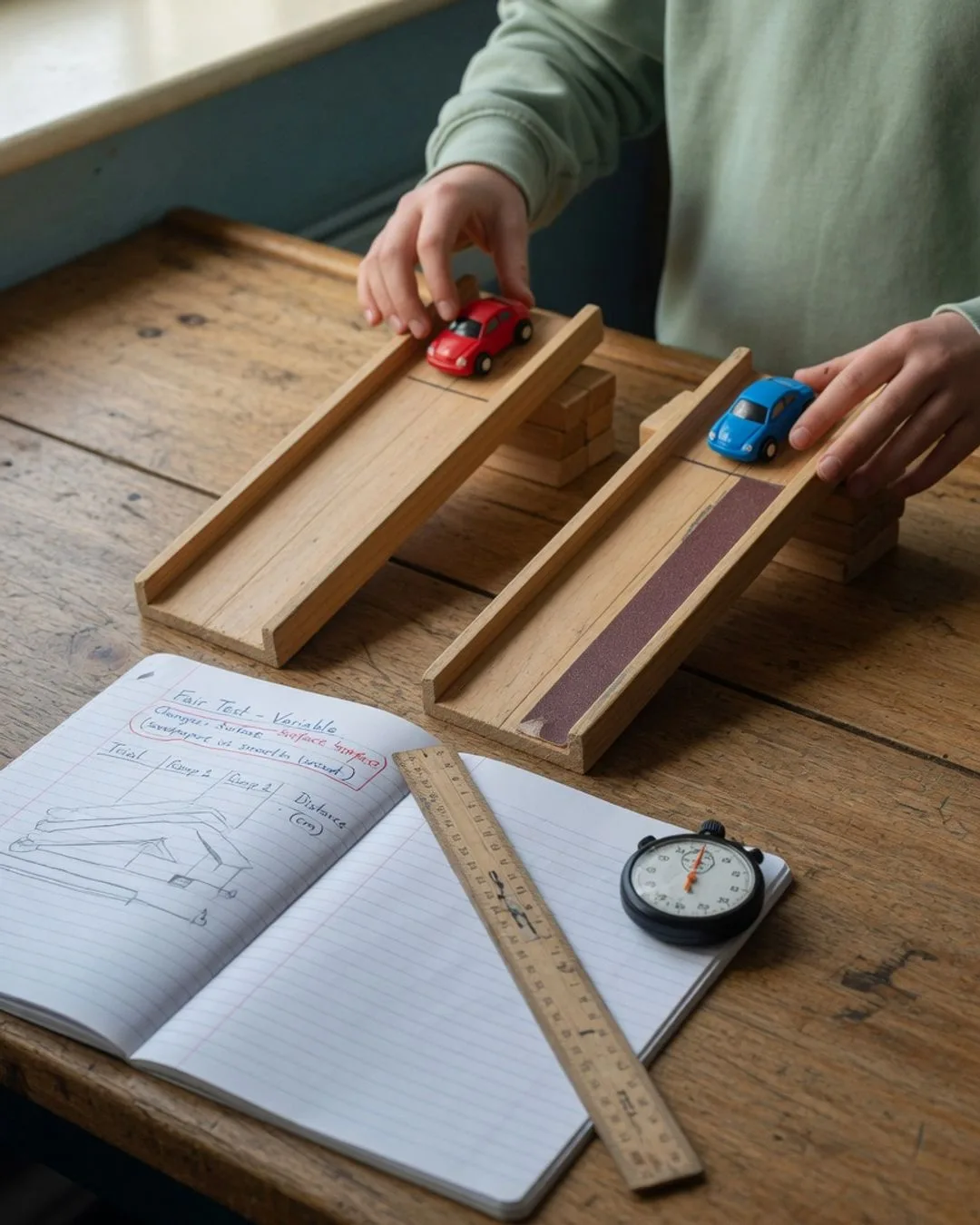
- That measurement is hard. Reading a ruler to the right place, deciding where a toy car really stopped at the bottom of a ramp, watching two timings of the same melting ice cube disagree — these teach a care about data that no worked example ever will.
- That the real world doesn't read the plan. The seedling grows crooked. One trial comes out strange. The pendulum swing isn't quite steady. Learning to reason about why a real result departs from what you expected is the heart of thinking like a scientist.
- That technique is knowledge. How you set up, how you hold the stopwatch, how long you wait, how carefully you keep everything else the same — the answer depends on the doing, and the doing can only be learned by doing.
The two-day rhythm
Practically, this idea becomes a schedule. The course runs on a two-day rhythm. The first is a Concept Day: a single skill is introduced and modeled — how to write a testable question, how to set up a clean data table, how to read a graduated cylinder of water at eye level. The next is a Practice Day, where you do that same skill yourself, with your own hands, and record it in your own lab notebook. Between the two days you work at home, and that gap is not dead time. It is where the idea and the doing knit together into something that lasts.
We are not against content; the sciences you study later are wonderful, and this course is the on-ramp to all of them. We are against rushing to the facts before you own the tools, because we have watched what that produces: a student who can recite a definition and has never once designed a fair test or defended a conclusion from their own data. Put the craft first, and science stops being a list of things to memorize. It becomes something you know how to do, which is the only kind of science anyone carries with them.