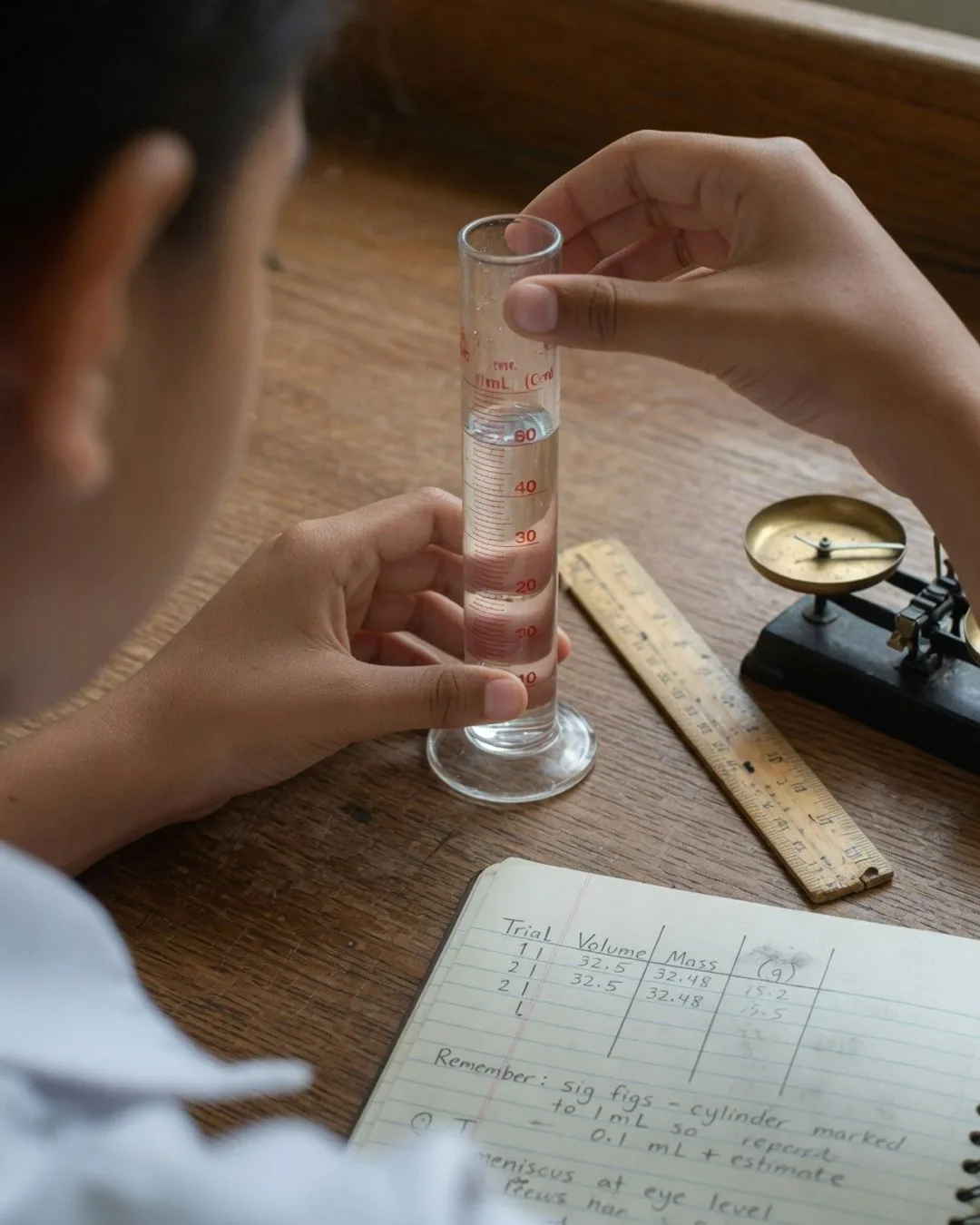
Once students have practiced the earlier skills — observing closely, keeping a clean lab notebook, measuring honestly, and telling a controlled variable from the one you are testing — the course arrives at the moment everything else builds toward: the experiment-design defense. A student brings a testable question of their own, a plan they wrote, the equipment from our simple toolkit, and their data. They run the experiment. Then a guide begins to ask: Why that design? What did you keep the same, and what did you change? How do you know your result isn’t just luck — and what does the data actually let you conclude?
It is, quite deliberately, an oral exam conducted over a live experiment. And it is the clearest single picture of what this whole course is for.
Why a defense, and not a worksheet
A worksheet hands the student a finished experiment and a table of numbers and asks them to fill in the blank. That is a copying task, and copying is the thinnest slice of what science actually demands. The defense asks something harder and truer: pick a real question — does raising the ramp make the toy car roll farther? — and figure out how to answer it fairly. Decide what to change (the ramp height), what to measure (how far the car travels), and what to hold steady (the same car, the same floor, the same gentle release with no push). Run enough trials that one odd result can’t fool you. Then reason out loud about whether your numbers mean anything. You cannot fake that. Either you understand why you held the floor and the car constant, or you stand there and you don’t.
Use AI to help you plan and rehearse. You still have to run the experiment yourself, look at your own data, and explain what it means in your own words.
What the guide is actually listening for
The defense isn't a recitation. A guide is listening for three things, and the rubric makes them explicit:
- A fair test. Did the student change one thing at a time and hold everything else steady — or did they raise the ramp and switch cars, so the result can’t say which change mattered?
- Design reasoning. Can the student explain why the plan is fair — why the controlled variables had to stay fixed, and why enough trials were run to trust the pattern instead of a single lucky roll?
- The conclusion, defended. Not just what happened, but why the data supports it: the measurements, the average across trials, the spread between them, and an honest statement of how sure the result really is.
That third one is where mastery and memorizing separate. A memorized answer has no give in it; the moment the guide asks “what if you’d only run the car once?” it collapses. Real understanding flexes. It can answer the question it wasn’t expecting, because it knows what a fair test is actually for.
Why this is the assessment that survives the next decade
There is a practical reason the experiment-design defense sits at the center of the course, and it has to do with the world students are walking into. A take-home write-up can be generated. A multiple-choice exam can be gamed. But no tool can design a student’s experiment for them, watch their toy car roll, and reason about the data in front of them in real time. The defense is built around the student’s own work, not because we banned anything, but because a skill you can actually perform is very hard to outsource.
Years from now, most students will not remember the exact distance their car rolled. They will remember standing over their own experiment, watching it run, and explaining to a person who kept asking why. That memory (the feeling of actually knowing something well enough to defend it) is the thing we are really teaching.