Why the craft of science comes first.
Six short essays for parents and guides of grades 7-8 students. This pack teaches how to do science (observe, question, measure, design a fair test, and defend what the data show) before any facts course. The first two explain the core of the method; the next three answer the questions families actually ask; the sixth answers how a course like this approaches learning in the age of AI.
The method
Why lab skills come before facts.
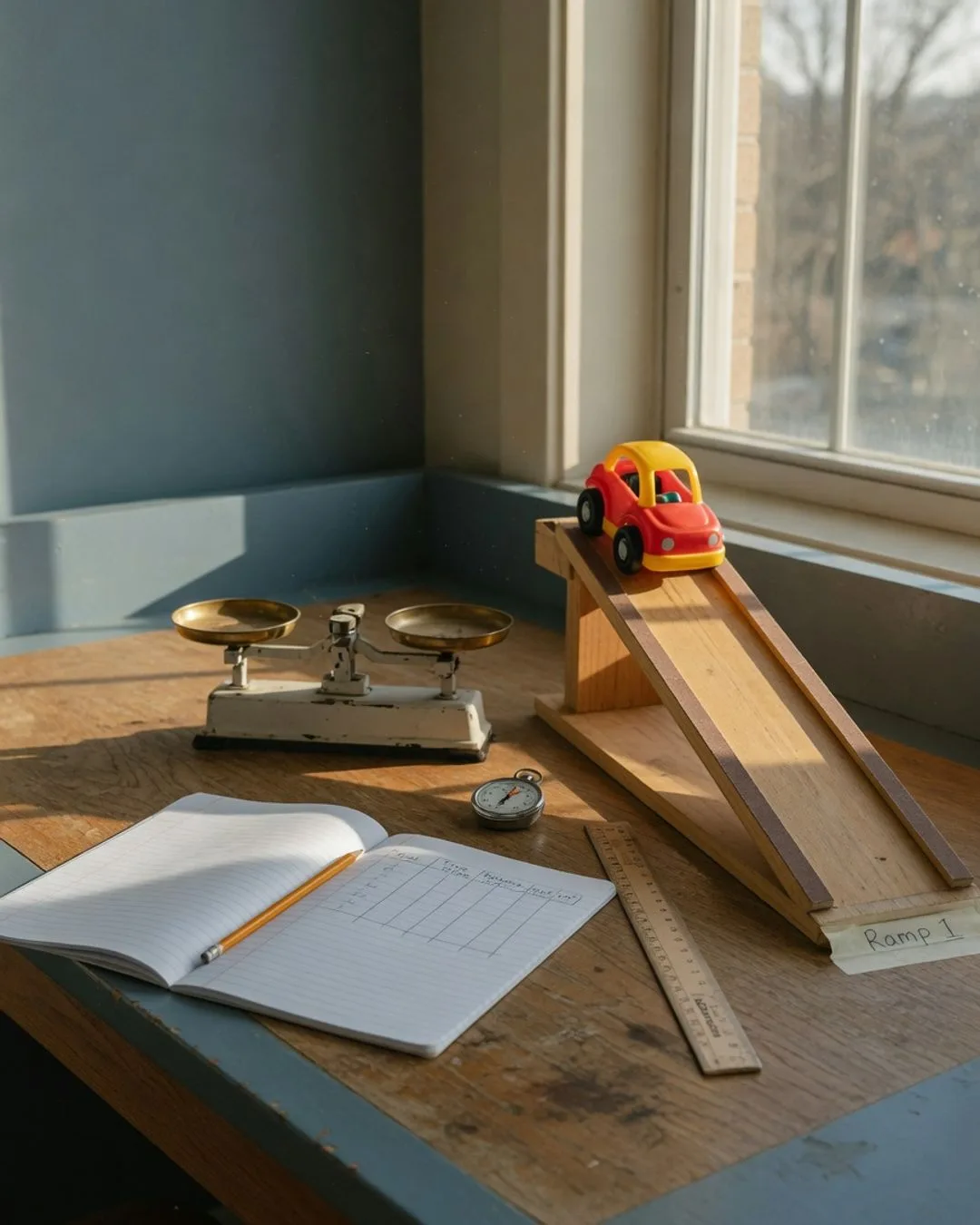
The habits of a scientist are invisible in a textbook. What a ruler, a stopwatch, and a seedling on a windowsill teach that no reading can, and why we teach students to do science before we ask them to learn any subject's facts.
Cram, pass, forget: why skills stick.
Facts crammed for a test evaporate by the next week. A skill mastered by doing — reading a graph, running a fair test — stays. Why "Learn → Master → Retain" replaces the test-and-move-on model.
The demonstrations
The experiment-design defense.
The single moment that captures the whole course: a student who designed and ran a controlled experiment of their own — and a guide asking "defend your variables, your method, and your conclusion."
Measurement under uncertainty.
Significant figures, precision versus accuracy, reading a scale honestly, error that adds up, and why a number reported without its doubt is not yet an honest answer.
Integration & AI
Semmelweis and the data.
Vienna, 1847: dated clinic records showed mortality falling after Semmelweis introduced handwashing; the often-cited 18% and 2% figures describe particular months, not permanent rates. The story asks students to weigh what the records supported, name what remained uncertain, and revise an inference when better evidence warrants it.
AI-proof by design.
We teach students to use AI thoughtfully while assessing the skills they must demonstrate themselves. This essay explains how the two approaches support each other.