Unit 01 · Observation & Asking Questions
Begin with a record you can inspect and a question that names what evidence could answer it. This unit compares observation, historical inference and controlled testing, then asks how a convenient sample can misrepresent a whole garden. A hypothesis needs a discriminating prediction, not a ritual sentence or a guarantee of proof.
Student learning: Observation & Asking Questions
Choose the level by readiness, not age alone, and record it before instruction. Foundation, core, and honors tasks are study pathways, not an AP course or a promise of college credit. The instructor retains practical assessment and the published science rubric; integration is reported separately.
Prerequisites: Count and add whole numbers, divide for a mean, and distinguish a description from a proposed explanation; use counters or a read-aloud table if needed.
Suggested sequence: read and discuss the explanation; attempt the worked model; analyze the data at your selected level; check the answers; then complete the source-linked response and a fresh transfer question. These activities supplement, not replace, supervised practical work and the full-year schedule.
Assigned reading and focus
- UC Museum of Paleontology, Understanding Science: How science works. Science-process reference. Read the opening comparison of the linear recipe with the real, revisable process of science. Identify why an observational or historical question need not become a controlled experiment. Our practice values are synthetic, not measurements taken from this source.
- OpenStax Introductory Statistics 2e, 1.2: Data, Sampling, and Variation in Data and Sampling. Sampling reference. Read Sampling, simple random samples, stratified samples and convenience sampling. Distinguish an accessible subset from the population the question names. Our practice values are synthetic, not measurements taken from this source.
- UC Museum of Paleontology, Understanding Science: Testing scientific ideas. Retrospective historical explanation and model-testing reference, not an original hospital record. Read Testing in the tropics: compare the two atoll explanations, their different predicted rock records and the reported drilling evidence. This is historical inference from traces, not an assigned drilling activity. Our practice values are synthetic, not measurements taken from this source.
- UC Museum of Paleontology, Understanding Science: Testing scientific ideas. Retrospective historical explanation and model-testing reference, not an original hospital record. In Testing ideas about childbed fever, identify the question, competing explanations and expected observations. Do not invent the exact words Semmelweis asked. Our practice values are synthetic, not measurements taken from this source.
Learn the science
Choose a pathway before instruction. Foundation typically supports grades 7-8 with guided tables and arithmetic; Core adds independent analysis; Extension adds explicit assumptions, models and critique. Readiness, accessibility and prerequisites govern placement. A scaffolded practice response is not automatic Mastery on every criterion.
A question chooses both what counts as evidence and the population the answer concerns. Counting flowers in equal-area quadrats is observational science: nothing is assigned to grow near a path. More flowers near a path is an observation about these records; watering caused the difference is an inference requiring more evidence. Historical inference also tests expectations: the assigned atoll account compares predicted rock layers with surviving traces without rerunning the past. A controlled experiment is useful when a change can be assigned safely, but it is not the only way to test an idea.
Assumptions: The garden-frame is a complete invented census of twelve equal-area quadrats at one instant. Count open flowers once per quadrat using the same definition. The illustrative garden-draw represents a draw without replacement from all twelve IDs, fixed before inspecting counts; it is not evidence that this particular sample must match the census.
Uncertainty: Repeatedly inspecting path quadrats reduces counting mistakes there but cannot repair omission of the interior. Random sampling addresses selection from a population; random assignment distributes treatments among experimental units. Neither makes a small sample representative by guarantee. Weather, watering, plant type and observer rules remain possible explanations for a location association.

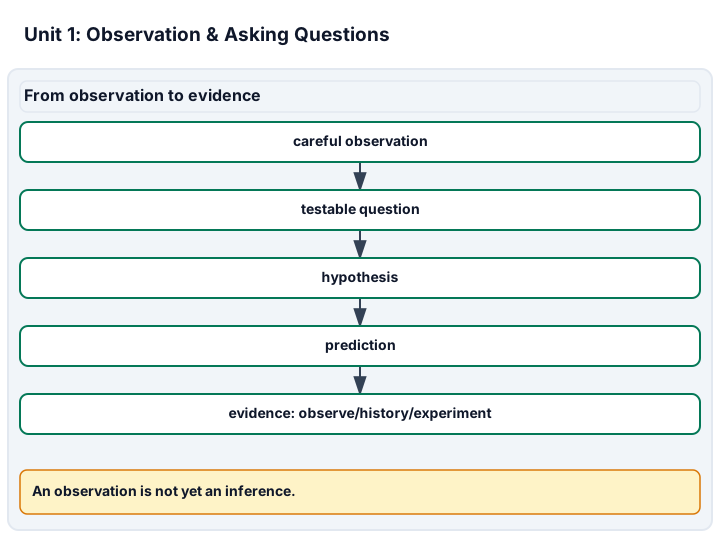
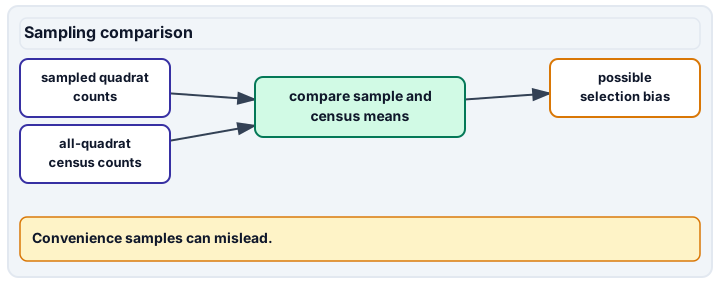
Diagram description
The first panel moves from careful observation to question, hypothesis, prediction and one of three evidence routes: observe, history or experiment. The second panel compares a sample mean with a census mean to identify possible selection bias.
Data, provenance, and assumptions
| Quadrat ID | Location | Open flowers (count) |
|---|---|---|
| P1 | path | 12 |
| P2 | path | 14 |
| P3 | path | 10 |
| P4 | path | 12 |
| I1 | interior | 3 |
| I2 | interior | 5 |
| I3 | interior | 4 |
| I4 | interior | 2 |
| I5 | interior | 6 |
| I6 | interior | 4 |
| I7 | interior | 3 |
| I8 | interior | 5 |
| Selected quadrat | Draw position |
|---|---|
| P2 | 1 |
| I2 | 2 |
| I4 | 3 |
| I8 | 4 |
| Location | Quadrats (count) | Mean flowers per quadrat |
|---|---|---|
| path | 4 | 9 |
| interior | 8 | 6 |
Investigation design: Who did the sample leave out?
Scope and safety: These are supplied-data and paper investigations, not laboratory procedures. An educator must approve any actual practice, materials, location, supervision, accessibility and emergency plan beforehand. Do not grow or open unknown cultures, handle unknown spills, use hazardous apparatus, test hygiene on people, or collect personal health disclosures. Paper work does not certify unobserved practical skill. Public worked answers are nonsecure practice, not private assessor items.
Materials and preparation
- Use the supplied garden-frame, garden-draw, garden-transfer records, assigned source sections, calculator and an accessible graph or diagram. No physical apparatus is required.
Procedure and schedule
- Question: How does the sampling frame change the claim we can make about open-flower counts in this fictional garden? Prerequisites: Count and add whole numbers, divide for a mean, and distinguish a description from a proposed explanation; use counters or a read-aloud table if needed.
- Variables: Record quadrat ID, location, common area and open-flower count. Location is observed, not manipulated; watering and plant type are unmeasured. Controls: Use equal quadrat area, the same open-flower definition and observation time. An observational comparison cannot hold every natural condition fixed.
- Sampling and replication: The spatial units are twelve quadrats; adjacent quadrats may be correlated. Recounting a quadrat is a counting check, not a new independently located quadrat.
- Analysis: Compare census, convenience and random-sample means; propose a documented sample before seeing results and distinguish selection uncertainty from a causal explanation. Review: An educator reviews prerequisites, source interpretation, reasoning and accessibility before assessment. A paper response does not certify unobserved practical technique; approved hands-on work requires a separate record.
Record: Retain the synthetic label, frame, draw order, counting definition, arithmetic, source section/date, first explanation, revision and transfer. An educator signs only evidence actually reviewed.
Worked model
The path count is 12 + 14 + 10 + 12 = 48, so its mean is 48/4 = 12 flowers per quadrat. The interior contributes 32; the full-garden mean is (48 + 32)/12 = 6.6667, reported as about 6.7 flowers per quadrat. The supplied random sample has (14 + 5 + 2 + 5)/4 = 6.5. It happens to be close; that is not a theorem about random samples. The question "are there more open flowers per equal-area quadrat near the path at this time?" is answerable from these records. The claim "the path caused flowering" is not.
Numerical calibration
- 6.666666666666667 flowers per quadrat in the full synthetic census
- 12 flowers per path quadrat
- 6.5 flowers per sampled quadrat
- 7 flowers per quadrat in the fresh garden
Attempt the assigned level
Try the tasks before reading the calibration. These are practice answers, not a secure examination; use a new dataset or changed assumption for the assessed transfer.
Foundation: typically grades 7-8
- Separate these statements into observation and inference: P2 has 14 open flowers; path plants are healthier; path quadrats average more flowers today. Calculate the path mean and write a question specifying population, measure and time.
Check after your attempt
- P2 = 14 is a supplied quantitative observation. "Healthier" is an unsupported interpretation without a health measure. A larger path mean is a summary of observations, not a cause. The path mean is 12 flowers per quadrat. Ask whether open-flower counts differ between the path and interior quadrats in this garden at the same observation time.
Core
- Use the census to compare the path-only estimate with the full-garden mean. Compute the garden-draw mean. Design a repeatable random-sampling plan using all twelve IDs, not whichever quadrats are easiest to reach. Name one possible confounder and a result that would weaken a proposed watering explanation.
Check after your attempt
- The convenient estimate 12 exceeds the census mean about 6.7; the four-ID draw gives 6.5. Number every quadrat, draw distinct IDs by a documented chance process before viewing counts, and use the same counting rule/time. Watering and plant type could vary with location. If equally watered, comparable plants still differed, a simple watering-only explanation would need revision; a recorded association alone is not an assigned watering test.
Extension: choose by prerequisites, not age alone
- Compare random sampling with random assignment. Explain how a stratified sample could include both locations without giving the four path quadrats half the population weight. From Testing in the tropics, state a prediction that discriminates two historical explanations and explain why the reported rock record supports rather than proves one uniquely.
Check after your attempt
- Sampling chooses units from the target population; assignment chooses their treatments. Sample within each location and weight means by 4/12 and 8/12, or take a proportional sample, rather than average two location means equally. In the source, a thick coral sequence above volcanic rock better fits the subsiding-island explanation than the thin-cover alternative. Dating, geology and other lines of evidence still matter; no past island was experimentally assigned to subside.
History, reading, and writing connection
Read Testing ideas about childbed fever in the assigned Understanding Science page. Write an observation, a proposed explanation and an expectation that could distinguish explanations. Cite the retrospective account, not an invented quotation. Compare its historical intervention with the garden observation and the atoll inference; the clinics were not randomized identical groups. Explain what each kind of evidence can and cannot establish.
Write in your own words or use an approved accessible equivalent. Cite a specific assigned section or figure, identify its evidence, and state one limitation or counterargument. Use the AI practice contract only for permitted coaching, never to invent observations or write the assessed response.
Transfer to a new case
A new garden has the garden-transfer census summary. A visitor samples only the path and announces nine flowers per quadrat everywhere. Calculate the weighted whole-garden mean, explain the sampling error and state whether repeating that same path survey tomorrow resolves it.
Calibration: The census mean is (4 x 9 + 8 x 6)/(4 + 8) = 7 flowers per quadrat, not 9 or the equally weighted 7.5. Path-only sampling omits two-thirds of the target quadrats. Repeating only the path tomorrow changes the time and still omits the interior; redesign coverage before interpreting differences.
Evidence to retain
Keep the observation/inference labels, population definition, selected IDs, means with denominators, sampling redesign and counterevidence. These support the five named observation/question criteria as supplied-record reasoning; original field observation remains a separately observed task. Save a source-linked historical response and fresh transfer beside, not inside, the separate integration rating.
Record units, calculations, source/date, uncertainty, and what is measured versus inferred. A simulation or supplied dataset must stay labeled as such. These are supplied-data and paper investigations, not laboratory procedures. An educator must approve any actual practice, materials, location, supervision, accessibility and emergency plan beforehand. Do not grow or open unknown cultures, handle unknown spills, use hazardous apparatus, test hygiene on people, or collect personal health disclosures. Paper work does not certify unobserved practical skill. Public worked answers are nonsecure practice, not private assessor items.
Return to all eight learning pathways. Print this unit page for the student lessons; the linked five-page packet remains the separate assessment companion.
Match evidence to the actual criterion
Integration is reported separately and cannot lower the science grade or block a science demonstration pass. Science and practical criteria determine that pass.
Use the supplied records for observation, questioning and inference practice. For an actual observation task, the educator watches the learner use an approved object, image or accessible equivalent. A claim can be tested by observational or historical evidence as well as by an approved controlled experiment; a paper calculation does not establish field technique.
- Science 1: Careful observation (qualitative & quantitative). Retain the labeled supplied counts and location descriptions; do not relabel them as personal field observations.
- Science 2: Asking testable questions. State the target population, common time and countable flower question.
- Science 3: Forming a hypothesis. Write a discriminating prediction and counterevidence for the watering or historical model.
- Science 4: Identifying variables. Distinguish recorded location and flower count from an assigned treatment and potential confounders.
- Science 5: Observation vs. inference. Separate observed counts, computed summaries and causal interpretations in the notebook.
Source, data, task and review inventory. Retain the selected level, first attempt, source/date, assumptions, correction and a fresh transfer. Do not reuse public answers as secure assessor items.
Unit mastery rubric
| Criterion | Developing | Proficient | Mastery |
|---|---|---|---|
| Careful observation (qualitative & quantitative) | Writes vague notes (“it changed”) or records conclusions instead of what was seen. | Describes what happened but mixes in guesses, or skips the numbers a ruler or stopwatch would give. | Records precise, separated observations — “the left seedling is 4 cm taller and leaning toward the window” — with no conclusions mixed in. |
| Asking testable questions | Asks questions that can’t be investigated (“which plant is prettier?”) or asks none at all. | Asks an investigable question but leaves population, measurement or timing unclear. | States an investigable question with a defined population and measure; selects observational, historical or experimental evidence appropriate to it. |
| Forming a hypothesis | Offers a vague guess or a restatement of the question, with nothing that could be proven wrong. | Proposes an explanation but leaves its prediction or possible counterevidence unclear. | States a proposed explanation, a discriminating prediction and evidence that could weaken it; an if/then format is optional. |
| Identifying variables | Cannot say what is being changed or what is being measured. | Names one variable but confuses what is changed with what is measured, or misses what to hold steady. | Names measured variables, possible assigned changes and relevant confounders; does not mislabel an observed association as an intervention. |
| Observation vs. inference | Reports opinions or interpretations as if they were facts (“the car likes the smooth floor”). | Usually tells them apart but slips an interpretation into the observation list. | Separates observed records, computed summaries and interpretations; identifies selection limits before making a broader or causal claim. |
| Integration (cross-domain) | Makes no supported connection between the source and the science. | Uses the source but needs help connecting evidence, writing, or limitations to the science. | Independently connects History, Reading, and Writing using a cited source, appropriate evidence, a limitation, and a scientific explanation. |
Integration is reported separately and cannot lower the science grade or block a science demonstration pass. Science and practical criteria determine that pass. Use the integration guide's evidence checklist for the separately reported criterion.
The supplied path quadrats average 12 flowers, but the whole garden averages about 6.7. Watering could explain a difference, but it was not assigned or measured here. I would sample the full frame and specify what evidence could challenge that explanation.
I counted the easiest places and assumed the path made the plants healthier. More counts from the same path must settle it.
Use the supplied records for observation, questioning and inference practice. For an actual observation task, the educator watches the learner use an approved object, image or accessible equivalent. A claim can be tested by observational or historical evidence as well as by an approved controlled experiment; a paper calculation does not establish field technique.
A 5-page clipboard packet — unit overview, key terms, the mastery rubric, anchor examples, and a score sheet you can print and grade against.