Unit 02 · The Lab Notebook
The notebook preserves what was observed, what was later calculated and what changed after review. Audit a supplied transcription without inventing missing data, then version the analysis when a source is recovered. A readable gap is more honest than an undocumented reconstruction.
Student learning: The Lab Notebook
Choose the level by readiness, not age alone, and record it before instruction. Foundation, core, and honors tasks are study pathways, not an AP course or a promise of college credit. The instructor retains practical assessment and the published science rubric; integration is reported separately.
Prerequisites: Read decimal lengths and times, compute a mean, and explain the difference between an observation and a remembered reconstruction.
Suggested sequence: read and discuss the explanation; attempt the worked model; analyze the data at your selected level; check the answers; then complete the source-linked response and a fresh transfer question. These activities supplement, not replace, supervised practical work and the full-year schedule.
Assigned reading and focus
- Columbia University / ORI, Data Acquisition and Management: Foundation Text. Research-record reference. Read III.B, The practice of keeping research notebooks, paper vs. electronic: recording dates, retained raw data, identified amendments and review. These research practices guide the audit, not permission to collect private records. Our practice values are synthetic, not measurements taken from this source.
- UC Museum of Paleontology, Understanding Science: Testing scientific ideas. Retrospective historical explanation and model-testing reference, not an original hospital record. In Testing ideas about childbed fever, list the dated observations and outcome definitions a researcher would need to audit the described comparison. The short account does not supply an original hospital notebook. Our practice values are synthetic, not measurements taken from this source.
Learn the science
Choose a pathway before instruction. Foundation typically supports grades 7-8 with guided tables and arithmetic; Core adds independent analysis; Extension adds explicit assumptions, models and critique. Readiness, accessibility and prerequisites govern placement. A scaffolded practice response is not automatic Mastery on every criterion.
A notebook is an audit trail, not the neatest possible answer. A supplied source reading and a copied value are different records. Corrections must keep the earlier entry legible, identify the source, explain the change and date the amendment. Missing is not zero, and a remembered plausible value cannot quietly become a measurement. Derived calculations belong beside the source, with their own labels. Digital version history or an accessible annotated record can preserve the same reasoning.
Assumptions: The notebook-ledger is an invented transcription exercise from four numbered ruler cards, not the learner measuring strips. All lengths use centimeters and the same marked endpoints. Card N3 is absent at the first review; the copied 12.5 there was explicitly reconstructed from memory and is unverified.
Uncertainty: The cards are readable to 0.1 cm, but that does not establish true length accuracy. Excluding an unverified value from the verified-only mean must be disclosed; three available cards may not represent the missing one. Reconstructing a supplied record is not evidence of real-time recording during an actual practical.

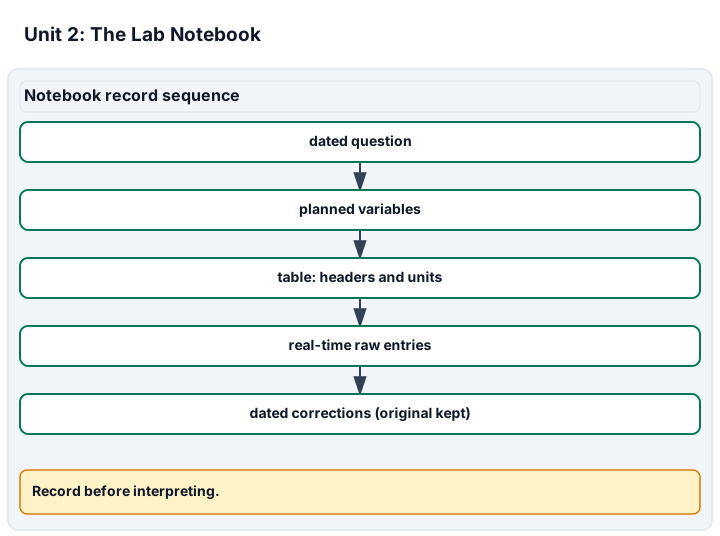
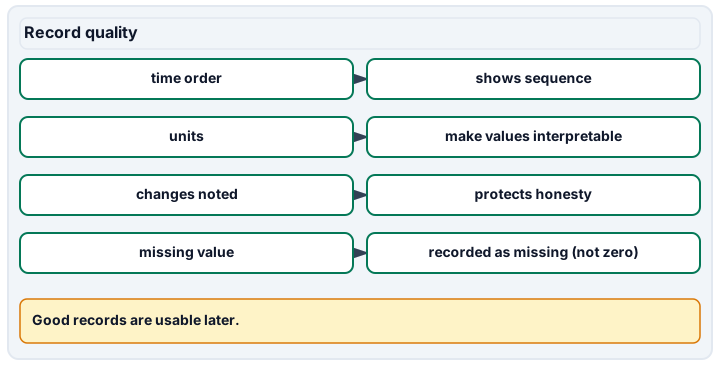
Diagram description
The sequence begins with a dated question, planned variables and a table with headers and units before raw entries, then dated corrections that keep the original. The grid explains time order, units, changes noted and missing-value handling.
Data, provenance, and assumptions
| Card ID | Collection time | Source length (cm) | Copied length (cm) | Audit note |
|---|---|---|---|---|
| N1 | 09:00 | 12.4 | 12.4 | source present |
| N2 | 09:02 | 12.6 | 126 | source present; transcription differs |
| N3 | 09:04 | missing | 12.5 | copy from memory; unverified |
| N4 | 09:06 | 12.5 | 12.5 | source present |
| Quantity | Value | Unit / meaning |
|---|---|---|
| recoveredReading | 13.3 | cm; original card recovered at 10:00 |
Investigation design: Repair a record without inventing a measurement
Scope and safety: These are supplied-data and paper investigations, not laboratory procedures. An educator must approve any actual practice, materials, location, supervision, accessibility and emergency plan beforehand. Do not grow or open unknown cultures, handle unknown spills, use hazardous apparatus, test hygiene on people, or collect personal health disclosures. Paper work does not certify unobserved practical skill. Public worked answers are nonsecure practice, not private assessor items.
Materials and preparation
- Use the supplied notebook-ledger, notebook-transfer records, assigned source sections, calculator and an accessible graph or diagram. No physical apparatus is required.
Procedure and schedule
- Question: Which claims can a second reader reconstruct from an incomplete notebook, and which corrections are justified by a source? Prerequisites: Read decimal lengths and times, compute a mean, and explain the difference between an observation and a remembered reconstruction.
- Variables: Track source length, copied length, source availability and version of the calculation. No experimental treatment is assigned in this document audit. Controls: Keep card IDs, centimeters and chronology stable across versions. Never rewrite source values to make a calculated mean look consistent.
- Sampling and replication: Four cards concern four fictional strips, with only three verifiable initially. Recopying the same card creates no new measurement or independent replicate.
- Analysis: Audit every row before calculating. Justify inclusion by source availability, compute the verified-only mean, then revise it when the missing source arrives. Review: An educator reviews prerequisites, source interpretation, reasoning and accessibility before assessment. A paper response does not certify unobserved practical technique; approved hands-on work requires a separate record.
Record: Retain all supplied cards, review date, collection times, visible N2 correction, N3 gap and recovery, calculation versions and reviewer questions; label the work as an audit of synthetic records.
Worked model
Start an audit entry with a title, today's review date and the separate supplied collection times. N2 changes from 126 to 12.6 cm: retain 126 visibly, link card N2, and date the correction. The difference is 126 - 12.6 = 113.4 cm, a transcription error, not instrument scatter. Keep N3 and its copied 12.5 in the record as unverified; omit it only from the explicitly verified-only calculation. Version 1 uses (12.4 + 12.6 + 12.5)/3 = 12.5 cm with three verified cards and one missing source.
Numerical calibration
- 12.5 cm; version 1, three verified cards
- 113.4 cm; copy minus supported source, not measurement uncertainty
- 12.7 cm; version 2 after source recovery
Attempt the assigned level
Try the tasks before reading the calibration. These are practice answers, not a secure examination; use a new dataset or changed assumption for the assessed transfer.
Foundation: typically grades 7-8
- Make a dated table with card ID, collection time, source length, copied value, unit and amendment. Mark which N2 value is supported, keep the old entry visible, and explain why N3 cannot be filled with zero or an invented replacement.
Check after your attempt
- The source supports N2 = 12.6 cm, not 126 cm. Use a legible strike-through or retained electronic version plus "transcription corrected from card N2", review date and author. N3 stays "source missing; copy unverified". A missing observation is not zero length and the tidy-looking copied value does not authenticate itself.
Core
- Compute and label the verified-only mean. Give the numerator, denominator and the reason N3 is not included. Draft a handoff another reader can audit, distinguishing collection time from review time and source measurements from your calculations.
Check after your attempt
- The three verified cards total 37.5 cm; 37.5/3 = 12.5 cm. N3 was excluded from this calculation because its source was unavailable, not because it spoiled the mean. The handoff lists all four IDs, times, units, supplied card source, N2 amendment, missing N3 and version-1 calculation. It does not claim the reviewer witnessed collection.
Extension: choose by prerequisites, not age alone
- Explain why a complete-looking copied table can be less reliable than one that shows a gap. Propose a versioned recovery and review policy and one setup detail the ledger does not establish that an actual repeat measurement would require.
Check after your attempt
- A filled cell can conceal memory reconstruction; a visible gap advertises an unresolved evidence problem. Preserve both versions, record recovery time/source and recalculate transparently rather than overwrite the first conclusion. Ruler zero alignment, calibration and precise endpoint definition would be needed for an actual repeat; the ledger alone cannot certify these or reproduce an identical measured result.
History, reading, and writing connection
Use the childbed-fever account to explain why a dated record, denominator and outcome definition matter. Write what the source actually describes and which raw records it does not provide. Compare that limit with missing N3 in the synthetic notebook exercise. Cite the source section and distinguish a retrospective interpretation from a contemporaneous observation; do not manufacture a historical notebook entry.
Write in your own words or use an approved accessible equivalent. Cite a specific assigned section or figure, identify its evidence, and state one limitation or counterargument. Use the AI practice contract only for permitted coaching, never to invent observations or write the assessed response.
Transfer to a new case
At 10:00 the actual fictional card N3 is recovered with 13.3 cm, as supplied in notebook-transfer. Create version 2 of the mean and explain what must remain in the notebook even though the earlier copied 12.5 now looks convenient.
Calibration: Add 13.3 to the verified 37.5: 50.8/4 = 12.7 cm. Retain version 1 (12.5 cm for three verified cards), the missing-source note and the copied 12.5 marked unverified. Log the recovered card and 10:00 review; do not pretend N3 had been verified at the original collection time.
Evidence to retain
Keep the source/copy table, visible amendment, missing-data decision, versioned mean and a reproducibility handoff. These address setup, tables, honesty and reproducibility, not criterion 2 Recording in real time. That criterion needs an educator to observe an approved activity and the contemporaneous entry. Required student-authored source writing and its integration rating stay separate.
Record units, calculations, source/date, uncertainty, and what is measured versus inferred. A simulation or supplied dataset must stay labeled as such. These are supplied-data and paper investigations, not laboratory procedures. An educator must approve any actual practice, materials, location, supervision, accessibility and emergency plan beforehand. Do not grow or open unknown cultures, handle unknown spills, use hazardous apparatus, test hygiene on people, or collect personal health disclosures. Paper work does not certify unobserved practical skill. Public worked answers are nonsecure practice, not private assessor items.
Return to all eight learning pathways. Print this unit page for the student lessons; the linked five-page packet remains the separate assessment companion.
Match evidence to the actual criterion
Integration is reported separately and cannot lower the science grade or block a science demonstration pass. Science and practical criteria determine that pass.
The supplied audit supports record structure, tables, corrections and reproducibility reasoning. Recording in real time still requires a watched, educator-approved task; reviewing these fictional cards later is not contemporaneous collection. Paper and accessible electronic records must retain source, chronology and visible amendments.
- Science 1: Notebook setup & dating. Use a titled, dated audit entry with collection and amendment times kept distinct.
- Science 3: Data tables. Provide labeled source/copy/derived-value columns with centimeters and source IDs.
- Science 4: Honesty & corrections. Retain the wrong transcription, unavailable source and both justified calculation versions.
- Science 5: Reproducibility. Document what a reader can reconstruct and which measurement setup details remain unknown.
Source, data, task and review inventory. Retain the selected level, first attempt, source/date, assumptions, correction and a fresh transfer. Do not reuse public answers as secure assessor items.
Unit mastery rubric
| Criterion | Developing | Proficient | Mastery |
|---|---|---|---|
| Notebook setup & dating | Works on loose scraps or the backs of worksheets; entries have no date or title. | Uses the notebook but skips dates, leaves entries untitled, or starts new work mid-page with no break. | Titles and dates entries, distinguishing collection, review and amendment times so another reader can audit the sequence. |
| Recording in real time | Does the whole activity first, then reconstructs the numbers from memory afterward. | Writes some things down during the work but fills the gaps later from memory. | Records each measurement and observation as it happens — the guide sees the pencil move while the paper airplane is still in the air. |
| Data tables | Scatters numbers through prose or random spots on the page, with no units. | Makes a table but leaves off headers or units, or rules the columns unevenly. | Rules a clean table with labeled column headers and units before the data starts coming in. |
| Honesty & corrections | Erases or scribbles out mistakes so the original is gone; quietly drops results that look “wrong.” | Corrects errors but hides some, or ignores a surprising reading instead of noting it. | Keeps originals legible, dates source-backed corrections, flags missing or anomalous data and explains any analytic exclusion. |
| Reproducibility | The notebook makes sense only to the student, and only today. | Records most steps but leaves out an amount, a timing, or a setup detail a stranger would need. | Records sources, units, method and analysis versions so another reader can reconstruct the work; states missing details rather than inventing them. |
| Integration (cross-domain) | Makes no supported connection between the source and the science. | Uses the source but needs help connecting evidence, writing, or limitations to the science. | Independently connects History, Reading, and Writing using a cited source, appropriate evidence, a limitation, and a scientific explanation. |
Integration is reported separately and cannot lower the science grade or block a science demonstration pass. Science and practical criteria determine that pass. Use the integration guide's evidence checklist for the separately reported criterion.
N2 was copied as 126 cm; the supplied card says 12.6. I retain both with a dated correction. N3 is unverified, so version 1 uses three cards and gives 12.5 cm. A later recovered source changes version 2 to 12.7 cm; I keep the first version.
I erased the awkward value, filled the missing source from memory and called the neat table my original observations.
The supplied audit supports record structure, tables, corrections and reproducibility reasoning. Recording in real time still requires a watched, educator-approved task; reviewing these fictional cards later is not contemporaneous collection. Paper and accessible electronic records must retain source, chronology and visible amendments.
A 5-page clipboard packet — unit overview, key terms, the mastery rubric, anchor examples, and a score sheet you can print and grade against.