Unit 03 · Measurement, Units & Significant Figures
An instrument can repeat a biased answer. Use supplied balance checks to separate display resolution, repeated spread, reference agreement and a proposed calibration model. Conversions and significant figures must preserve meaning, not inflate precision.
Student learning: Measurement, Units & Significant Figures
Choose the level by readiness, not age alone, and record it before instruction. Foundation, core, and honors tasks are study pathways, not an AP course or a promise of college credit. The instructor retains practical assessment and the published science rubric; integration is reported separately.
Prerequisites: Add decimals, find a mean and range, convert g to mg; honors requires rearranging a line equation and discussing model assumptions.
Suggested sequence: read and discuss the explanation; attempt the worked model; analyze the data at your selected level; check the answers; then complete the source-linked response and a fresh transfer question. These activities supplement, not replace, supervised practical work and the full-year schedule.
Assigned reading and focus
- JCGM VIM, 4.14: Resolution. Metrology reference. Read definition 4.14 and its note: the smallest perceptible change is a property of the indication, not a guarantee of closeness to a reference. Our practice values are synthetic, not measurements taken from this source.
- JCGM International Vocabulary of Metrology (VIM), 2.13: Measurement accuracy. Metrology reference. Read definition 2.13 and Notes 1-3. Discuss accuracy as agreement, not a numerical score called "percent accuracy". Our practice values are synthetic, not measurements taken from this source.
- JCGM VIM, 2.39: Calibration. Metrology reference. Read definition 2.39 and Notes 1-3. Distinguish a reference-response relationship from physically adjusting a balance or verifying a requirement. Our practice values are synthetic, not measurements taken from this source.
- UC Museum of Paleontology, Understanding Science: Testing scientific ideas. Retrospective historical explanation and model-testing reference, not an original hospital record. In Testing ideas about childbed fever, distinguish the described percentage outcome from raw counts, and identify why comparison needs denominators and periods. Our practice values are synthetic, not measurements taken from this source.
Learn the science
Choose a pathway before instruction. Foundation typically supports grades 7-8 with guided tables and arithmetic; Core adds independent analysis; Extension adds explicit assumptions, models and critique. Readiness, accessibility and prerequisites govern placement. A scaffolded practice response is not automatic Mastery on every criterion.
Resolution tells you what changes an instrument can display. Precision describes closeness among repeated indications under stated conditions. Accuracy concerns closeness to the quantity being measured; a stable offset can make repeated numbers agree with each other while disagreeing with a reference. A calibration relates reference values and indications, with uncertainty. Averaging reduces some random variation but does not remove a persistent bias. Keep guard digits during calculations and round the reported measurement to a justified level.
Assumptions: All balance-checks are synthetic digital indications with a stated 0.1 g display step. The instructional reference values are 50.00 g and 100.00 g, each with an assumed uncertainty of 0.02 g for this exercise; they are not certified real masses. Repeats use the same object and conditions. A constant-offset correction is only a provisional local model.
Uncertainty: Resolution is not accuracy. The unknown indications span 0.2 g; that observed range is not the total uncertainty or a confidence interval. Reference uncertainty, zero drift, nonlinearity and loading method remain. Two reference points can define a line, but cannot validate it between or beyond the points; use additional approved checks before accepting a calibration model.

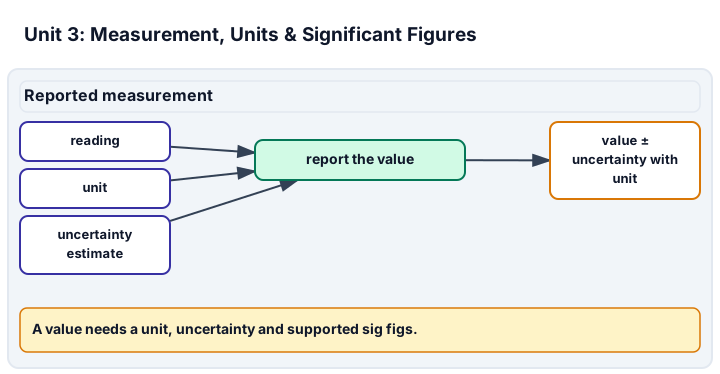
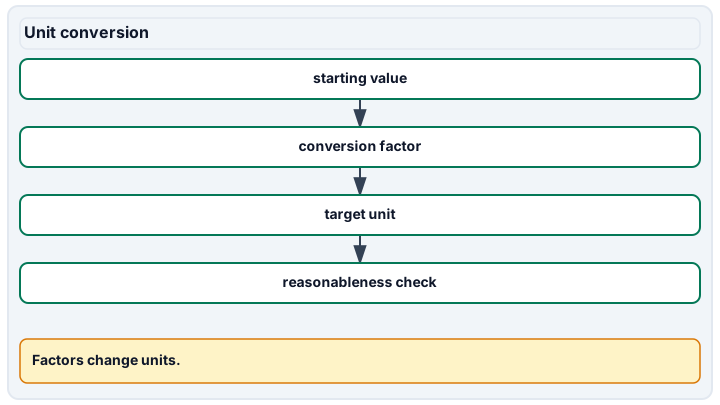
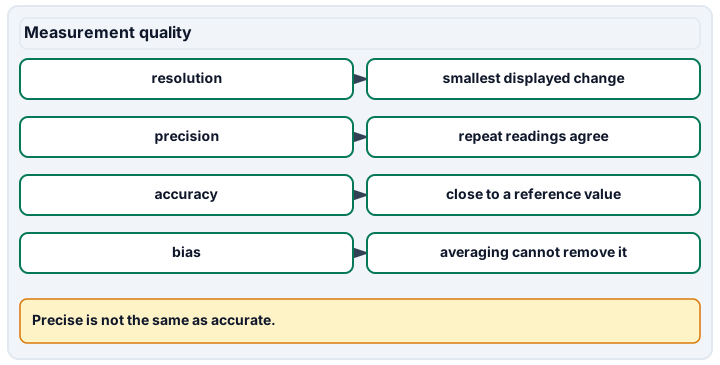
Diagram description
Reported measurement uses reading, unit and uncertainty estimate to produce a value with uncertainty, unit and significant figures. Unit conversion shows a value converted by a factor and checked. Measurement quality defines resolution, precision, accuracy and bias.
Data, provenance, and assumptions
| Object | Repeat | Indication (g) |
|---|---|---|
| reference-low | 1 | 50.4 |
| reference-low | 2 | 50.5 |
| reference-low | 3 | 50.6 |
| unknown | 1 | 72.8 |
| unknown | 2 | 72.9 |
| unknown | 3 | 73 |
| reference-high | 1 | 101 |
| reference-high | 2 | 101.2 |
| reference-high | 3 | 101.1 |
| Quantity | Value | Unit / meaning |
|---|---|---|
| referenceLow | 50 | g; stated 50.00 g, assumed uncertainty 0.02 g |
| referenceHigh | 100 | g; stated 100.00 g, assumed uncertainty 0.02 g |
| displayStep | 0.1 | g; digital resolution |
| nextCheck | 50.2 | g; next-day indication of the same 50.00 g reference |
Investigation design: Many digits do not make a balance accurate
Scope and safety: These are supplied-data and paper investigations, not laboratory procedures. An educator must approve any actual practice, materials, location, supervision, accessibility and emergency plan beforehand. Do not grow or open unknown cultures, handle unknown spills, use hazardous apparatus, test hygiene on people, or collect personal health disclosures. Paper work does not certify unobserved practical skill. Public worked answers are nonsecure practice, not private assessor items.
Materials and preparation
- Use the supplied balance-checks, balance-settings records, assigned source sections, calculator and an accessible graph or diagram. No physical apparatus is required.
Procedure and schedule
- Question: Which claims about an unknown mass survive checks of resolution, repeatability and calibration model? Prerequisites: Add decimals, find a mean and range, convert g to mg; honors requires rearranging a line equation and discussing model assumptions.
- Variables: Reference value and indicated mass are the paired variables; object identity, display step and check date remain explicit in the record. Controls: The supplied scenario holds instrument, object placement and conditions fixed within a repeat set. A changed date can reveal drift rather than a treatment effect.
- Sampling and replication: Three readings per object assess repeatability of that object, not three independent reference masses or three balances.
- Analysis: Calculate offsets and spread, compare a constant-offset model with a two-point line, and use the new dated check as counterevidence to stability. Review: An educator reviews prerequisites, source interpretation, reasoning and accessibility before assessment. A paper response does not certify unobserved practical technique; approved hands-on work requires a separate record.
Record: Retain source section/date, stated reference uncertainties, raw display digits, offsets, graph of indication against reference, assumptions and unrounded calculations alongside the rounded report.
Worked model
Low-reference mean = 50.5 g, so mean indication minus reference = +0.5 g. Unknown mean = 72.9 g; the provisional constant-offset result is 72.9 - 0.5 = 72.4 g, or 72,400 mg, not an exact mass. The high-reference mean 101.1 g has offset +1.1 g, inconsistent with assuming the same +0.5 g everywhere. A candidate two-point line has slope (101.1 - 50.5)/(100 - 50) = 1.012 indicated g per reference g. Inverting it gives 50 + (72.9 - 50.5)/1.012 = 72.1344 g, provisionally about 72.1 g. The disagreement is a reason to investigate the model, not select a prettier answer.
Numerical calibration
- 0.5 g; low-reference indication minus stated reference
- 72.4 g; conditional constant-offset model
- 72400 mg; same provisional mass, not extra precision
- 1.012 indicated g per reference g; candidate two-point line
- 72.13438735177866 g; unrounded provisional line result
- 0.3 g; old low-reference mean minus next-day indication
Attempt the assigned level
Try the tasks before reading the calibration. These are practice answers, not a secure examination; use a new dataset or changed assumption for the assessed transfer.
Foundation: typically grades 7-8
- Find the digital display step, means for the low reference and unknown, and the unknown reading range. Explain how repeated values could be close yet biased. Record 73 from the supplied table as a 73.0 g display reading.
Check after your attempt
- The step is 0.1 g. Means are 50.5 g and 72.9 g; unknown minimum and maximum are 72.8 and 73.0 g, a 0.2 g span. The reference mean exceeds the stated 50.00 g by 0.5 g despite close repeats. 73.0 preserves the stated display resolution; extra calculator zeros would not make it accurate.
Core
- Derive the low-reference offset correction and apply it provisionally to the unknown. Convert to milligrams. Then use the high-reference data to test the constant-offset assumption and state what additional evidence is needed.
Check after your attempt
- Subtract +0.5 g, giving 72.4 g = 72,400 mg under the local model. The high-reference offset is +1.1 g, so one offset does not explain both check points. Retain the raw readings and check zero, loading method, drift and additional reference values under educator supervision; the computed corrected number is not certified accuracy.
Extension: choose by prerequisites, not age alone
- Derive the response slope using both reference means and invert that candidate linear response for the unknown. Compare with the constant-offset answer. Explain why three repeats at each point do not validate the line or determine all uncertainty.
Check after your attempt
- The slope is 1.012 and the provisional inverted mass is 72.1344 g, reported about 72.1 g, versus 72.4 g from the offset model. The two points determine rather than test the line. Repeats estimate within-condition spread only; additional reference points, uncertainty information and independent checks are needed for model validation.
History, reading, and writing connection
Read the historical childbed-fever example and revisit the guide's preserved synthetic rate activity. Write why outcome definitions, denominators and dates matter as much as a displayed percentage. Contrast a historical rate with the current balance reference: neither extra decimal places nor a close cluster proves accuracy. Cite the section, distinguish the guide's invented counts from historical records and name an unresolved measurement or definition limit.
Write in your own words or use an approved accessible equivalent. Cite a specific assigned section or figure, identify its evidence, and state one limitation or counterargument. Use the AI practice contract only for permitted coaching, never to invent observations or write the assessed response.
Transfer to a new case
The fresh nextCheck in balance-settings reads 50.2 g for the same low reference. How far has the indication shifted from yesterday's mean? Should a learner silently keep the old correction on a new unknown reading?
Calibration: Yesterday was 50.5 g; the new indication is lower by 0.3 g. A single next-day reading does not establish a new stable calibration. Retain both dates, pause the old-correction claim and ask for repeated approved checks. Do not hide the drift by rounding or assert that another decimal place resolves it.
Evidence to retain
Retain raw indicated values, units, means, reference assumptions, the two candidate corrections, reported digits and the drift transfer. These support units, significant figures, precision versus accuracy and repeat-measurement analysis. Criterion 1 Reading instruments still requires a watched reading of an educator-approved instrument; a numerical table does not show eye position or handling.
Record units, calculations, source/date, uncertainty, and what is measured versus inferred. A simulation or supplied dataset must stay labeled as such. These are supplied-data and paper investigations, not laboratory procedures. An educator must approve any actual practice, materials, location, supervision, accessibility and emergency plan beforehand. Do not grow or open unknown cultures, handle unknown spills, use hazardous apparatus, test hygiene on people, or collect personal health disclosures. Paper work does not certify unobserved practical skill. Public worked answers are nonsecure practice, not private assessor items.
Return to all eight learning pathways. Print this unit page for the student lessons; the linked five-page packet remains the separate assessment companion.
Match evidence to the actual criterion
Integration is reported separately and cannot lower the science grade or block a science demonstration pass. Science and practical criteria determine that pass.
Use the supplied checks for numerical reasoning and retain units, assumptions and unrounded work. Reading instruments is assessed through an educator-observed reading of an approved instrument with appropriate positioning and calibration checks. A table cannot show handling skill, and a calculated correction is not a certified calibration.
- Science 2: Units & conversions. Retain grams and the exact unit conversion to milligrams without implying extra precision.
- Science 3: Significant figures. Distinguish guard digits from the supported final display and reported result.
- Science 4: Precision vs. accuracy. Use the reference disagreement to separate resolution, repeatability and accuracy.
- Science 5: Repeat measurement. Show repeated-reading means and ranges, identifying that the same object was reread.
Source, data, task and review inventory. Retain the selected level, first attempt, source/date, assumptions, correction and a fresh transfer. Do not reuse public answers as secure assessor items.
Unit mastery rubric
| Criterion | Developing | Proficient | Mastery |
|---|---|---|---|
| Reading instruments | Reads from an angle, guesses randomly between the marks, or doesn’t know where the scale starts. | Reads the right tool but looks from above the water line or rounds to the nearest big mark. | Reads an approved instrument with appropriate zero, scale and viewing position; records supported digits and units during observed practice. |
| Units & conversions | Writes bare numbers with no units; cannot move between centimeters and meters. | Records units most of the time but stumbles converting within the metric system. | Attaches the correct unit to every measurement and converts cleanly between metric units when asked. |
| Significant figures | Copies every digit the calculator shows, inventing precision the tool never had. | Senses that the extra digits are wrong but keeps or drops them inconsistently. | Keeps guard digits during calculation and reports supported final digits; distinguishes instrument resolution from total uncertainty. |
| Precision vs. accuracy | Uses “precise” and “accurate” as if they mean the same thing. | Can define both but cannot say which one a given set of results has. | Distinguishes resolution, precision and accuracy using repeat readings and reference checks; states calibration assumptions and limits. |
| Repeat measurement | Measures once and treats that single number as the answer. | Takes a few trials but reports only one, or averages them incorrectly. | Reports repeated-reading means and spread, identifies the object measured and explains which systematic errors averaging cannot remove. |
| Integration (cross-domain) | Makes no supported connection between the source and the science. | Uses the source but needs help connecting evidence, writing, or limitations to the science. | Independently connects History, Reading, and Writing using a cited source, appropriate evidence, a limitation, and a scientific explanation. |
Integration is reported separately and cannot lower the science grade or block a science demonstration pass. Science and practical criteria determine that pass. Use the integration guide's evidence checklist for the separately reported criterion.
The low reference averages 50.5 g for a stated 50.00 g. Subtracting 0.5 g gives a provisional 72.4 g for the unknown. The high-reference offset differs, so I cannot call that correction accurate across the range. Resolution and repeatability are not calibration.
The balance has a decimal display, so all its readings must be accurate. I copied every calculator digit and did not check a reference.
Use the supplied checks for numerical reasoning and retain units, assumptions and unrounded work. Reading instruments is assessed through an educator-observed reading of an approved instrument with appropriate positioning and calibration checks. A table cannot show handling skill, and a calculated correction is not a certified calibration.
A 5-page clipboard packet — unit overview, key terms, the mastery rubric, anchor examples, and a score sheet you can print and grade against.