Unit 04 · Designing a Controlled Experiment
A fair comparison specifies its treatment, response, allocation, observation rules and independent units. Reconstruct a random-allocation record, plan a masked reading and test whether a station could be confounded with treatment. Strong design improves inference without guaranteeing identical groups or certain causation.
Student learning: Designing a Controlled Experiment
Choose the level by readiness, not age alone, and record it before instruction. Foundation, core, and honors tasks are study pathways, not an AP course or a promise of college credit. The instructor retains practical assessment and the published science rubric; integration is reported separately.
Prerequisites: Subtract decimal lengths, average differences, and distinguish observational location from an assigned treatment; review Unit 1 sampling first.
Suggested sequence: read and discuss the explanation; attempt the worked model; analyze the data at your selected level; check the answers; then complete the source-linked response and a fresh transfer question. These activities supplement, not replace, supervised practical work and the full-year schedule.
Assigned reading and focus
- OpenStax Introductory Statistics 2e, 1.4: Experimental Design and Ethics. Study-design reference. Read the opening definitions of explanatory/response variables and experimental units, then the blinding paragraphs. Critique the simplifying causal language: randomization balances unmeasured factors in expectation, not perfectly in every small sample. Our practice values are synthetic, not measurements taken from this source.
- UC Museum of Paleontology, Understanding Science: Testing scientific ideas. Retrospective historical explanation and model-testing reference, not an original hospital record. Read Testing ideas about childbed fever as a historical intervention, not a randomized identical-group trial. Compare its limits with the explicit allocation in our synthetic design. Our practice values are synthetic, not measurements taken from this source.
Learn the science
Choose a pathway before instruction. Foundation typically supports grades 7-8 with guided tables and arithmetic; Core adds independent analysis; Extension adds explicit assumptions, models and critique. Readiness, accessibility and prerequisites govern placement. A scaffolded practice response is not automatic Mastery on every criterion.
A controlled comparison asks what changes when a defined treatment is assigned. Random allocation reduces systematic selection differences; it does not create identical organisms. Blocking on a known starting difference can make a small comparison more informative. Blinded observation prevents the observer from changing measurement decisions to fit the expected treatment. It is different from randomization and from concealing hazards. The treatment key here is public, so this is design rehearsal, not a claim that the learner was genuinely blinded.
Assumptions: Eight fictional pots are blocked in pairs by initial height. Before any outcomes are seen, the first ID in each supplied shuffled pair is assigned code S and the second R. In the scenario each pot has its own independently assigned light station; other stated conditions are comparable. Code R means 4 hours and S 8 hours of daily light over the same observation period. The outcome is final minus initial height, not final height alone.
Uncertainty: Four pots per condition provide a small comparison, not a magic sample size guaranteeing a real effect. If one shared station served every pot in a condition, treatment would be confounded with station. Multiple leaves or repeated height readings are subsamples, not additional assigned pots. Knowing the key ends blinding; a future observer needs an educator-held code key and a fixed endpoint rule.

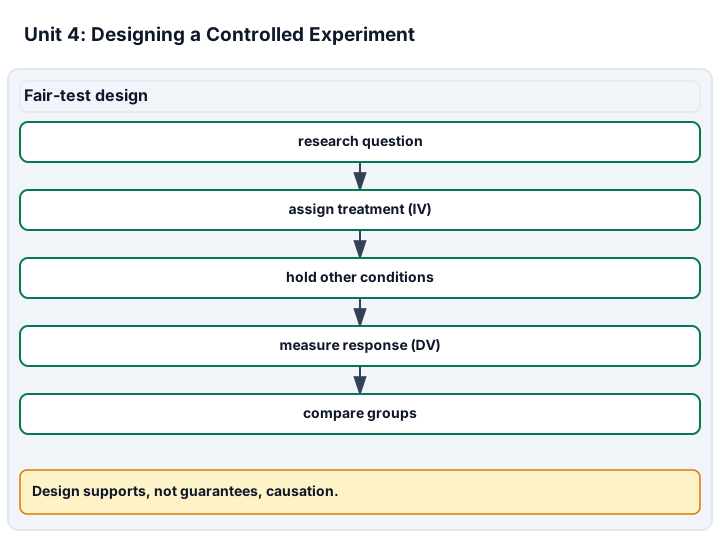
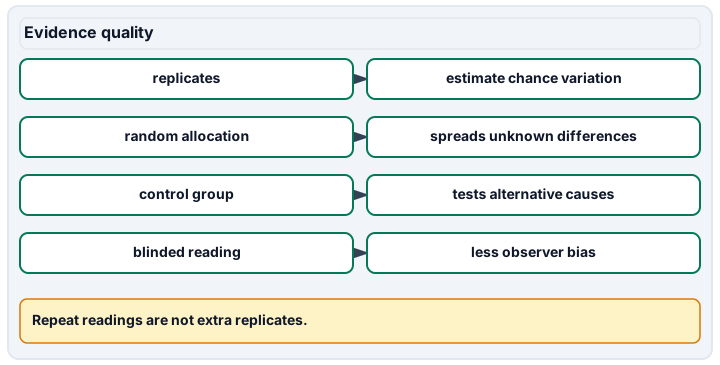
Diagram description
Fair-test design moves from question to treatment assignment, held conditions, response measurement and group comparison. Evidence quality pairs replicates, random allocation, control group and blinded reading with what each contributes.
Data, provenance, and assumptions
| Block | First drawn pot: S | Second drawn pot: R |
|---|---|---|
| B1 | P2 | P1 |
| B2 | P3 | P4 |
| B3 | P6 | P5 |
| B4 | P7 | P8 |
| Pot | Initial height (cm) | Code | Final height (cm) |
|---|---|---|---|
| P1 | 10 | R | 14 |
| P2 | 10 | S | 17 |
| P3 | 11 | S | 17 |
| P4 | 11 | R | 14 |
| P5 | 9 | R | 14 |
| P6 | 9 | S | 17 |
| P7 | 12 | S | 19 |
| P8 | 12 | R | 16 |
| Block | R growth (cm) | S growth (cm) |
|---|---|---|
| T1 | 5 | 6 |
| T2 | 4 | 5 |
| T3 | 6 | 7 |
| T4 | 5 | 6 |
Investigation design: Randomize the assignment; mask the observation
Scope and safety: These are supplied-data and paper investigations, not laboratory procedures. An educator must approve any actual practice, materials, location, supervision, accessibility and emergency plan beforehand. Do not grow or open unknown cultures, handle unknown spills, use hazardous apparatus, test hygiene on people, or collect personal health disclosures. Paper work does not certify unobserved practical skill. Public worked answers are nonsecure practice, not private assessor items.
Materials and preparation
- Use the supplied allocation-draw, coded-growth, growth-transfer records, assigned source sections, calculator and an accessible graph or diagram. No physical apparatus is required.
Procedure and schedule
- Question: Does the supplied controlled design distinguish a treatment comparison from baseline, selection and observation biases? Prerequisites: Subtract decimal lengths, average differences, and distinguish observational location from an assigned treatment; review Unit 1 sampling first.
- Variables: Light duration is assigned; height change is measured. Starting height defines a block, while station, watering and reading rules are potential confounders. Controls: Use comparable starting conditions, common period, water, soil and reading endpoints; in a real proposal the educator must verify independently assigned stations.
- Sampling and replication: Four separately assigned pots per condition are the stated experimental units. Three leaves or height rereadings per pot are not new treatment replicates.
- Analysis: Reconstruct the allocation, compute growth and within-block contrasts, rehearse a blinded-reading design and compare the fresh study without discarding disagreement. Review: An educator reviews prerequisites, source interpretation, reasoning and accessibility before assessment. A paper response does not certify unobserved practical technique; approved hands-on work requires a separate record.
Record: Retain the supplied random draw, block IDs, raw heights, growth formula, code key and release timing, control checklist, stated sample unit, uncertainty and proposed procedure with educator approval status.
Worked model
Use P1 to model the calculation: 14 - 10 = 4 cm growth, not 14 cm. R gains are 4, 3, 5, 4 cm; their mean is 4 cm. S gains are 7, 6, 8, 7 cm; their mean is 7 cm. Each blocked difference is 3 cm, and the mean S-minus-R difference is 3 cm. The allocation record shows how treatment was assigned independently within each initial-height block. It does not by itself prove the station design was implemented or that light duration is the only possible explanation.
Numerical calibration
- 4 cm growth; four independent R pots in the scenario
- 7 cm growth; four independent S pots in the scenario
- 3 cm; mean S-minus-R growth
- 1 cm; fresh mean S-minus-R growth
Attempt the assigned level
Try the tasks before reading the calibration. These are practice answers, not a secure examination; use a new dataset or changed assumption for the assessed transfer.
Foundation: typically grades 7-8
- Use allocation-draw to assign codes before consulting outcomes. Identify the independent and dependent variables, calculate each pot's growth and the two group means, and explain why comparing only final heights can mislead.
Check after your attempt
- The assigned factor is light duration, not pot identity; the measured response is height change in centimeters over the stated period. First-drawn P2, P3, P6 and P7 receive S; the partners R. R mean growth is 4 cm and S is 7 cm. Final height includes initial-size differences, so use the measured change or an explicitly adjusted model.
Core
- Explain why pairing by starting height, random assignment within pairs and blinded observation solve different problems. Draft a future height-reading protocol with the code key held by the instructor until readings are fixed. State the independent sample size and why measuring three leaves on each pot would not triple it.
Check after your attempt
- Blocking addresses a known baseline difference; a chance allocation avoids choosing favorable pots for S; a masked reader with the same endpoint rule avoids expectation-driven readings. Keep the key with the instructor, record all measurements before decoding, then retain the decoding record. There are four independently assigned pots per group. Three leaves per pot would still be subsamples of those four pots, not twelve independent assignments.
Extension: choose by prerequisites, not age alone
- Analyze the design if a single station were used for all S pots and a second for all R pots. Would more pot readings solve that problem? Describe an improved design and explain why neither randomization nor blinding licenses a claim of certain causation.
Check after your attempt
- The station and treatment would vary together, leaving one treated station per condition. More readings within it cannot separate a light-duration effect from a station effect. Randomize multiple independent stations to treatments, or use an approved blocked design that separates those factors. Blinding reduces observer bias but not station confounding; chance imbalance, measurement limits and execution failures still require scrutiny.
History, reading, and writing connection
Compare the historical handwashing intervention described in the source with the supplied pot design. Write which comparison, allocation and observation records each supplies or lacks. Preserve that Semmelweis's clinics were not randomized identical groups; staffing, timing and other differences require attention. Explain why source-linked evidence may support prevention without proving every causal claim. No live hygiene test is assigned.
Write in your own words or use an approved accessible equivalent. Cite a specific assigned section or figure, identify its evidence, and state one limitation or counterargument. Use the AI practice contract only for permitted coaching, never to invent observations or write the assessed response.
Transfer to a new case
In growth-transfer the new matched blocks use new independently assigned pots. Calculate the mean S-minus-R growth. A student predicted the earlier 3 cm difference would recur exactly. What should change in the claim, and what design records would you request before combining studies?
Calibration: Each new difference is 1 cm, so the mean is 1 cm, not 3 cm. The direction repeats but the exact-size prediction fails; report variation across studies rather than discard the new one. Request comparable timing, station allocation, plant starting conditions and reading rules. Different conditions may make pooling inappropriate.
Evidence to retain
Keep the allocation ledger, pot growth calculations, blocked comparison, proposed blinded-observation protocol and station-confound critique. These address all five design criteria as planning/analysis evidence. The instructor separately observes any approved setup and implementation; the synthetic record proves no practical was performed. Keep source reading and original writing for separate integration.
Record units, calculations, source/date, uncertainty, and what is measured versus inferred. A simulation or supplied dataset must stay labeled as such. These are supplied-data and paper investigations, not laboratory procedures. An educator must approve any actual practice, materials, location, supervision, accessibility and emergency plan beforehand. Do not grow or open unknown cultures, handle unknown spills, use hazardous apparatus, test hygiene on people, or collect personal health disclosures. Paper work does not certify unobserved practical skill. Public worked answers are nonsecure practice, not private assessor items.
Return to all eight learning pathways. Print this unit page for the student lessons; the linked five-page packet remains the separate assessment companion.
Match evidence to the actual criterion
Integration is reported separately and cannot lower the science grade or block a science demonstration pass. Science and practical criteria determine that pass.
The paper case supports design planning, randomization, masking and replication reasoning. Any actual setup and implementation must be educator-approved and watched separately. Preserve the allocation record and deviations; neither choosing one factor nor obtaining an attractive mean turns a limited comparison into proof.
- Science 1: Independent & dependent variables. Name light duration and growth over the common period, not final height alone.
- Science 2: Controlled variables (fair test). List held conditions and the station confound that could remain.
- Science 3: Control / comparison group. Show the chance allocation and explain why a comparable group is not an identical group.
- Science 4: Replication & sample size. Count assigned pots or stations separately from repeated readings and leaf subsamples.
- Science 5: Procedure clarity. Write a reproducible masked-reading and code-release plan with an instructor review gate.
Source, data, task and review inventory. Retain the selected level, first attempt, source/date, assumptions, correction and a fresh transfer. Do not reuse public answers as secure assessor items.
Unit mastery rubric
| Criterion | Developing | Proficient | Mastery |
|---|---|---|---|
| Independent & dependent variables | Cannot say what is being changed or what is being measured. | Names one but mixes up which is changed and which is measured. | Names the assigned treatment and measured response with units and timing; distinguishes baseline value from change. |
| Controlled variables (fair test) | Changes factors without tracking their effects. | Controls some conditions but overlooks a plausible confounder. | Controls relevant conditions, identifies remaining variation or confounders, and explains how the design strengthens but does not guarantee a causal inference. |
| Control / comparison group | Runs only the test condition, with nothing to compare it to. | Knows a comparison is needed but sets up one that is not a fair baseline. | Defines an appropriate comparison group and explains its similarities, differences, and allocation; does not assume organisms are identical. |
| Replication & sample size | Tests one seedling once and calls it settled. | Includes repeats but confuses independent units with repeated readings or subsamples. | Identifies independently assigned units, distinguishes subsamples and repeats, and justifies replication without claiming a magic sample size guarantees an effect. |
| Procedure clarity | Keeps the plan in their head; written steps are vague or missing amounts. | Writes steps but leaves out a measurement, timing, or detail a stranger would need. | Documents allocation, controls, measurement rule and feasible blinding; records deviations and obtains educator approval before actual practice. |
| Integration (cross-domain) | Makes no supported connection between the source and the science. | Uses the source but needs help connecting evidence, writing, or limitations to the science. | Independently connects History, Reading, and Writing using a cited source, appropriate evidence, a limitation, and a scientific explanation. |
Integration is reported separately and cannot lower the science grade or block a science demonstration pass. Science and practical criteria determine that pass. Use the integration guide's evidence checklist for the separately reported criterion.
The supplied random draw assigns pots within initial-height blocks. R grows 4 cm on average and S 7 cm. I need separate assigned stations, a fixed height rule and a reader who does not know the key. Four pots per condition do not guarantee causation.
I gave the strongest pots the longer light treatment, measured whichever leaf looked tallest and counted three leaves as three independent plants.
The paper case supports design planning, randomization, masking and replication reasoning. Any actual setup and implementation must be educator-approved and watched separately. Preserve the allocation record and deviations; neither choosing one factor nor obtaining an attractive mean turns a limited comparison into proof.
A 5-page clipboard packet — unit overview, key terms, the mastery rubric, anchor examples, and a score sheet you can print and grade against.