Unit 08 · Communicating & Defending Findings
A defensible report lets readers see the evidence, calculations and limits, including results that changed the conclusion. Compare rates with their denominators, retain a reversal between batches and answer a critique without inventing a mechanism. Written practice and a live defense remain different evidence.
Student learning: Communicating & Defending Findings
Choose the level by readiness, not age alone, and record it before instruction. Foundation, core, and honors tasks are study pathways, not an AP course or a promise of college credit. The instructor retains practical assessment and the published science rubric; integration is reported separately.
Prerequisites: Compute count/denominator percentages, distinguish percentage points from relative change and compare two labeled groups; review the preserved rate activity before proceeding.
Suggested sequence: read and discuss the explanation; attempt the worked model; analyze the data at your selected level; check the answers; then complete the source-linked response and a fresh transfer question. These activities supplement, not replace, supervised practical work and the full-year schedule.
Assigned reading and focus
- UC Museum of Paleontology, Understanding Science: Testing scientific ideas. Retrospective historical explanation and model-testing reference, not an original hospital record. Read the opening logic of supported and contradicted expectations, and Testing ideas about childbed fever. Distinguish a source-supported historical interpretation from an unsupported claim about every critic's motives. Our practice values are synthetic, not measurements taken from this source.
- OpenStax Introductory Statistics 2e, 1.2: Data, Sampling, and Variation in Data and Sampling. Sampling reference. Read the sampling and variation discussion; focus on the population, comparable denominators and why a small selected sample cannot represent every later batch. Our practice values are synthetic, not measurements taken from this source.
- UC Museum of Paleontology, Understanding Science: Testing scientific ideas. Retrospective historical explanation and model-testing reference, not an original hospital record. Read the childbed-fever example and its expected-versus-observed framing. Identify the claim the passage supports and avoid inventing quotations, motives or a single explanation of reception. Our practice values are synthetic, not measurements taken from this source.
Learn the science
Choose a pathway before instruction. Foundation typically supports grades 7-8 with guided tables and arithmetic; Core adds independent analysis; Extension adds explicit assumptions, models and critique. Readiness, accessibility and prerequisites govern placement. A scaffolded practice response is not automatic Mastery on every criterion.
A scientific report connects a question, method, observed record, calculation, interpretation and limitation so another person can challenge the reasoning. A smaller count is not automatically a smaller rate. New evidence can reverse a pattern, requiring a narrower claim rather than an excuse. Combining batches without showing them can also hide the reversal. A clear report persuades by allowing scrutiny, not by overstating certainty or predicting what an examiner wants to hear.
Assumptions: The claim-batches are synthetic quality checks of two paper-fold patterns A and B. A failure means a folded card did not meet a stated dimensional tolerance in a fictional inspection; no strength test or hazardous load is assigned. Counts concern distinct cards within each batch, not repeat readings of the same cards. Tolerance and inspection definitions match, but allocation, supplier and batch conditions are not documented as randomized.
Uncertainty: The pilot is small and later batches may differ. Pooling requires a reason to treat studies as comparable, and these unequal totals weight them differently. A difference of pooled percentages is descriptive, not a significance test or proof of equivalence. No data here identify the mechanism producing failures. A challenge to the original claim should trigger review of the record, not invented explanations.

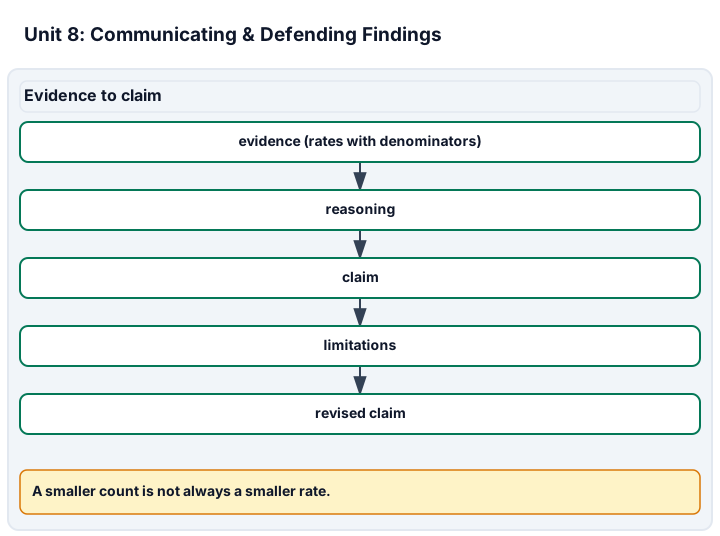
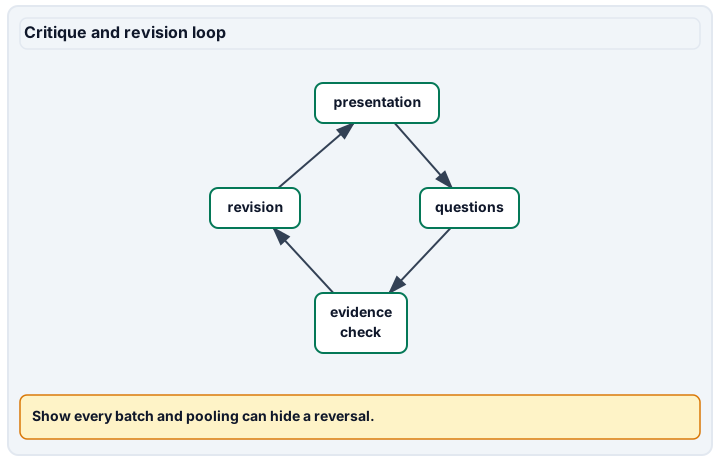
Diagram description
Evidence to claim begins with rates that include denominators, adds reasoning, forms a claim, states limitations and revises the claim. The cycle shows presentation, questions, evidence checking and revision.
Data, provenance, and assumptions
| Batch | Pattern | Cards inspected | Cards outside tolerance |
|---|---|---|---|
| pilot | A | 40 | 4 |
| pilot | B | 20 | 4 |
| new | A | 30 | 6 |
| new | B | 30 | 3 |
| Pattern | Cards inspected | Cards outside tolerance |
|---|---|---|
| A | 10 | 2 |
| B | 100 | 12 |
Investigation design: Write the revision the new evidence requires
Scope and safety: These are supplied-data and paper investigations, not laboratory procedures. An educator must approve any actual practice, materials, location, supervision, accessibility and emergency plan beforehand. Do not grow or open unknown cultures, handle unknown spills, use hazardous apparatus, test hygiene on people, or collect personal health disclosures. Paper work does not certify unobserved practical skill. Public worked answers are nonsecure practice, not private assessor items.
Materials and preparation
- Use the supplied claim-batches, claim-transfer records, assigned source sections, calculator and an accessible graph or diagram. No physical apparatus is required.
Procedure and schedule
- Question: How should a scientific claim change when a new batch reverses the original comparison? Prerequisites: Compute count/denominator percentages, distinguish percentage points from relative change and compare two labeled groups; review the preserved rate activity before proceeding.
- Variables: Pattern and batch identify groups; number inspected is the denominator and out-of-tolerance cards the numerator. A cause has not been independently isolated. Controls: Hold the stated tolerance definition and inspection rule fixed when computing rates; flag undocumented allocation or supplier differences rather than assume comparability.
- Sampling and replication: Cards are distinct inspected items in each batch. Separate batches test stability in a different context; repeated inspection of one card would not increase the denominator of distinct cards.
- Analysis: Compute within-batch and pooled rates with denominators, display reversal, revise the written claim and propose a design that could test the remaining uncertainty. Review: An educator reviews prerequisites, source interpretation, reasoning and accessibility before assessment. A paper response does not certify unobserved practical technique; approved hands-on work requires a separate record.
Record: Retain source/date, synthetic label, numerator/denominator pairs, graph choice, pooled and separated analyses, old and revised memo, critique response, fresh transfer and a separate live-defense review record.
Worked model
Pilot rates are 4/40 = 10% for A and 4/20 = 20% for B, despite equal failure counts. In the new batch, A is 6/30 = 20% and B is 3/30 = 10%, a reversal. If pooled descriptively, A is 10/70 = 14.2857% and B is 7/50 = 14%, so A minus B is about +0.286 percentage points, not a stable 50% reduction. Replace "A prevents failures" with "A had the lower observed rate in the pilot, but the new batch reversed the difference; these records do not establish A as reliably better or explain a cause."
Numerical calibration
- 10 percent; pilot A, 4/40
- 20 percent; pilot B, 4/20
- 20 percent; new A, 6/30
- 10 percent; new B, 3/30
- 0.2857142857142836 percentage points; descriptive A minus B, not a significance test
- 8 percentage points; fresh A minus B
Attempt the assigned level
Try the tasks before reading the calibration. These are practice answers, not a secure examination; use a new dataset or changed assumption for the assessed transfer.
Foundation: typically grades 7-8
- Calculate the four within-batch rates, label each denominator and draw a grouped bar chart or clearly labeled table. Write a claim that fits both batches rather than selecting only the pilot.
Check after your attempt
- Pilot A = 10% and B = 20%; new A = 20% and B = 10%. Show percentage units, batch labels and counts alongside denominators. The pattern reverses; neither "A always wins" nor "B always wins" describes both. A table is valid if it makes the reversal and sample sizes clear.
Core
- Draft a short report with question, supplied method, counts/rates, interpretation and limitation. Calculate pooled rates without averaging the four percentages equally. Respond to a peer who asks you to delete the new batch because it contradicts the pilot.
Check after your attempt
- State that the question is comparative out-of-tolerance rates under a common inspection definition, not universal product quality. Pooled A = 10/70 = 14.2857%, pooled B = 7/50 = 14%; their difference is about +0.286 percentage points. Keep both batches and explain why allocation and batch differences limit causality and pooling. Reject deletion for disagreement alone; revise the original claim and retain its dated version.
Extension: choose by prerequisites, not age alone
- Write a source-linked defense of the revised claim. Separate the numerical evidence from a proposed mechanism and from the Semmelweis historical analogy. Identify a specific future design that could challenge your interpretation, and explain why a written rehearsal is not yet an oral-defense pass.
Check after your attempt
- The reversal and differing denominators support caution about a stable advantage, not equality or a proven manufacturing mechanism. A preregistered, educator-approved inspection comparison with common materials, independently sampled cards, randomized pattern assignment and masked readers could test stability across batches. The Semmelweis reading illustrates comparing predictions with evidence; its wards were not randomized identical groups and our cards are not hospital data. An educator must hear or observe an approved accessible live defense before scoring criterion 3.
History, reading, and writing connection
Write a short comparison of the revised card-inspection report and the source's childbed-fever interpretation. Include a citation, a source-supported historical claim, numerical evidence from our explicitly synthetic record and a meaningful limit for each. Retain the historical distinction between a nonrandomized intervention and an identical-group experiment. Do not attribute every disagreement to pride, angry letters or one cause; analyze only evidence the assigned source supports.
Write in your own words or use an approved accessible equivalent. Cite a specific assigned section or figure, identify its evidence, and state one limitation or counterargument. Use the AI practice contract only for permitted coaching, never to invent observations or write the assessed response.
Transfer to a new case
In claim-transfer a speaker says "A had only two failures while B had twelve, so A is safer." Compute comparable rates and their difference, revise the statement and identify a claim the inspection data cannot support.
Calibration: A = 2/10 = 20%; B = 12/100 = 12%; A minus B = +8 percentage points. A has fewer failures in count but a higher observed out-of-tolerance rate. Say exactly that, with the sample sizes and uncertainty. Dimensional inspection does not establish safety, universal superiority, equivalence or a causal explanation.
Evidence to retain
Keep the initial memo, revised source-linked report, graph/table, denominator calculations, response to critique and new-case transfer. These address written report, visuals, claim-evidence-reasoning and critique. Criterion 3 Oral defense needs an observed live or approved accessible equivalent; public written answers cannot certify it. Integration separately requires History, Reading, and Writing with the historical source and its limits.
Record units, calculations, source/date, uncertainty, and what is measured versus inferred. A simulation or supplied dataset must stay labeled as such. These are supplied-data and paper investigations, not laboratory procedures. An educator must approve any actual practice, materials, location, supervision, accessibility and emergency plan beforehand. Do not grow or open unknown cultures, handle unknown spills, use hazardous apparatus, test hygiene on people, or collect personal health disclosures. Paper work does not certify unobserved practical skill. Public worked answers are nonsecure practice, not private assessor items.
Return to all eight learning pathways. Print this unit page for the student lessons; the linked five-page packet remains the separate assessment companion.
Match evidence to the actual criterion
Integration is reported separately and cannot lower the science grade or block a science demonstration pass. Science and practical criteria determine that pass.
Assess the written report, visual, reasoning and response to critique against their actual criteria. Oral defense requires a live or approved accessible equivalent observed by the educator. Public worked answers are practice, so assessment uses a fresh dataset or challenge while retaining all six criteria and separate integration.
- Science 1: Clear written report. Retain a report separating question, supplied method, results, interpretation, source and limitation.
- Science 2: Visuals support the claim. Use a labeled table or grouped bars that show both batches and their denominators.
- Science 4: Claim–evidence–reasoning. Tie the revised claim to actual rates and a reasoned limit, not an unmeasured mechanism.
- Science 5: Responding to critique. Keep the counterevidence, answer the deletion request and version the claim honestly.
Source, data, task and review inventory. Retain the selected level, first attempt, source/date, assumptions, correction and a fresh transfer. Do not reuse public answers as secure assessor items.
Unit mastery rubric
| Criterion | Developing | Proficient | Mastery |
|---|---|---|---|
| Clear written report | Report is missing pieces — no question stated, or data and conclusion jumbled together. | Includes most parts, but the order is muddled or the method is too thin for a reader to follow. | Separates question, method, source, data, analysis and conclusion; labels supplied records and preserves revisions. |
| Visuals support the claim | Uses no table or graph, or picks one that does not fit the data. | Includes a graph but it is mislabeled, or it does not clearly connect to the point being made. | Uses a labeled visual with denominators and relevant groups; does not hide a reversed pattern through selection or pooling. |
| Oral defense | Cannot explain the work aloud, or just reads the report back word for word. | Explains the gist but stumbles when asked to go past what is written down. | Explains the investigation aloud in their own words and answers questions about any part of it. |
| Claim–evidence–reasoning | States a conclusion with no data behind it, or lists data with no claim. | Connects a claim to data but skips the reasoning that links the two. | Links each claim to specific evidence and justified reasoning, distinguishing observed patterns from untested mechanisms. |
| Responding to critique | Ignores a challenge, gets defensive, or swaps in whatever answer is suggested. | Hears the critique but cannot tell a fair point from an unfair one. | Addresses critique with evidence, retains counterevidence and revises an unsupported claim without inventing excuses or observations. |
| Integration (cross-domain) | Makes no supported connection between the source and the science. | Uses the source but needs help connecting evidence, writing, or limitations to the science. | Independently connects History, Reading, and Writing using a cited source, appropriate evidence, a limitation, and a scientific explanation. |
Integration is reported separately and cannot lower the science grade or block a science demonstration pass. Science and practical criteria determine that pass. Use the integration guide's evidence checklist for the separately reported criterion.
In the pilot A has 4/40 failures and B 4/20: 10% versus 20%. The next batch reverses that pattern. I keep both and revise my claim; these records do not show A is reliably better. I cannot infer a manufacturing mechanism from counts alone.
A had fewer failures in the example I preferred, so it always wins. I hid the later batch and called the inspection result a safety guarantee.
Assess the written report, visual, reasoning and response to critique against their actual criteria. Oral defense requires a live or approved accessible equivalent observed by the educator. Public worked answers are practice, so assessment uses a fresh dataset or challenge while retaining all six criteria and separate integration.
A 5-page clipboard packet — unit overview, key terms, the mastery rubric, anchor examples, and a score sheet you can print and grade against.