Unit 07 · Lab Safety & Technique
Safe work begins with a specific approved activity, not a generic checklist or a high paper score. Reason through unknown-material, electrical and privacy scenarios, then examine a supplied technique comparison. Keep hazard awareness separate from equipment handling that an educator actually observes.
Student learning: Lab Safety & Technique
Choose the level by readiness, not age alone, and record it before instruction. Foundation, core, and honors tasks are study pathways, not an AP course or a promise of college credit. The instructor retains practical assessment and the published science rubric; integration is reported separately.
Prerequisites: Know how to contact the responsible educator and read the local safety plan; distinguish an unknown substance from a known dry object. Review Unit 3 before percent-error work.
Suggested sequence: read and discuss the explanation; attempt the worked model; analyze the data at your selected level; check the answers; then complete the source-linked response and a fresh transfer question. These activities supplement, not replace, supervised practical work and the full-year schedule.
Assigned reading and focus
- NSTA: Safety and School Science Instruction. Educator safety-policy reference, not permission to perform a procedure. Read Declarations: safety programs, safety training and the recommendations for maintaining a safe environment. Focus on activity-specific risk assessment, elimination of unsafe activities, supervision and accessibility. Our practice values are synthetic, not measurements taken from this source.
- Columbia University / ORI, Data Acquisition and Management: Foundation Text. Research-record reference. Read III.C, Authorizations to collect data, for the distinction between a worthwhile question and permission to involve people. This lesson instead uses synthetic, non-personal records. Our practice values are synthetic, not measurements taken from this source.
- JCGM International Vocabulary of Metrology (VIM), 2.13: Measurement accuracy. Metrology reference. Read 2.13 and its notes for the ruler-reference comparison. The arithmetic is measurement reasoning, not a safety certification. Our practice values are synthetic, not measurements taken from this source.
- UC Museum of Paleontology, Understanding Science: Testing scientific ideas. Retrospective historical explanation and model-testing reference, not an original hospital record. Read Testing ideas about childbed fever as evidence supporting preventive action. Separate a historical interpretation from permission to reproduce a historical medical procedure. Our practice values are synthetic, not measurements taken from this source.
Learn the science
Choose a pathway before instruction. Foundation typically supports grades 7-8 with guided tables and arithmetic; Core adds independent analysis; Extension adds explicit assumptions, models and critique. Readiness, accessibility and prerequisites govern placement. A scaffolded practice response is not automatic Mastery on every criterion.
A safety decision must name the actual hazard, exposure route or failure mode, who may act and what must be known before work resumes. Goggles alone do not authorize every activity. An unknown spill near electrical equipment is not a routine wipe-up. A request for real health diaries creates a privacy and consent issue even without chemicals. A paper scenario can show hazard awareness; it cannot demonstrate that a learner actually handled equipment, used PPE or responded in an emergency.
Assumptions: The decision-cards and ruler records are fictional. No unknown materials are present or requested. Technique readings describe the same flat reference card using two viewing positions, with centimeter units and a 0.1 cm reading step. The instructional reference is 5.30 cm, not a certified artifact. Actual practice, if chosen later, is limited to an educator-approved intact ruler and dry card, with accessible positioning.
Uncertainty: Good agreement with a supplied reference does not prove handling skill. The difference between oblique and eye-level means illustrates possible parallax in this scenario, not a universal correction for all angles. The ethical decisions have no numerical risk score; missing identity, consent, training or equipment information can require stopping rather than estimating a reassuring number.

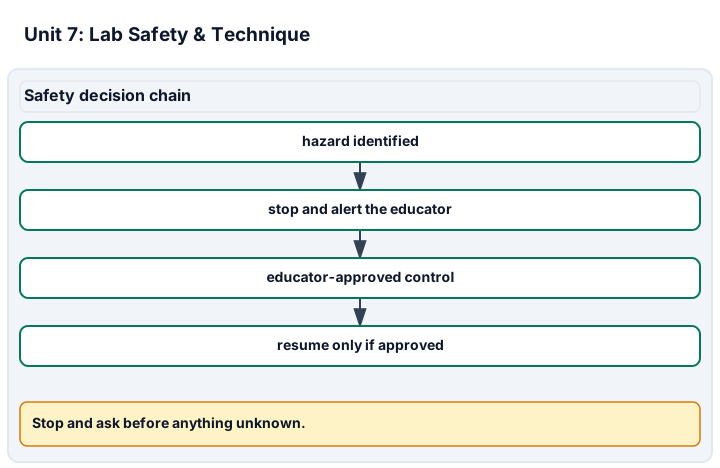
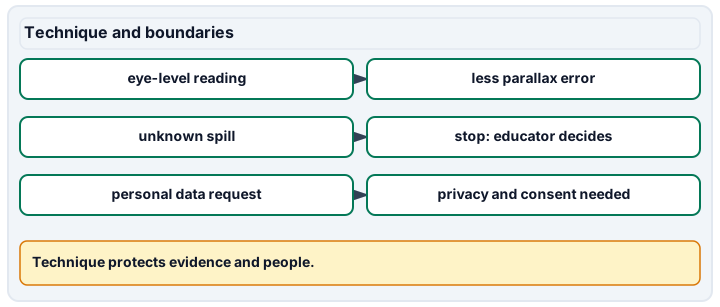
Diagram description
Safety decision chain starts with hazard identification, stops and alerts the educator, uses educator-approved controls and resumes only if approved. Technique and boundaries connects eye-level reading to lower parallax, unknown spills to educator decisions, and personal data requests to privacy and consent.
Data, provenance, and assumptions
| Card | Situation | Missing authorization or information |
|---|---|---|
| SAFE-A | Unknown spill beside an electrical cord | Substance, exposure and electrical status unknown |
| SAFE-B | Unlabeled closed container proposed for culturing | Unknown culture and no approved biological protocol |
| SAFE-C | Partner proposes uploading names and personal health diaries | No consent, privacy review or educational need for identifiable data |
| SAFE-D | Dry card and intact ruler on a clear bench | Educator must still approve setup, access needs and observation plan |
| Repeat | Eye-level reading (cm) | Oblique reading (cm) |
|---|---|---|
| 1 | 5.2 | 5.9 |
| 2 | 5.3 | 6 |
| 3 | 5.4 | 6.1 |
| Quantity | Value | Unit / meaning |
|---|---|---|
| reference | 8 | cm; stated reference length |
| aligned | 8 | cm; aligned reading |
| oblique | 8.7 | cm; oblique reading |
Investigation design: Approve the conditions, not just the answer
Scope and safety: These are supplied-data and paper investigations, not laboratory procedures. An educator must approve any actual practice, materials, location, supervision, accessibility and emergency plan beforehand. Do not grow or open unknown cultures, handle unknown spills, use hazardous apparatus, test hygiene on people, or collect personal health disclosures. Paper work does not certify unobserved practical skill. Public worked answers are nonsecure practice, not private assessor items.
Materials and preparation
- Use only the fictional decision cards, supplied ruler readings, source sections and an accessible response sheet. No biological material, liquid, electrical apparatus or personal record is required. Any separate dry-card/ruler practical needs educator approval first.
Procedure and schedule
- Question: Which conditions justify proceeding, modifying or declining a proposed activity, and what does a numerical technique comparison actually establish? Prerequisites: Know how to contact the responsible educator and read the local safety plan; distinguish an unknown substance from a known dry object. Review Unit 3 before percent-error work.
- Variables: Decision variables are the known hazard, missing information, authorized actor and stopping condition. The separate numerical outcome is indicated length under two viewing positions. Controls: No student contact with unknown contents or spills; no real personal or health data. Keep ruler origin and reference card the same in the supplied comparison and do not generalize its offset.
- Sampling and replication: Three readings per viewing position concern one reference card, not three independent demonstrations of competence. New scenario reasoning and actual observed technique are distinct evidence.
- Analysis: Explain the scenario-specific decision in words, then compare reading means and reference agreement. Do not aggregate ethical judgments into an arbitrary safety score. Review: The educator reviews each decision and approves or declines any actual practice before materials are used. No public answer, synthetic dataset or correct calculation substitutes for observed PPE, handling, disposal or approved emergency rehearsal.
Record: Record each scenario, missing approval, proposed alternative and educator review; keep numerical units and reference assumptions separately. An actual observed practical record identifies the approved task, conditions, accommodations and actions witnessed, without private health details.
Worked model
For SAFE-A stop, move away, warn others without entering the area and alert the educator; do not touch the spill, cord or switch or attempt cleanup. For SAFE-B do not open, sample or culture the contents; request an approved alternative. For SAFE-C reject collection/upload and use synthetic records; do not paste private data into an AI tool. SAFE-D can proceed only after educator approval, with the learner actually observed if technique is assessed. Separately, the mean eye-level reading is 5.3 cm and oblique mean 6.0 cm: their difference is 0.7 cm. Both sets span 0.2 cm, so similar repeatability can coexist with different reference agreement.
Numerical calibration
- 5.3 cm; supplied eye-level mean
- 6 cm; supplied oblique mean
- 0.7 cm; difference between supplied method means
- 8.75 percent absolute error of the fresh oblique reading against its stated reference
Attempt the assigned level
Try the tasks before reading the calibration. These are practice answers, not a secure examination; use a new dataset or changed assumption for the assessed transfer.
Foundation: typically grades 7-8
- For each decision card name the hazard or privacy issue, the safe stop/approval decision and the responsible adult. Then calculate the two ruler-reading means. Which part of your response is hazard reasoning and which is measurement arithmetic?
Check after your attempt
- A: unknown substance and electricity require stepping back and alerting the educator, not wiping. B: unknown biological contents must stay unopened and uncultured; ask for a safe alternative. C: use synthetic data instead of identifiable health diaries. D: obtain educator approval for dry ruler/card work. Means are 5.3 and 6.0 cm. These calculations describe the supplied readings; they do not rate the ethical choices or show practical competence.
Core
- Compare repeatability and reference agreement of both viewing methods. Write a review gate for SAFE-D that names setup, accessibility, supervision, evidence and stopping conditions. Explain why the same cleanup plan cannot be copied from known dry-card work to SAFE-A.
Check after your attempt
- Both reading sets have a 0.2 cm range but only the eye-level mean matches the stated 5.30 cm reference. Have the educator check an intact ruler/card, stable clear surface, comfortable line of sight or approved accessible alternative, supervision and a record of observed actions. Stop for damaged equipment, pain or unexpected conditions. An unknown spill/electrical hazard has different controls and requires the responsible adult and local emergency plan, not student cleanup.
Extension: choose by prerequisites, not age alone
- A supervisor asks you to approve the culture and health-diary projects because the learner scored all the paper questions correctly. Respond with the missing authorizations, a safer substitute and exactly what this lesson can and cannot establish.
Check after your attempt
- Correct paper answers cannot authorize biological work or collection of personal health information. Decline both proposals and use supplied synthetic records or reviewed images instead. State who must approve any genuinely different activity and its data-handling plan. This lesson supports criterion 2 Procedure & hazard awareness; Unit 3 Precision vs. accuracy receives the numerical comparison. PPE, handling, cleanup and emergency performance need separately observed educator-approved tasks, not inferred mastery.
History, reading, and writing connection
Use the historical reading to explain how evidence can support a preventive practice while causal details remain incomplete. Write one source-supported claim, one limit and why this course does not reproduce historical medical or hygiene experiments. Connect that distinction to the educator review gate for today's fictional safety scenarios. Do not collect personal health records or require agreement with a predetermined moral verdict.
Write in your own words or use an approved accessible equivalent. Cite a specific assigned section or figure, identify its evidence, and state one limitation or counterargument. Use the AI practice contract only for permitted coaching, never to invent observations or write the assessed response.
Transfer to a new case
For the fresh 8.0 cm reference in technique-transfer, calculate the absolute percent error of the oblique 8.7 cm reading. Does its similarity to the earlier offset authorize a universal 0.7 cm correction or certify that the learner can respond to an unknown spill?
Calibration: Absolute percent error is |8.7 - 8.0|/8.0 x 100 = 8.75%. This is a measurement comparison, not "percent safe" or a numerical ethics judgment. Two selected examples do not validate a universal parallax correction, and no arithmetic demonstrates spill response. Rehearse only an approved scenario and record actual observed actions separately.
Evidence to retain
Keep the four justified decisions and the instructor review gate as evidence for criterion 2 Procedure & hazard awareness only. Link the reference/precision calculations to Unit 3 criterion 4 Precision vs. accuracy. Criteria 1, 3, 4 and 5 here require witnessed educator-approved practical or emergency-rehearsal evidence. Paper work does not certify those performances; a learner must never create a real hazard to demonstrate a response.
Record units, calculations, source/date, uncertainty, and what is measured versus inferred. A simulation or supplied dataset must stay labeled as such. These are supplied-data and paper investigations, not laboratory procedures. An educator must approve any actual practice, materials, location, supervision, accessibility and emergency plan beforehand. Do not grow or open unknown cultures, handle unknown spills, use hazardous apparatus, test hygiene on people, or collect personal health disclosures. Paper work does not certify unobserved practical skill. Public worked answers are nonsecure practice, not private assessor items.
Return to all eight learning pathways. Print this unit page for the student lessons; the linked five-page packet remains the separate assessment companion.
Match evidence to the actual criterion
Integration is reported separately and cannot lower the science grade or block a science demonstration pass. Science and practical criteria determine that pass.
Paper decisions support Procedure & hazard awareness only. PPE/setup, handling, cleanup/disposal and emergency performance require observed educator-approved tasks or safe rehearsals, with accommodations. No learner creates a hazard for assessment. The ruler arithmetic belongs to Unit 3 Precision vs. accuracy, not to unobserved technique credit.
- Science 2: Procedure & hazard awareness. For each fictional situation, name the specific hazard or privacy boundary, stop/approval decision, responsible educator and conditions for resuming.
Unit 3 criterion 4: Precision vs. accuracy receives the numerical technique comparison; no handling or safety performance is inferred from it.
Source, data, task and review inventory. Retain the selected level, first attempt, source/date, assumptions, correction and a fresh transfer. Do not reuse public answers as secure assessor items.
Unit mastery rubric
| Criterion | Developing | Proficient | Mastery |
|---|---|---|---|
| PPE & setup | Begins before checking required protection or workspace conditions. | Sets up with prompts but misses a protection or access need. | Uses protection and workspace controls appropriate to the approved task; the educator observes setup and checks accessibility before work. |
| Procedure & hazard awareness | Dives in without reading the steps or noticing any warnings. | Reads the procedure but skims the warnings, or can’t say where help is. | Identifies task-specific hazards, privacy limits, missing information and stop conditions; names the responsible adult and approval needed. |
| Careful handling | Handles tools or materials roughly or the wrong way — a risk to the work and to people. | Uses tools correctly most of the time but gets careless when rushing. | Handles only approved tools and materials as trained under observation; stops for damage, unfamiliar conditions or uncertainty. |
| Cleanup & disposal | Walks away leaving spills, trash, or tools out for someone else. | Cleans up part way — wipes the bench but leaves materials out, or disposes of things carelessly. | Follows the approved cleanup and disposal plan under observation; does not touch unknown spills or improvise disposal. |
| Emergency response | Does not yet identify the required alert or protective action. | Identifies help but needs prompts to apply the approved response. | Demonstrates the approved emergency response in a safe rehearsal: alert, avoid exposure and follow the local plan; no improvised cleanup. |
| Integration (cross-domain) | Makes no supported connection between the source and the science. | Uses the source but needs help connecting evidence, writing, or limitations to the science. | Independently connects History, Reading, and Writing using a cited source, appropriate evidence, a limitation, and a scientific explanation. |
Integration is reported separately and cannot lower the science grade or block a science demonstration pass. Science and practical criteria determine that pass. Use the integration guide's evidence checklist for the separately reported criterion.
For the fictional unknown spill near a cord, I step back, warn others and alert the educator; I do not touch or wipe it. The ruler means are measurement evidence, not a safety score. Actual handling must be approved and observed separately.
I got the paper answers right, so I can handle the unknown material and clean any spill without asking.
Paper decisions support Procedure & hazard awareness only. PPE/setup, handling, cleanup/disposal and emergency performance require observed educator-approved tasks or safe rehearsals, with accommodations. No learner creates a hazard for assessment. The ruler arithmetic belongs to Unit 3 Precision vs. accuracy, not to unobserved technique credit.
A 5-page clipboard packet — unit overview, key terms, the mastery rubric, anchor examples, and a score sheet you can print and grade against.