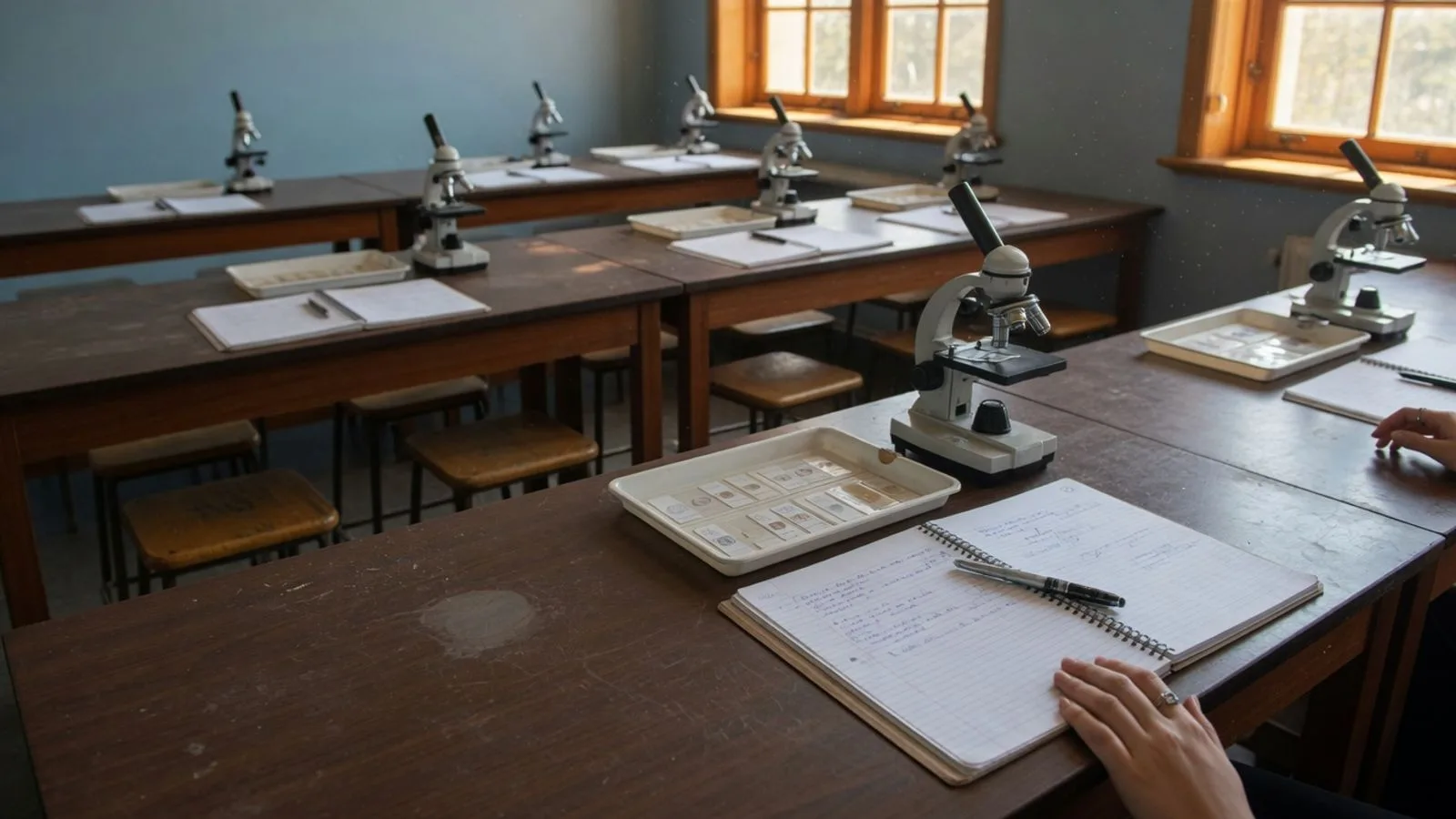
A pre-health lab cohort, taught by the person who runs the labs your kid will hit in college.
Eight Saturday mornings. Real dissection, real microscopy, real lab notebooks. Capped at eight students, 7th–12th grade. Led by Leslie Nichols — Boise State's Anatomy & Physiology Laboratory Coordinator, Idaho-certified, and a veteran public-school middle- and high-school biology teacher.
No payment required to reserve. We'll confirm details by email before any commitment.
Skips fall break & Halloween.
Exact venue in confirmation email.
Sibling discount available.
Need-based scholarships — ask.
Leslie Nichols — a credentialed lab specialist who loves teaching this age.
- · BSU A&P Laboratory Coordinator (27+ labs, 1,000+ students per term)
- · BSU A&P lecture & lab instructor
- · Public-school middle & high school biology teacher (Idaho-certified)
- · 22-year homeschool co-op leader
Fall cohort isn’t the only way to work with Leslie. See all 3 packages →
An 8-Saturday Life Sciences Intensive
A comparative-anatomy spine. A pre-health-grade capstone. Small enough that every student does every lab.
~3 hours each, 9 AM–noon. One semester, beginning to end. Skip-friendly with structured make-ups.
7th–12th grade. Every student handles every specimen. No "watch from the back of the room."
Each student finishes with a working pre-health lab notebook and a letter of completion from their instructor.
What this is: a small, mastery-based lab-bench cohort taught by a credentialed Idaho science teacher. We move on when students can do the work, not when the calendar says so — and the deeper goal is to teach students how to reason through the scientific method on their own. Reference curriculum (OpenStax, Khan Academy) is commodity and free; the instructor, the bench, and the habits of mind are what this cohort is built around.
Real labs, not lab simulations.
Across 8 Saturdays, students work through a comparative-anatomy spine that mirrors a college-freshman pre-health track — just calibrated for high-school maturity and attention.
Specimens, microscopes, and models stay on the bench. Lab notebooks travel home each week. The capstone is a real piece of work the student can show on a transcript or an application.
- Microscopy fundamentals — cells, tissues, what to actually look for.
- Tissue identification — the four big classes, with real slides.
- Comparative dissection (invertebrate) — the warmup specimen.
- Comparative dissection (vertebrate) — the comparison.
- Anatomy & physiology blocks — bones, muscles, organs, with real models.
- Capstone project — student-driven; final week is presentation + portfolio review.
Real benches. Real specimens. Real lab notebooks.
Meet Mr. Bones.
Bright Minds’ unofficial mascot — fedora, paisley necktie, and a strong opinion about every joint in the human body. He’s on the bench for the Fall 2026 cohort, ready to point at things on cue.
Articulated. Slightly battered. Excellent at posing for photos.
Essays from Leslie.
Short pieces on what we actually do at the bench — and why the hands-on version is the one that sticks.
Why hands-on lab science matters more, not less.
K–12 and college science are shifting to video and simulation. The downstream consequences for pre-health students are measurable.
Read essay →
Mastery vs seat-time.
A pension formula from 1906 is currently running the biology classroom. Why our cohort moves on when the work is right, not when the bell rings.
Read essay →Follow the data, not the conclusion.
A real scientist starts without the answer. Why we teach the scientific method as a loop — including the “No” arrow most kids never get to take.
Read essay →Try it before you commit — The Lab Bench Workshop, July 14–16.
Three July mornings. Real microscopy and dissection. $245 — with $100 credit toward Fall cohort.
Eight seats. One cohort.
Reserve your student's seat for Fall 2026. Reservation is non-binding — we'll send schedule and tuition details before any commitment.
Reserve a spot →Questions? Read the FAQ or see the pathway.