Mastery vs seat-time.
The Carnegie unit, which governs the American high-school schedule, originated in 1906 as a way to standardize faculty workload for pension eligibility. Whether or not a student had actually learned anything was not what it was designed to measure. That assumption is still running the school day. It does not run our cohort.
The Carnegie unit helped standardize secondary coursework in 1906, when the Carnegie Foundation was establishing eligibility requirements for its faculty pension system. A unit represented roughly 120 hours of instruction in a subject over a school year.1
Contact time is useful for organizing courses. It does not, by itself, show what a student has learned. A transcript can record time and credit while leaving the practical skills behind that credit unclear.
Time in class matters. What students can demonstrate matters too.
What the research actually says
Research on mastery learning examines what happens when students receive feedback and further practice before progressing:
- Bloom’s mastery learning work. In the 1960s and 70s, Benjamin Bloom and his students documented something striking: when students were allowed to keep working on a unit until they actually demonstrated mastery (typically ~80% on a formative assessment), then advance, average outcomes improved by roughly one standard deviation, and the spread between weak and strong students narrowed. Bloom’s famous “two sigma problem” paper extended this to one-on-one tutoring with mastery, which produced about two standard deviations of improvement in those research conditions. These results are not a forecast for every modern class.2
- Spaced and deliberate practice. Cognitive-science work from Anders Ericsson and others on deliberate practice, and from the “testing effect” literature, all support planned practice with feedback. Time spent studying is not the same as a skill demonstrated. Missing foundations should be identified and addressed.3
- The Carnegie Foundation itself has tried to walk it back. The same foundation that created the unit has, in the last two decades, repeatedly published papers acknowledging that seat-time is a poor proxy for learning and urging movement toward competency-based credit. The K–12 system has, mostly, not moved.4
The evidence gives teachers useful options. Putting them into practice requires time, staffing, and a workable schedule.
Average student outcome (percentile rank) under three instructional regimes. Adapted from Bloom (1984).
A cohort of eight is a practical compromise, closer to the +2σ end of this chart than a 1-to-30 classroom can ever be.
What this looks like on a Saturday
A Saturday cohort of eight is small enough to actually run on mastery instead of seat-time. That sounds dramatic. In practice it’s a hundred small choices that all push the same way:
1. The skill, not the schedule, is the gate.
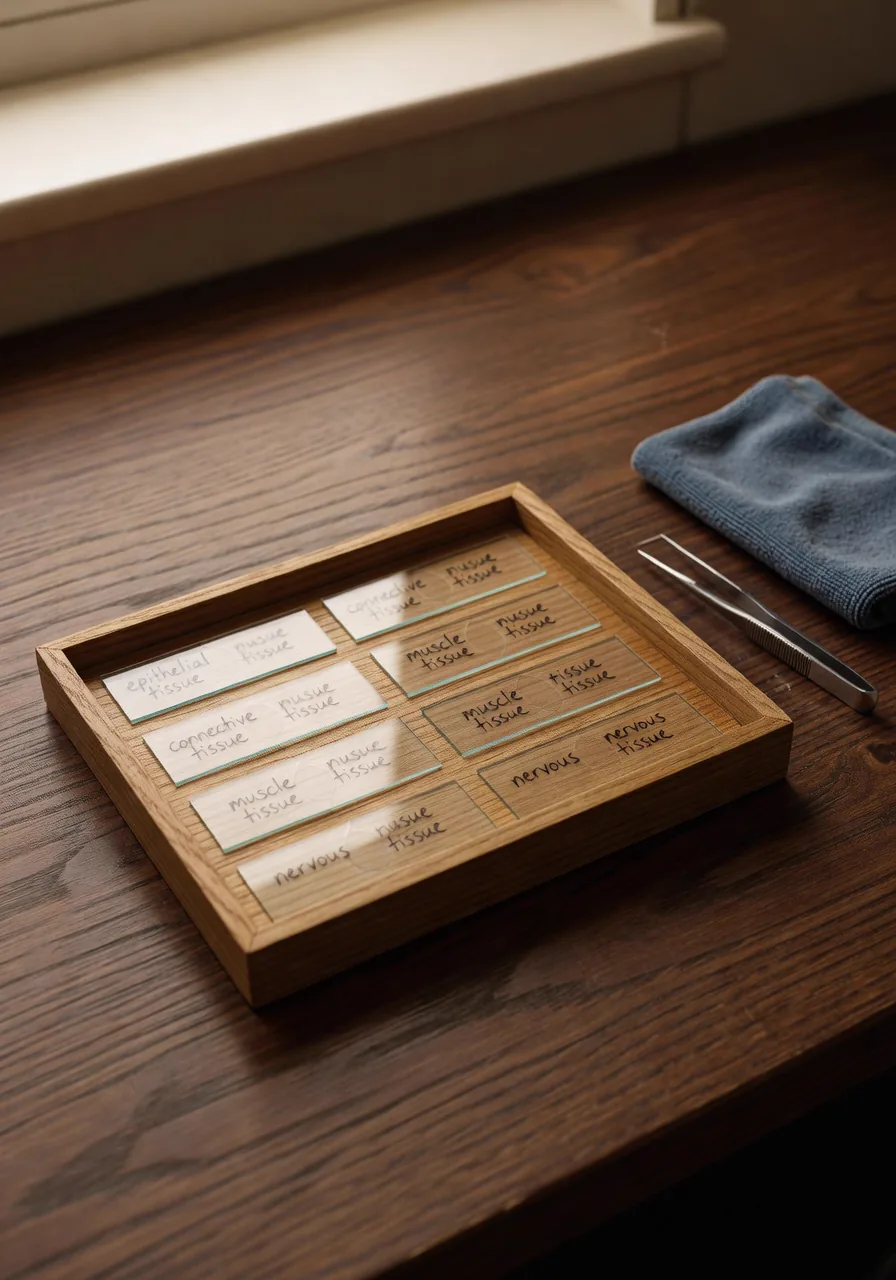
When the syllabus says “week 1: focus the microscope and identify four tissue types,” that’s the skill. If the student walks in week two and still can’t crisply focus on a stained slide and tell me which one is epithelial, we don’t skip ahead to keep up with the calendar. We re-do the bench checkpoint. The clock waits.
2. Re-doing isn’t a punishment, it’s the work.
One of the quiet psychological costs of seat-time school is that doing something twice feels like failure. In a mastery framing, doing something twice is simply part of learning. That’s how musicians, athletes, and surgeons learn. Repetition with feedback is the entire technology.
3. The cohort moves; the individuals stretch.
Here’s the honest constraint. Eight students share a calendar, and we have to keep the cohort roughly together so that the dissection day still has a class around it. Pure self-paced mastery is not what we offer; we’re not a tutoring service. What we offer is a cohort calendar with planned flexibility. At specific checkpoints, students can repeat a skill or try a more demanding version without disrupting the rest of the schedule.
We don’t pretend to abolish the schedule. We just don’t pretend the schedule is teaching anyone anything by itself.
Planning time for feedback
Individual observations, feedback, and reassessments take time. Larger classes need ways to organize that work, such as planned assessment stations, additional instructors, or staggered checks. The question is how each student will receive useful feedback, not whether the teacher cares enough.
A small-group program is one practical option. The eight-student design discussed here illustrates how a teacher might organize direct observation. It is not a research-established class-size requirement or a current enrollment offer.
What students can take forward
A notebook records observations and corrections. A practical demonstration shows what the student can do at that point. Together, they help the student identify progress and decide what still needs practice.
The habit I want students to develop is straightforward: check what you know, notice what you cannot yet explain, and choose the next useful practice task. Later courses will still require new learning, but students need not rely on guesswork about how to study.
We move on when the work is right, not when the bell rings. That principle needs a clear standard and an agreed plan for feedback and reassessment.
Sources & further reading
- The Carnegie unit was defined in 1906 by the Carnegie Foundation for the Advancement of Teaching as an administrative measure tied to a faculty pension fund (the same fund that became TIAA), not to student learning. See Carnegie Unit and Student Hour for the documented origin and the foundation’s subsequent century of administrative use of the unit.
- Bloom, B. S. (1984). “The 2 Sigma Problem: The Search for Methods of Group Instruction as Effective as One-to-One Tutoring.” Educational Researcher, 13(6), 4–16. doi:10.3102/0013189X013006004. The classic mastery-learning effect-size paper; tutored mastery groups outperformed conventional instruction by roughly two standard deviations. Background: Bloom’s 2 sigma problem.
- On retrieval practice / the “testing effect”: Roediger, H. L. & Karpicke, J. D. (2006). “Test-enhanced learning: Taking memory tests improves long-term retention.” Psychological Science, 17(3), 249–255. doi:10.1111/j.1467-9280.2006.01693.x. On deliberate practice as a distinct skill-acquisition mechanism: Ericsson, K. A. & Pool, R. (2016). Peak: Secrets from the New Science of Expertise.
- Carnegie Foundation for the Advancement of Teaching (2015), The Carnegie Unit: A Century-Old Standard in a Changing Education Landscape, the foundation’s own re-evaluation of the seat-time unit it originally designed. Coverage and summary: Paul Fain, “Carnegie Says Credit Hour, Although Flawed, Too Important to Discard,” Inside Higher Ed, Jan. 29, 2015.