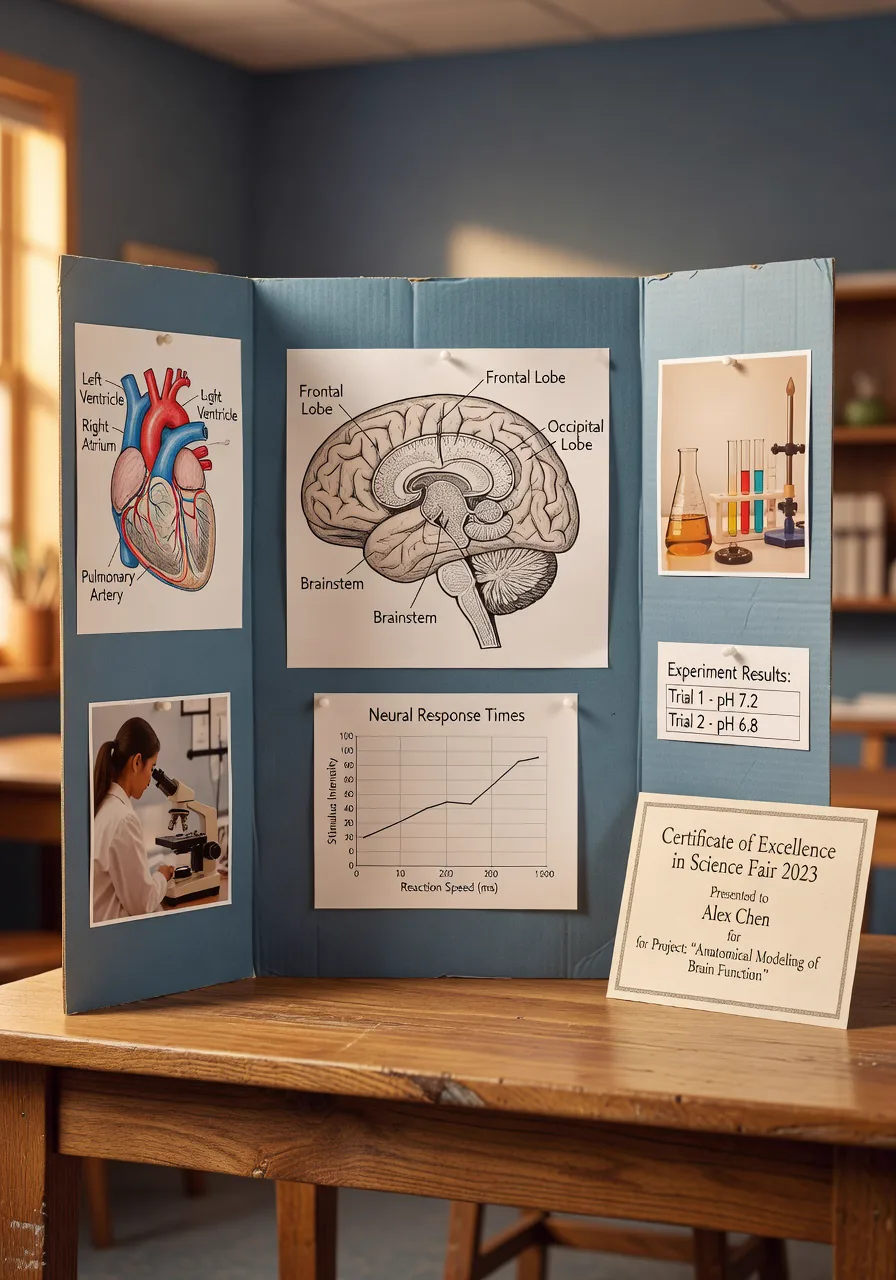
The capstone defense.
Why every Bright Minds student stands up in week eight and explains their own work, out loud, to their peers and their family. The fastest known way to find the holes in your own understanding, and the closest thing a fourteen-year-old will get to the way real scientists actually defend their conclusions.
Richard Feynman had a trick. When he wanted to know whether he actually understood something, not simply whether he could pass a test on it but whether he understood it, he would try to explain it from first principles to a freshman class. If he got stuck, if he couldn’t carry the explanation through without gaps, he’d know exactly where his own understanding had been performative all along, and he’d go fix it.1
The capstone defense is the same trick, scaled to a fourteen-year-old.
“The shortest path to the holes in your own understanding is to teach.”
How it works
In week eight, after seven Saturdays of microscopy, dissection, drawing, and notebook work, every student presents their capstone: a 7–10 minute talk on a question they chose, drawn from something they actually observed in lab. The audience is the rest of the cohort, their families, and me. The format is short and honest:
- The question. What did they want to know? (“Why does the fetal pig have a hole between the atria that the textbook says shouldn’t be there?”)
- The method. What did they look at, draw, measure? Which of their notebook pages support the claim?
- The conclusion and what they would check. What do they think the answer is, and what would they look at next to be more sure?
- Q&A. Three to five questions from peers and instructors. Some friendly. Some pointed. All real.
That’s it. No multiple-choice exam. No 30-question study guide. The defense is the assessment.
Drawn from something they actually observed.
Notebook pages that support the claim.
The best answer and what they would check next.
Three to five questions. Some pointed. All real.
7–10 minutes of presentation, then live questions. The defense is the assessment.
What we’re actually testing
A well-designed multiple-choice test can assess knowledge and reasoning efficiently. It does not show how a student handles equipment or explains decisions made during their own practical work.
A defense asks the student to explain a conclusion using their own evidence and respond to questions about it. The teacher can ask why a method was chosen, what an observation supports, and what remains uncertain.
Match the assessment to the learning goal. A defense adds useful evidence when the student must explain decisions from their own work.
Why a 7th grader is the right audience
Explaining a concept to a younger learner requires the student to define unfamiliar terms and choose a clear example. That effort can reveal a missing step in the explanation.
A useful preparation prompt is: imagine you have to explain this to a curious eighth grader who has never heard of it. Can you? Explaining an idea in familiar words can reveal gaps hidden by technical vocabulary. It is a practice method, not a guarantee of passing an assessment.
Reasoning, not recitation. Ask what the student observed, what the evidence supports, and what they would check next.
Helping students prepare
A student may understand the science and still be nervous about presenting it. Give them opportunities to rehearse, identify the notebook pages they need, and practice answering questions. Discuss accommodations before the assessment.
Judge the explanation and its evidence, not speaking speed or apparent confidence. If a response is unclear, use a focused question to understand what the student means.
What goes home
A capstone defense produces three artifacts that walk out the door with the student:
- The notebook. Already theirs from week one. Now anchored by a presentation that points back at specific pages.
- The slide deck or board. Their own work. Photographable. Usable as a college-application portfolio piece.
- A letter of completion from Leslie, your Bright Minds instructor, written from direct observation rather than from a transcript line. The kind of letter that actually has something concrete to describe.
That bundle is unusual for a fourteen- or fifteen-year-old to have. It’s the kind of thing a nursing-school admissions reader, a research mentor, or a college interviewer can open, and it is rooted in something the student actually did and can actually still explain, even three years later, when somebody asks.
The honest part
A capstone defense scales poorly. It works because the cohort is eight students, because every defense gets the full fifteen minutes including Q&A, and because the audience is small enough to ask real questions. It’s one of the things you can do with a cohort of eight that you simply cannot do with a class of thirty.
That is a deliberate choice. We do not run a full school. We offer a small Saturday lab where students receive the individual attention this work requires. The defense gives them an opportunity to show what they have learned.
Sources & further reading
- The “Feynman technique” (teach the concept in plain language, find the gaps, and go back to fill them) is widely attributed to Feynman’s teaching habits at Caltech and is described in James Gleick’s biography Genius: The Life and Science of Richard Feynman (Pantheon, 1992). The underlying cognitive-science finding that explaining material to others substantially improves the explainer’s own retention is the “protege effect.” See Fiorella, L. & Mayer, R. E. (2013), “The relative benefits of learning by teaching and teaching expectancy.” Contemporary Educational Psychology, 38(4), 281–288. doi:10.1016/j.cedpsych.2013.06.001.
- On oral defenses and authentic assessment in science education: Darling-Hammond, L. & Adamson, F. (2014), Beyond the Bubble Test: How Performance Assessments Support 21st Century Learning (Jossey-Bass), and the broader Stanford Center for Assessment, Learning, and Equity (SCALE) literature on performance-based assessment.
Posted Apr 30, 2026.