Cram, pass, forget. Or learn, master, retain.
John D. Mays’ From Wonder to Mastery is the cleanest articulation I’ve read of what is actually wrong with American middle- and high-school science instruction. His three-pillar replacement (Mastery, Integration, Wonder) is, with one small framing adjustment, the model we already run on a Saturday in Boise. Credit where it’s due. Notes on what we keep, what we adapt, and how we frame it.
From Wonder to Mastery: A Transformative Model for Science Education, by John D. Mays, describes a familiar teaching problem: students may perform well on a test without retaining the material.1
The diagnosis: Cram–Pass–Forget
Mays calls this pattern the Cram–Pass–Forget cycle:
“The method most students use is what we call the Cram–Pass–Forget cycle. … students cram for their tests, pass them, and then soon forget most of what they learned. Success in such an environment revolves around jumping through hoops, not genuine learning.”2
A unit test gives useful information about performance at one moment. It does not establish what the student will remember months later. Retention needs further practice and opportunities to use earlier learning.
Mays’ replacement loop has the same three-syllable shape, by design. He wants readers to notice the change:
Mays’ rhetorical move: a one-line swap that names the entire problem and points at the fix.
- Unit test is the goal
- Grade is the payoff
- Knowledge gone within weeks
- Hoops, not learning
- Cumulative testing, not unit-and-forget
- Fewer topics, deeper attention
- Ongoing accountability for prior material
- Knowledge accumulates year over year
The shift looks small on the page. In practice it changes everything: the curriculum scope, the test design, the grading, and what the student actually walks out the door knowing.
The three pillars: Mastery, Integration, Wonder
The book’s pedagogical model is built on three pillars, each of which is a corrective for a specific failure mode of conventional middle-school science.3
1. Mastery: narrow the curriculum, then study it thoroughly
Mays’ first move is to attack the breadth-over-depth textbook tradition directly. American middle-school science textbooks are encyclopedic by design. They cover everything lightly, in the hope of touching every state standard. The result is shallow, vocabulary-heavy, and forgettable. His prescription: cull the bloated curriculum, teach a smaller set of topics deeply, and hold students continuously accountable for prior material through cumulative review and cumulative testing. The point is not to cover everything. The point is for the student to actually know it next year.
2. Integration: connect the disciplines
The second pillar attacks the school day’s habit of chopping knowledge into hour-long unrelated boxes. Mays argues that math should appear in science class regularly, writing should appear in lab reports, and historical context should appear in both, because that is how the disciplines actually relate in real work. A nursing student writing up an assessment, an engineer documenting a failure analysis, and a researcher publishing a paper all need to combine their skills. None of them can do their math, their writing, and their science in separate classrooms. Integration teaches the habit before the habit’s needed.
3. Wonder: curiosity that comes from experience
The third pillar is the one most easily mocked and most quietly important. Students who never look up from the textbook never have the experience that makes a scientist a scientist: the moment of looking at something real, such as a beating frog heart, a mineral fluorescing under UV, or a microscope field that differs from the textbook image, and thinking that’s real, and I want to know why. Wonder isn’t decoration. It’s the fuel. A curriculum that systematically extinguishes it has done damage that no amount of test prep recovers.
Where Mays’ approach and ours differ
Mays writes from a Christian classical-education tradition, and his publisher’s textbooks are most widely used in private Christian schools and homeschools. I want to be straightforward about that, and equally straightforward about how Bright Minds Learning relates to it.
I’m a Christian myself. Faith is real, it matters in my life, and it does not belong at the lab bench. Religion is taught at home. Science, taught well, is neither secular nor religious. Both labels introduce a worldview into a discipline whose entire point is to follow the data wherever the data goes. A “secular” science classroom that begins from the assumption that materialism is true has skipped a step. A “Christian” science classroom that begins from the assumption that the answer is already known has skipped the same step from the other direction. Both have stopped doing science and started doing apologetics. The two activities are not the same activity.
The scientific method doesn’t care which side of the aisle you started on. It only asks whether the data agrees with the prediction.
What we run instead is the scientific reasoning as a cycle: hypothesis, experiment, analysis, and the willingness to take the “No” arrow when the data says the theory was wrong. That cycle is the one frame that works across worldviews, because it is indifferent to all of them. Students from different backgrounds can examine the same evidence and revise their conclusions. Following a method does not guarantee a correct answer; it makes the reasoning available for others to examine.
The encouraging part: Mays’ three pillars don’t require his worldview frame. Mastery, Integration, and Wonder are pedagogical claims. They’re defensible on the evidence. They’re what a serious science classroom looks like in any tradition. We borrow them gratefully and run them through our own frame.
What this looks like at our bench
These ideas connect with practices from my earlier teaching. In the example cohort design, the three principles guide the choice of activities:
- Mastery. Eight Saturdays, eight students, a deliberately small set of topics covered in depth: cell biology, tissues, microscopy, dissection, and the lab notebook itself. Every Saturday revisits prior weeks at the bench, not as review-for-the-test but as continued accountability: do you still know it? The capstone defense in week eight is the whole eight weeks, not the final unit. We don’t move on until the work is right. (Related essay: Mastery vs seat-time.)
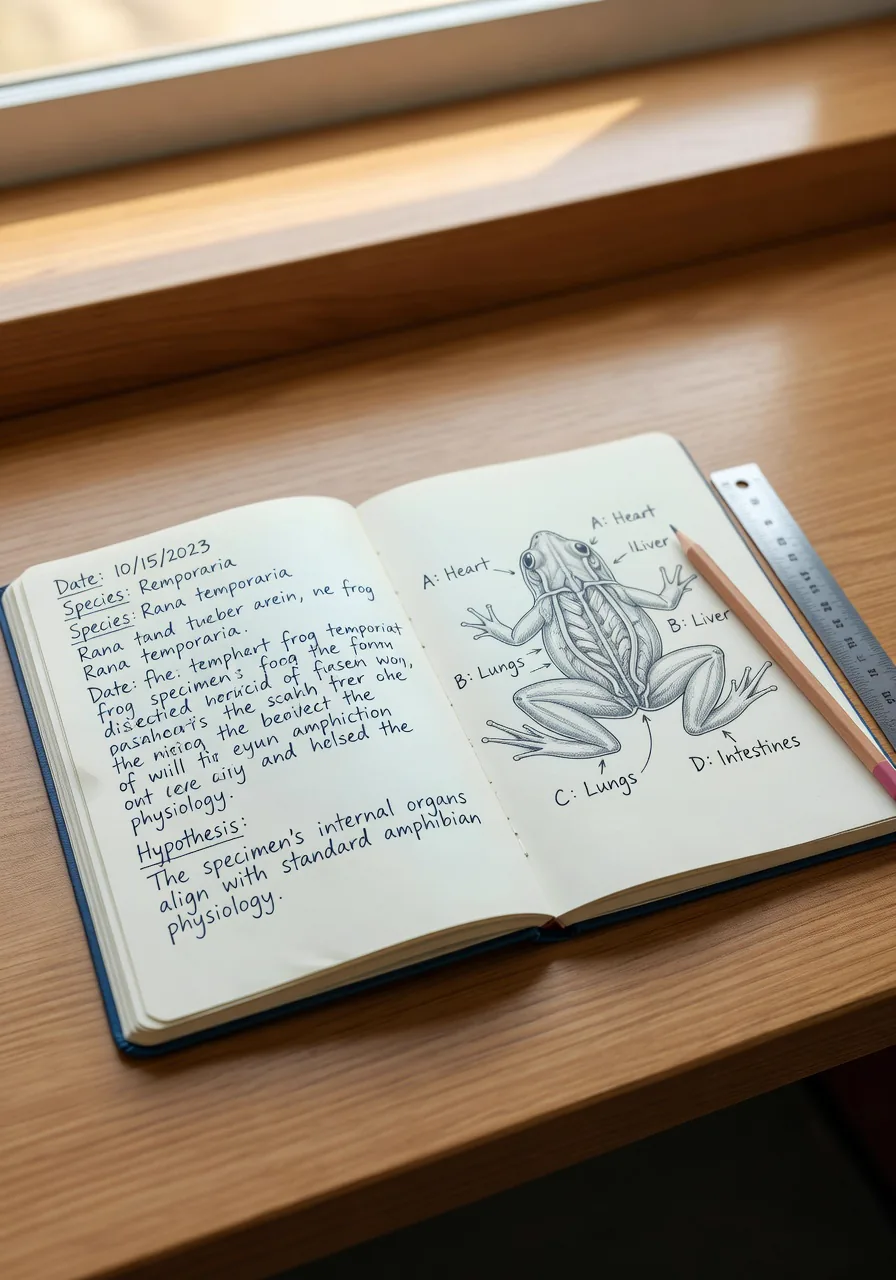
- Integration. Math and writing live inside science class, not next door to it. Microscopy means calculating field-of-view diameter and total magnification. Dissection means a written, dated, structured lab notebook entry with a protocol, observations, sources of error, and a short discussion, rather than a fill-in-the-blank worksheet. The capstone is an oral defense, in plain English, to a real audience. (Related essays: Why a real lab notebook, The capstone defense.)
- Wonder. Real specimens. Real microscopes. Real animals to dissect, sourced from teaching suppliers. The wonder isn’t something we add at the end as decoration; it’s built into the choice to use the actual thing instead of a video of the thing. (Related essay: Why hands-on matters.)
The useful test is whether each principle changes what students do and the feedback they receive.
What the kid carries out the door
The graduate of a Cram–Pass–Forget science education has a transcript line. The graduate of a Learn–Master–Retain education has, instead, a set of habits: the experience of having developed and retained knowledge, the integration of math and writing into how they think about a problem, and the quiet expectation that real things are more interesting than textbooks claim they are.
These habits can support later study, but they need continued practice. Ask students to explain a concept after a delay, apply it to a new example, and identify what they still need to learn. Those checks tell us more than a promise of lasting understanding.
Sources & further reading
- Mays, John D. (2018). From Wonder to Mastery: A Transformative Model for Science Education. Novare Science & Math. Reissued by Classical Academic Press (2021), ISBN 978-1-60051-411-1. Mays founded Novare Science & Math and its Centripetal Press imprint (since acquired by Classical Academic Press), which publish science textbooks built around the model described in the book.
- Centripetal Press, “Mastery Integration Wonder.” The Cram–Pass–Forget vs Learn–Master–Retain framing, and the diagnosis of the cycle as “ubiquitous in schools and colleges across the nation,” is taken verbatim from the publisher’s canonical statement of Mays’ model.
- The three-pillar structure (Mastery, Integration, Wonder), including the “cull the bloated curriculum” language under Mastery and the “eliminating the habit of compartmentalizing disciplines of learning” framing under Integration, is summarized at centripetalpress.com/about/mastery-integration-wonder and developed at length in From Wonder to Mastery (Mays, 2018). For independent confirmation that mastery-style cumulative review outperforms unit-and-forget instruction, see Bloom (1984), Roediger & Karpicke (2006), and the related citations in our companion essay Mastery vs seat-time.
Posted Apr 30, 2026. Reading notes on John D. Mays, From Wonder to Mastery (Novare Science & Math, 2018), with credit to Mays for the diagnostic framing and the three-pillar model. Bright Minds Learning is not affiliated with Novare Science & Math, Centripetal Press, or Classical Academic Press.