A course pack is not an online class.
If this is not a live class, video course, or portal subscription, what are families actually getting? A practical explanation of the course-pack format and the adult role it assumes.
A course pack can sound like an online class if you have not seen one before. It is not. It is also not a video course, not a portal subscription, and not a promise that Leslie is teaching your student every week unless a separate arrangement is made.
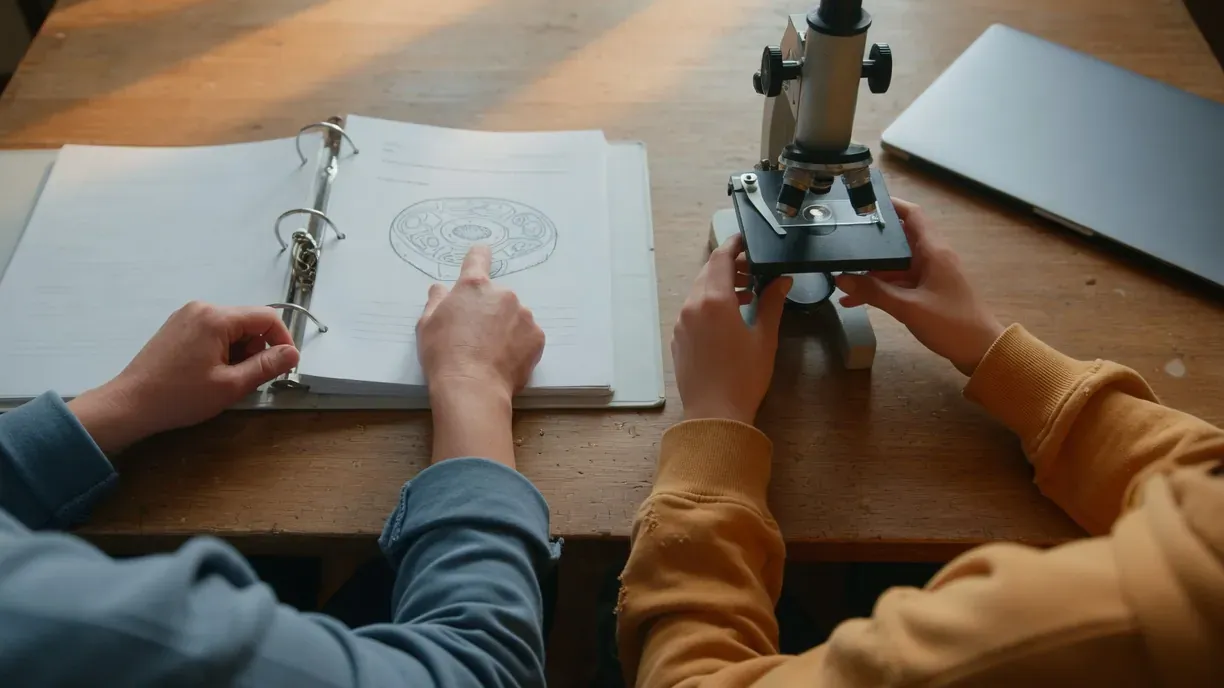
The simplest definition is this: a Bright Minds course pack is a set of teaching materials for an adult who will guide hands-on science. The course-pack orientation page names the likely adult: a parent, co-op teacher, or micro-school guide who stays involved in the learning.
A pack gives the adult a course to run. It does not replace the adult.
What families are actually getting
The FAQ says the published collection includes course maps, lab activities, rubrics, demonstration prompts, study guidance, and equipment references. In plain English, those parts answer four questions:
- What do we do this week? Course maps and learning pathways organize the sequence.
- What does the student do with their hands? Lab guides and practical activities keep the course physical.
- How do we judge the work? Rubrics and demonstrations describe what mastery looks like.
- How do we help a student study honestly? Public lessons, practice answers, AI-use guides, notebooks, and defenses support learning without turning assessment into a worksheet hunt.
NGSS calls for students to use practices and concepts together, rather than memorize detached facts.1 That is the reason the pack is organized around evidence, demonstrations, and repeated practice, not just reading.
What it is not
The site is explicit: a course pack is “a course you teach, rather than a class we teach for you.” It is not an online class with a teacher on the other end, not a video course your student watches alone, and not a portal subscription. The overview also says instructor training and a future portal are being developed, not currently offered as a credential or launched software service.
That distinction protects families from planning around facts that are not yet true. It also protects the science. Watching an explanation can help; doing the work, writing the notebook, and defending the evidence are different tasks.
The adult-guide role
The adult does not need to be a university professor to read a course page. But running a lab safely and assessing science require preparation and competence for the chosen activity. The remote home-lab page separates the roles clearly: the student does the thinking, the lab adult supervises the bench, and the guide judges the evidence when an assessment is arranged.
In a family setting, that adult may be a parent. In a co-op, it may be a teacher or guide. Guide training and certification are not currently offered. The certification pages in each instructor toolkit describe a proposed framework, not an available credential or a list of certified providers; the current program status explains what is available now.
Why practice materials are public
Students learn from practice when they can compare an attempt with feedback and try again. Spaced and interleaved practice helps students connect old and new material over time.3 That is why a pack can include public practice answers while keeping assessment separate.
Public practice materials help standardize instruction. They do not remove the adult’s judgment. A polished answer, especially one produced at home, is not the same as a watched performance or a live explanation from the student’s own notebook.
Three ways a pack might be used
- One family. A parent uses the map and resources with one student, then discusses fit, hazards, and support needs before planning any lab that requires more expertise.
- A co-op or micro-school. A guide uses shared rubrics and scheduling tools to run a group, remembering that calibration and preparation still matter.
- A separately arranged guide relationship. Leslie or another suitably qualified teacher may be involved only when the arrangement, availability, subject, cost, and responsibilities are confirmed. Today that conversation starts when you contact Leslie; the course-pack overview lists what to include.
Sources & further reading
- Next Generation Science Standards, Three-Dimensional Learning, verified Sept. 29, 2026. Used for the practices-plus-concepts framing.
- OpenStax, Biology 2e, verified Sept. 29, 2026. A free, openly licensed college biology textbook, listed for further reading.
- MIT Open Learning, Spaced and Interleaved Practice, verified Sept. 29, 2026. Used for the learning value of distributed practice.