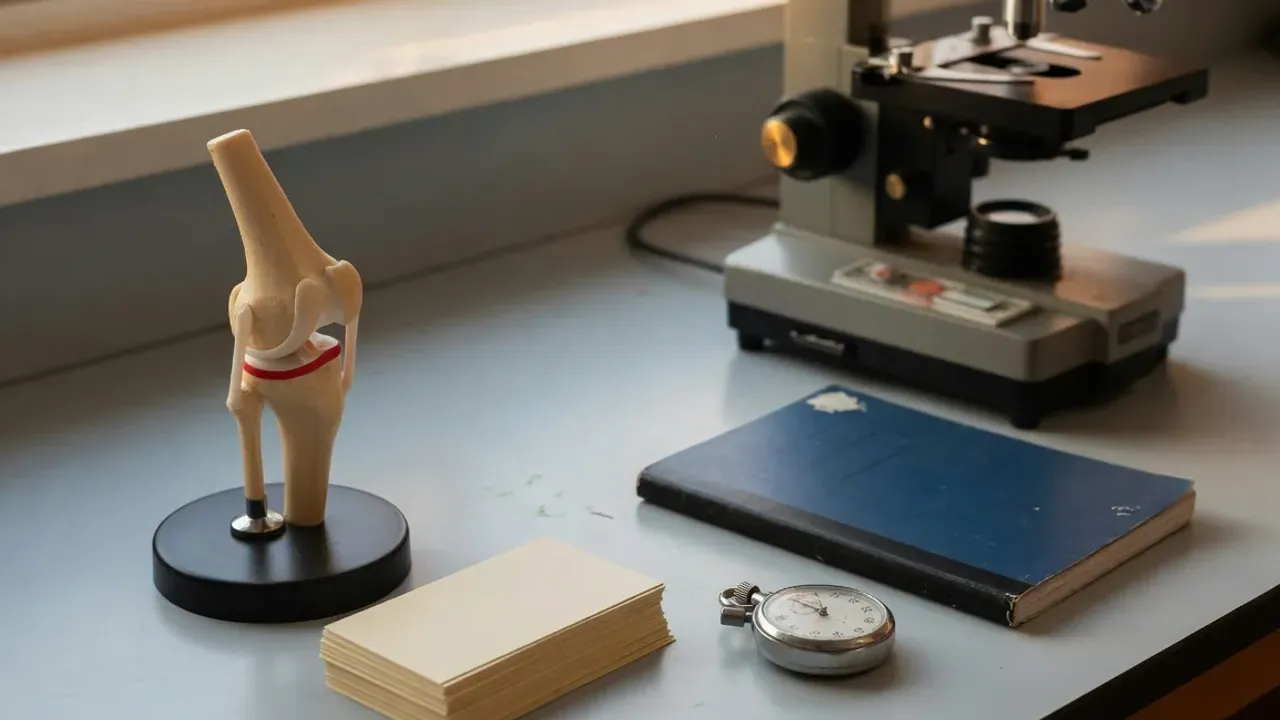
College lab shock: what changes before the first A&P lab.
The first college lab can feel different from high-school science because the expectations are procedural, spatial, vocabulary-heavy, and time-bound.
Some students arrive at college with strong grades and still feel stunned by the first Anatomy & Physiology lab. The shock is not only the amount of content. It is the kind of work: procedural, spatial, vocabulary-heavy, and time-bound.
Leslie’s college section gives the background for why Bright Minds writes about this transition. It says she formerly served as an anatomy and physiology adjunct lecture and lab instructor and laboratory coordinator at Boise State University, coordinating a multi-section lab program serving more than 1,000 students per term. The same page says Bright Minds is gathering interest in advanced preparation for college-level science and pre-health study.
College lab shock happens when recognition is treated as readiness.
Recognition is not the same as practical work
A multiple-choice item can ask whether a student recognizes a term. A practical station asks whether the student can identify a structure, use the vocabulary correctly, keep moving, and explain why the answer fits. Those are related skills, but they are not identical.
Students do not need to read a college text early. They do need to understand that college lab language becomes a working tool, not just a list.
The habits that help
- Notebook habits: recording observations, corrections, and questions while the work is happening.
- Terminology habits: using position, plane, direction, tissue, and system language precisely.
- Spatial habits: connecting a flat diagram, a model, a slide, and a real specimen or image.
- Retrieval habits: pulling an answer from memory without always looking back at the page.
The college resources page includes a study guide that describes ways to space study, retrieve answers from memory, mix related topics, and explain ideas in your own words. Research summaries from MIT and Carnegie Mellon make the same point: durable learning usually requires repeated, effortful recall over time.23
Preparation is support, not a guarantee
Bright Minds can discuss preparation for college-level science and pre-health study, and the main tutoring page describes “Personalized, research-based instruction that builds real understanding.” That does not promise a college grade, admission outcome, or placement result. It means the preparation should target the habits college labs actually demand.
A readiness checklist
- Can the student explain a diagram without reading the caption?
- Can the student keep a usable lab notebook without rewriting it later from memory?
- Can the student practice terminology out loud without waiting for a word bank?
- Can the student handle timed review without panic?
- Can the student say what evidence would change their answer?
For next steps, see the college section, college resources, the lab notebook essay, the hands-on lab essay, and science tutoring.
Sources & further reading
- OpenStax, Anatomy & Physiology 2e, fetched Sept. 29, 2026. Listed for further reading on the vocabulary and scope of a standard A&P course.
- MIT Open Learning, Spaced and Interleaved Practice, fetched Sept. 29, 2026. Used for the value of spacing and mixing practice over time.
- Carnegie Mellon University, Retrieval Practice, fetched Sept. 29, 2026. Used for the point that pulling information from memory is a learning strategy, not only an assessment.