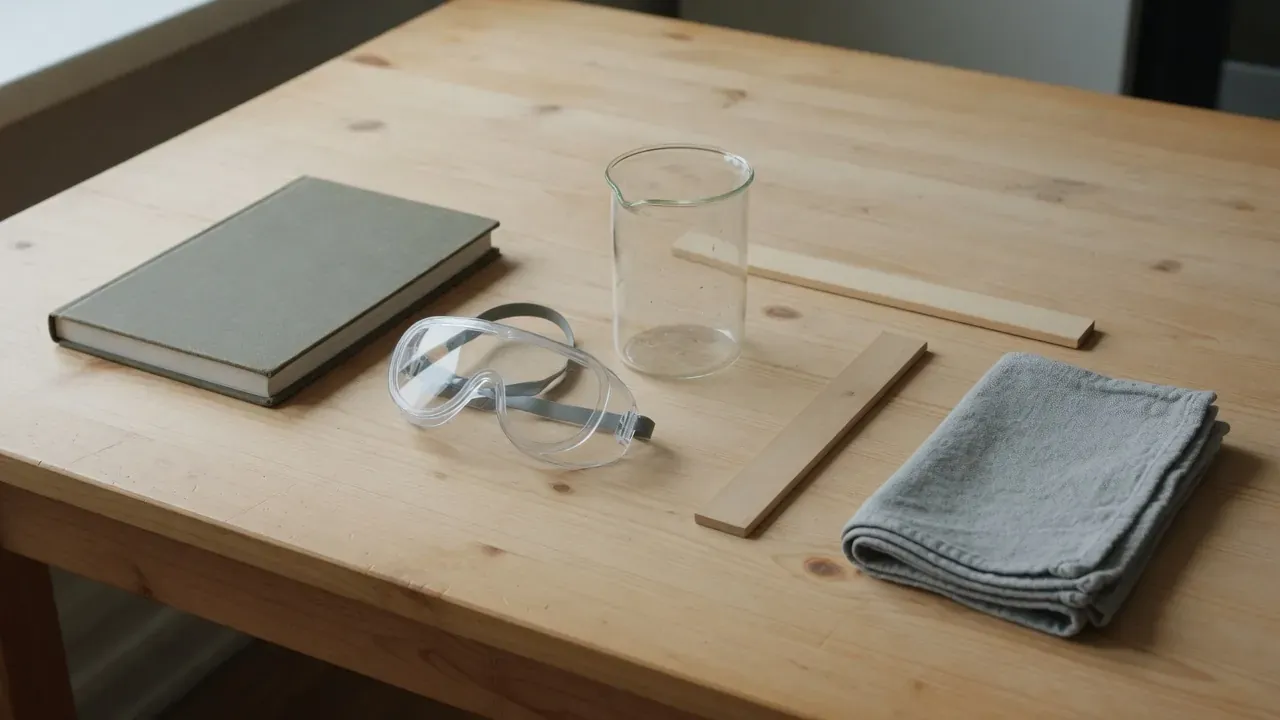
Home lab safety starts before the lab.
Real science at home begins with deciding what should and should not happen at home. These are the questions to settle before any home-lab work is planned.
When families ask about home lab work, the first question is usually about supplies. The better first question is about conditions: what kind of activity is being considered, who will supervise it, what the home can safely support, and what should be moved to a different setting or replaced.
The site is clear that the remote home-lab track is proposed, not a currently bookable remote class: “this page describes an approach we want to test with families and educators. It is not a currently bookable remote class or a directory of certified guides.” The safety conversation belongs before anyone buys materials or assumes a lab can travel.
Safety is not the last checkbox before science starts. It is part of deciding whether this version of the science should happen at all.
Readiness is bigger than age
Bright Minds serves older students, but grade band alone does not make a home bench ready. The course-pack FAQ says, “The catalog spans grades 7–12, with a suggested range for each subject. Reading, mathematics, prior science, and safe tool use matter as much as age.” For home labs, the room and adult matter too.
The home-lab safety page covers the broad categories families must think about before work begins: bench setup, protective gear, chemicals and reagents, sharps and dissection, heat and electricity, younger children and pets, and when to substitute a lab. This post does not repeat procedures. It explains why those categories should be settled with a qualified adult and, when applicable, the guide before any activity is attempted.
Some observations travel easily; some activities do not
A low-risk observation and a lab involving heat, sharps, preserved specimens, biological materials, or chemical hazards are not the same planning problem. A family may be comfortable with one and not the other. That is not failure; it is honest matching.
The remote home-lab page warns against promising the entire catalog from any kitchen: “Remote guidance may make otherwise inaccessible learning possible, but it is not automatically equivalent to an in-person course. The choice depends on the learner, available supervision, activity hazards, and what the guide can observe reliably.”
The adult role is not optional
The Bright Minds FAQ says, “A parent or teacher does need the subject knowledge and practical competence to supervise the selected activities and judge the work. The guides and rubrics make that preparation clearer; they do not replace it.” That is especially important at home, where a kitchen table may also be near younger children, pets, food, or daily household traffic.
NSTA’s safety position statement says hands-on investigations are essential for high-quality K–12 science instruction, while also carrying potential for injury and requiring safety programs that manage biological, chemical, and physical hazards.1 The home version should be just as honest: practical work is valuable, but practical work needs limits.
Ask before substituting materials
Substituting a material can change the activity, the hazard profile, and what can be assessed. A family should not assume that a household item, a cheaper source, or a different specimen teaches the same thing. The right question is not “Can we make this work somehow?” It is “Does this substitute still support the intended evidence, and is it appropriate for our setting?”
The home-lab safety page is written for exactly this moment. It tells families “how to set up, what to watch, and when to substitute a lab rather than force it.” Read it before a unit starts, and ask your guide before you swap any material, not after.
Remote does not mean unsupported
A proposed remote home-lab approach can widen access for rural or remote families. It should not blur responsibility. The remote page says, “The lab adult supervises the bench. The guide judges the evidence. The student does the thinking. Clear responsibilities matter at any distance.”
That sentence is the safest summary of the model: adults handle the room, the guide handles the evidence, and the student handles the learning. If any one of those roles cannot be filled for a specific activity, the activity should be changed, postponed, or moved to a setting that can support it.
For the proposed remote home-lab track, nothing is assumed in advance: “Equipment, supervision, subject knowledge, and the activities that can be assessed safely all need to be agreed.” Some labs travel home well; others need a plan, a substitute, or a supervised setting elsewhere.
Sources & further reading
- National Science Teaching Association, Safety and School Science Instruction, fetched Sept. 29, 2026. Used for the claim that hands-on investigations are essential but require serious safety planning.