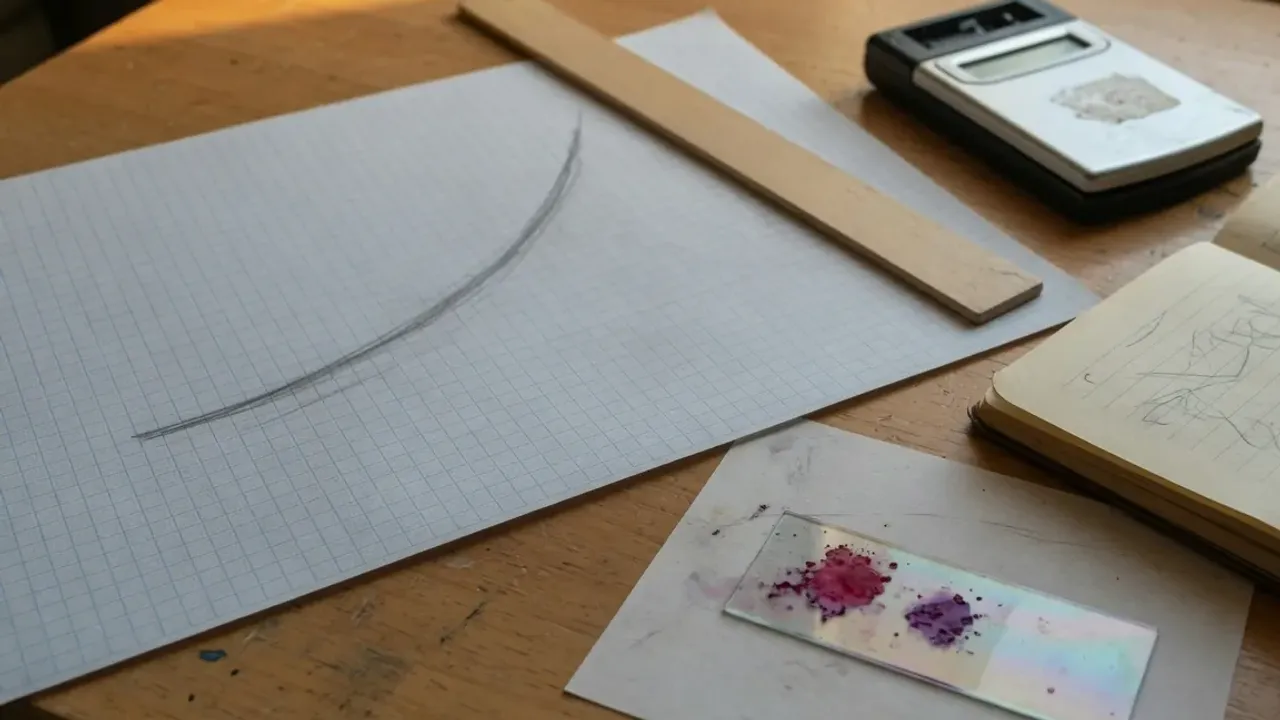
Why math and writing belong inside science class.
Calculations, sketches, short explanations, and lab paragraphs are not decorations around science. They are how students make evidence visible.
A student can memorize a vocabulary list and still be lost when the lab starts. That is one reason Bright Minds course materials keep asking students to calculate, draw, write, and explain. Those are not separate school subjects pasted onto science. They are part of how science works.
The course-pack hub describes the proposed materials as a way to “Explore a lab-led approach to science with course maps, practical work, rubrics, and live demonstrations” and as “a clearer way to teach, give feedback, and see what a student can do.” If a course is meant to show what a student can do, the work has to include the tools scientists actually use: quantities, diagrams, words, and evidence.
Integration is not extra enrichment. It is the habit of using the right tool for the scientific question.
Math makes the claim testable
In microscopy, field of view is a measurement problem. In chemistry, a beautiful explanation still fails if the units are wrong. In physics, a motion story becomes clearer when the graph has a scale and the axes mean something. In ecology, a pattern in counts or percentages can change the way a student interprets a system.
NGSS describes science learning as three-dimensional: practices, crosscutting concepts, and core ideas work together.1 That is why a lab question often asks for both a sentence and a number. The sentence without the number can become vague. The number without the sentence can become meaningless.
Writing makes the reasoning visible
A lab notebook is not a memory scrapbook. It is a place to record what was observed, where uncertainty entered, what changed, and what the student thinks the evidence supports. Writing from a notebook is different from writing a report from memory because the student has to return to the record, not just the conclusion.
NAEP describes its science assessment as measuring students’ knowledge and abilities, with item maps showing the skills students at each level can demonstrate.3 A short lab discussion paragraph can reveal whether a student understands the evidence, or whether they only remember the phrase the unit used.
Separating subjects can hide weak understanding
When math happens only in math class, a student may learn a formula without knowing when a quantity matters. When writing happens only in English class, a student may learn paragraph structure without practicing careful claims from evidence. Science exposes those gaps quickly.
A student who can explain a biology graph, sketch a rock layer sequence, calculate a dilution, and write a cautious claim from a messy dataset is not doing five unrelated assignments. They are practicing the same scientific habit from several angles.
What this looks like across course families
- Life science: microscope drawings, classification decisions, and claim-evidence-reasoning paragraphs.
- Physical science: unit conversions, graph reading, proportional reasoning, and short explanations of cause and effect.
- Earth and space science: map scale, time scale, model limits, and careful description of patterns.
- Health science: evidence literacy, data interpretation, and clear boundaries between science claims and personal advice.
That is why the course-pack hub emphasizes practical work and feedback, why mastery and retention matter, and why a real lab notebook can be more than a place to keep answers.
Sources & further reading
- Next Generation Science Standards, Three-Dimensional Learning, fetched Sept. 29, 2026. Used for the practices, crosscutting concepts, and core-ideas framing.
- Next Generation Science Standards, NGSS Appendices, fetched Sept. 29, 2026. Listed for additional background on science practices and crosscutting concepts.
- National Center for Education Statistics, NAEP Science, fetched Sept. 29, 2026. Used for the point that science reporting includes what students know and can do.