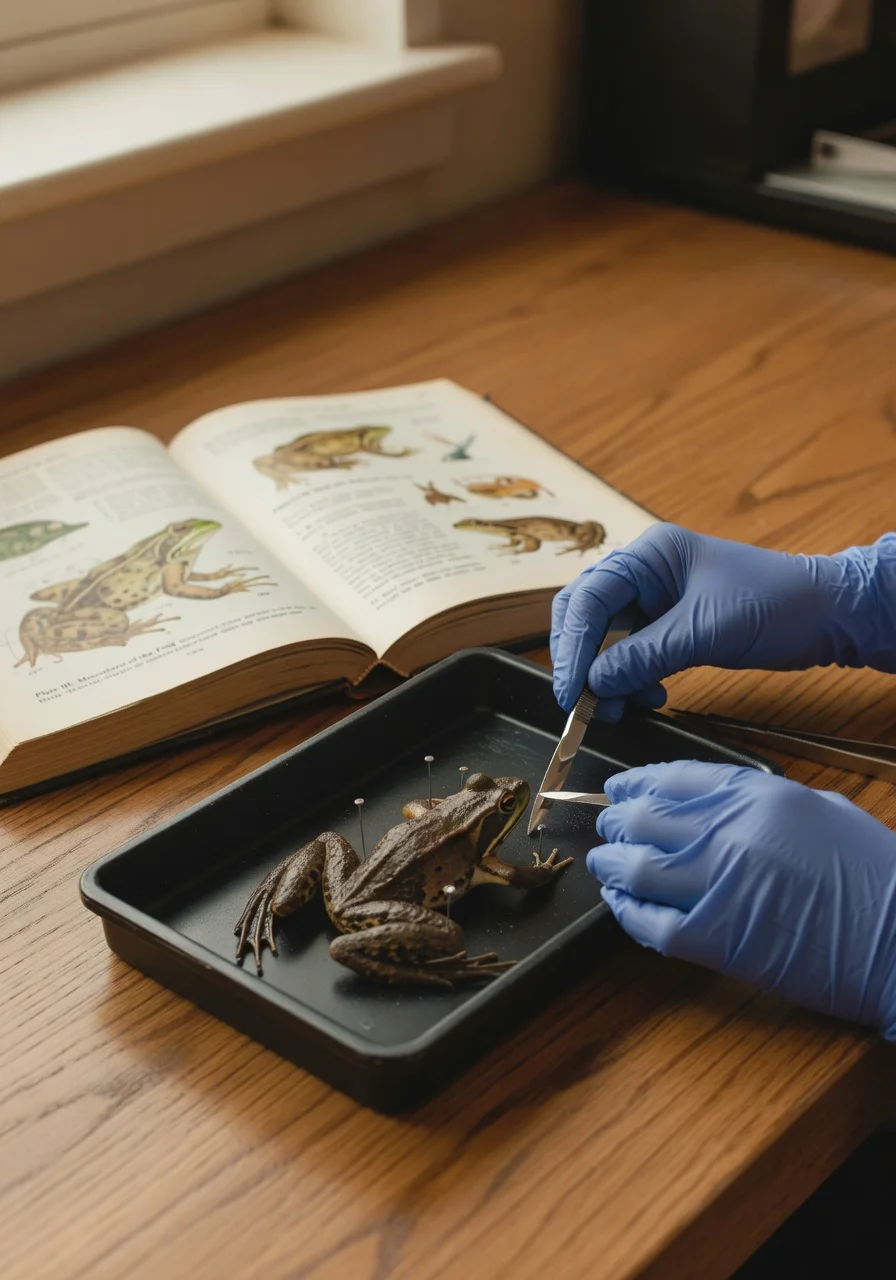
What dissection actually teaches.
The squeamish-kid essay. Every parent who calls about the cohort asks some version of this question: my kid isn’t sure they wants to cut a frog open. Good. Neither were any of mine. Here’s what happens between the first incision and the last one.
Here’s the thing nobody warns parents about dissection: the kids who are most worried about it are usually the ones who get the most out of it.
The students who arrive casually, including those who have been promising for weeks to “rip it apart,” are almost never the ones holding the scalpel by the second hour. The kids who walked in quiet, gloves a little too tight, are the ones I usually have to drag back to the rest of the schedule because they’ve spent forty minutes on the heart and want to keep going.
That isn’t random. It’s the lesson.
What we’re actually doing at the bench
We dissect a small, finite list of specimens at Bright Minds: an earthworm, a starfish, a clam, a grasshopper, a perch, and the centerpiece, a fetal pig. They are all preserved specimens bought from established biological-supply companies.1 Nothing is killed for our classes.
Before any tool comes out of its tray, we do two things. First, the students sketch the specimen, intact, in the lab notebook, recording its name, length, weight, and condition. Second, we have a short, honest conversation: this animal lived. We’re going to learn from its body. The fact that it’s small and dead does not make it not worth careful attention.
This is the first thing dissection teaches, and the most important. It is not callousness. It is the opposite. It is reverence. The kids who’ve never done a real dissection sometimes show up expecting it to be a horror movie. They leave understanding that it is closer to a quiet, careful kind of attention, the same attention a surgeon, a veterinarian, or a forensic pathologist would eventually need.
“Reverence is the first thing learned. Callousness, never.”
What a video literally cannot teach
A good dissection video is a useful study tool. I assign them. But three things are not transmissible by screen, and any college anatomy instructor will tell you the same:
Every angle, every neighboring organ, real depth, rather than a camera’s chosen view.
The textbook shows the canonical case. The bench shows the actual one.
Control of scalpel depth and the choice of scissors over a blade belong to the same family of skills as suturing or drawing blood.
- Three-dimensionality. A video is a 2D projection of a 3D object. The student watching the video sees an organ from one angle, the camera’s. The student at the bench sees it from every angle, in relation to every neighboring organ, with depth and texture and weight. The mental model that gets built is different in kind, not just degree. This is the reason cadaver lab still exists in medical school in the era of CT.2
- Variation. Every specimen is slightly different. The textbook and the video show the canonical case. The bench shows the actual one, with its slightly atypical aortic arch or unusually long mesentery, and the student has to figure out whether the variation matters. That comparison between the general and the particular (Is this normal? Is this pathological? Am I looking at it incorrectly?) introduces the skill of clinical reasoning in a single afternoon.
- Fine motor skill under attention. Holding the scalpel correctly. Knowing the depth of a cut. Choosing the scissors over the scalpel for a delicate membrane. These are motor skills, the same family as suturing, drawing blood, or threading a catheter. They live in the hands and they cannot be downloaded.3
The kid who decides this isn’t for them
Now and then, a student finishes the cohort and decides quietly that medicine, nursing, or research isn’t their path. They found out at fourteen, in a Saturday lab in Boise, instead of at twenty, three semesters into a pre-med program with student loans and a family of expectations.
A practical experience can help a student ask better questions about further study. Disliking one activity does not decide a career, just as enjoying it does not establish readiness for professional work.
Give students a chance to try the work, reflect on it, and decide what they want to learn next.
What parents can ask
Ask your student to explain one structure they observed and how it connects with another. They can use a labeled drawing or notebook page to support the explanation. Ask what they found difficult and what they would like to examine more closely.
That’s what dissection actually teaches. Not gore tolerance. Not the appearance of being “advanced.” A genuine, three-dimensional, you-figured-it-out-yourself understanding of how a vertebrate body is put together, and the quiet confidence of someone who knows they have actually seen the thing they’re talking about.
A student's ability to explain the work gives a family something specific to discuss. Later courses will bring new expectations, techniques, and material to learn.
We don’t dissect for shock. We dissect because biology is three-dimensional, and the only honest way to learn a three-dimensional thing is in three dimensions, with your hands.
Sources & further reading
- Bright Minds dissection specimens are preserved teaching specimens bought from established biological-supply companies, such as Carolina Biological Supply. Nothing is killed for our classes.
- Ghosh, S. K. (2017). “Cadaveric dissection as an educational tool for anatomical sciences in the 21st century.” Anatomical Sciences Education, 10(3), 286–299. doi:10.1002/ase.1649. A representative review of why hands-on cadaveric work persists in medical education despite the rise of imaging and digital anatomy tools. The three-dimensional variation, the procedural skill, and the professional socialization simply don’t transfer through a screen.
- On procedural and fine-motor skill acquisition as a distinct learning channel from cognitive content learning, see McGaghie, W. C., Issenberg, S. B., Cohen, E. R., Barsuk, J. H., & Wayne, D. B. (2011). “Does simulation-based medical education with deliberate practice yield better results than traditional clinical education? A meta-analytic comparative review of the evidence.” Academic Medicine, 86(6), 706–711. doi:10.1097/ACM.0b013e318217e119. Background on deliberate practice itself: K. Anders Ericsson and Robert Pool, Peak: Secrets from the New Science of Expertise (2016).
Posted Apr 30, 2026.