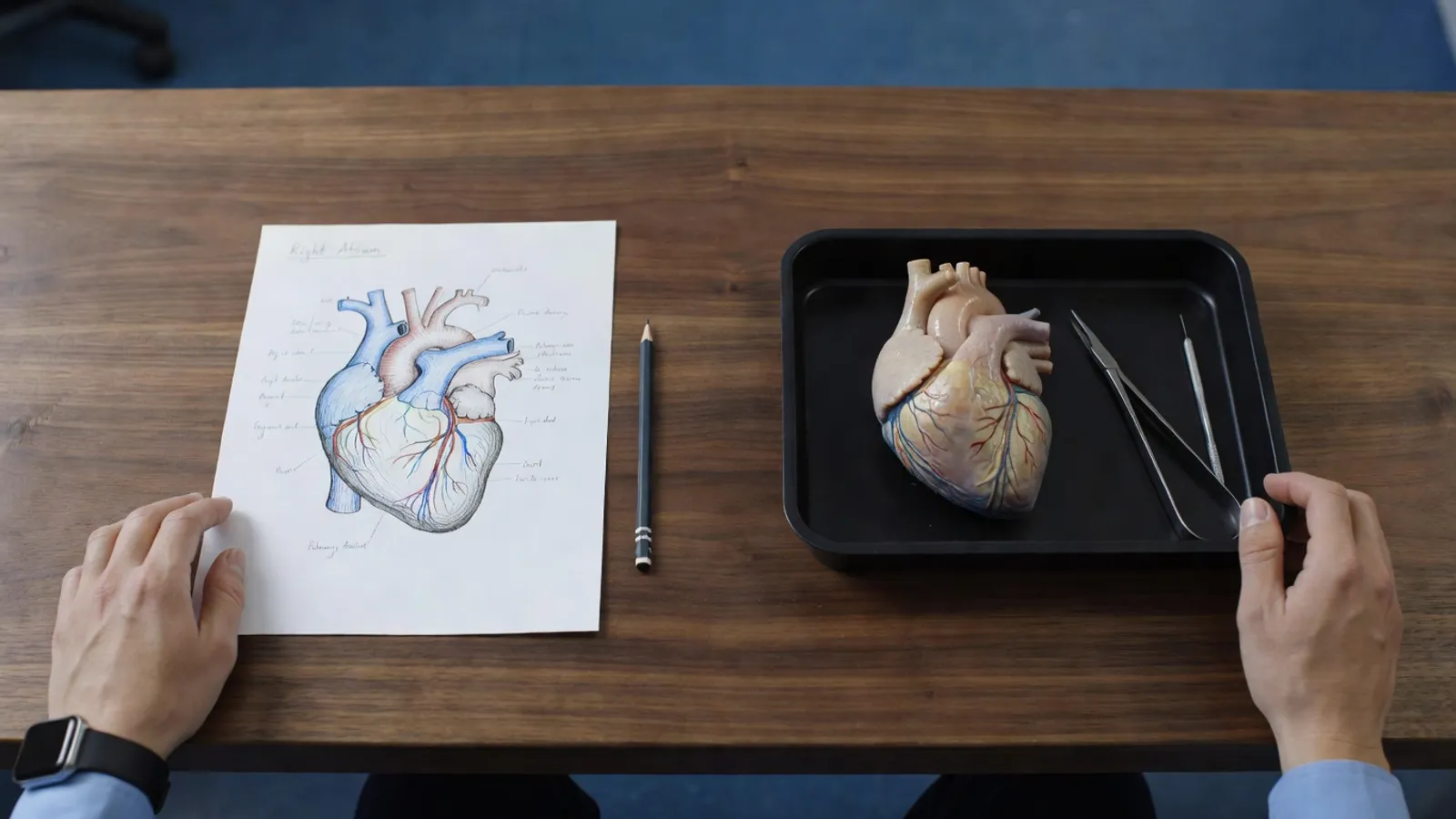
Replacing bench work with paper exercises: a measurement problem.
Replacing a bench activity with a paper exercise is a proposal we can test. The key question is whether students can still demonstrate the intended skill. Research on transfer of learning helps us decide what evidence to look for.
Suggestions to replace bench activities with paper exercises usually arrive in good faith. They tend to be motivated by real concerns: lab time is expensive, prep load is high, supply costs have risen, some students find the bench environment intimidating. Each of those concerns is legitimate and deserves a serious response.
A proposed paper substitute rests on a claim: practice on the page will prepare students to perform the intended task. Applying learning from one setting to another is called transfer. Educational research helps frame the question, but a specific replacement still needs evaluation in its own teaching context.
Paper exercises can help students learn names, sequences, and explanations. That does not by itself show that students can use an instrument or identify a structure on an unfamiliar specimen. If we assess only the paper task, we may miss a gap in the hands-on skill.
What “transfer” means
Transfer means applying something learned in one context to another. The literature distinguishes near transfer, where the new context closely resembles the original learning context, from far transfer, where the contexts differ substantially in several ways.
Identifying a familiar structure on a second, similar diagram is an example of near transfer. Applying that knowledge in a substantially different task is harder to assume. The Detterman and Sternberg volume Transfer on Trial argued, on the basis of a substantial review, that far transfer is rare in laboratory studies and harder to produce than intuition suggests.1 Barnett and Ceci's later framework describes how contexts can differ, including the setting, timing, task, people, and subject matter. It helps us specify what a transfer claim asks students to do.2
Moving from a worksheet to a specimen may change several things at once: the material, the action required, and whether the student works alone or with a partner. Rather than assume success or failure, ask which parts of the skill transfer and what additional practice students need.
What paper exercises can teach
A well-designed paper exercise can support declarative knowledge: facts about structures and procedures that students can state. It can train recognition of correct sequences when the steps are listed and the student is asked to order or identify them. It can build the ability to label a diagram, sometimes more efficiently than the bench, since the labeled diagram is the test condition.
These are useful outcomes, and paper work may strengthen what students learn in lecture. The question is whether a replacement also preserves the skills that were practiced at the bench.
Which skills need separate evidence
The four kinds of learning discussed in essay 01 are procedural skill, decisions under uncertainty, identification on unfamiliar specimens, and comparison of observations with a partner. A labeling worksheet does not directly demonstrate these skills. Some paper activities can support reasoning and collaboration, but handling an instrument still requires hands-on practice and observation.
Research on simulation-based medical education supports deliberate practice for procedural learning.3 It does not establish the effect of every undergraduate worksheet replacement. The comparison below illustrates why an individual labeling exercise should not be treated as evidence of every skill a hands-on task might assess.
| Learning category | Bench task | Paper analog | Where the gap shows up |
|---|---|---|---|
| Declarative knowledge | Yes | Yes | No gap, either works |
| Diagram recognition | Yes | Yes | No gap, either works |
| Procedural memory | Yes | No | First clinical procedure |
| Decision under uncertainty | Yes | No | Atypical patient presentation |
| Perceptual identification | Yes | No | Specimen / chart / scan |
| Social calibration | Yes | No | First clinical team |
Why a learning gap may appear later
A paper assessment may not reveal a gap in practical skill. A student can know the steps of a procedure without being able to perform them. If the course does not observe performance, the difficulty may first become apparent in a later course or placement.
The transition-to-practice literature in nursing has documented this pattern at scale. Kavanagh and Szweda's national study of new-graduate nurses found that fewer than one in four entered practice with the level of clinical-judgment competency expected for safe practice, even though the same graduates had passed their academic coursework and the NCLEX.4 Casey, Fink, and colleagues' graduate-nurse experience surveys report a similar lag between credentialed competence and applied competence in the first six to twelve months of practice.5 These studies raise questions about preparation for practice; they do not show that replacing a particular undergraduate lab caused the reported difficulties.
To find a gap in practical skill, we need to observe practical performance. A written score alone may not reveal it.
Where paper substitution is defensible
Paper exercises have a useful place in a laboratory course. Their value depends on the learning goal, not simply on whether the activity uses paper or a specimen.
Paper exercises are excellent for pre-lab preparation, where their function is to bring the student into the lab session ready to spend the bench time on the procedural and perceptual work, not on memorizing names. They are excellent for moving rote memorization off the bench, freeing the bench hour for tasks that require it. They are excellent for assessing declarative knowledge specifically, when that is the construct the assessment is designed to measure. They may also form part of an accessible alternative. The instructor and the institution's accessibility staff should determine how that alternative meets the course's essential learning requirements.
Paper exercises can be valuable complements to bench work. Before using them as substitutes, identify which learning goals they cover and which still require another form of practice or assessment.
Considering costs without losing the learning goal
Cost is one reason to consider substitution. Bench time is expensive. Prep load is high. Supplies and consumables have risen in price. Sections compete for limited lab space and limited instructor coverage. The cost concern is legitimate, and dismissing it is neither fair nor effective.
Ask whether costs can be reduced while preserving the intended learning. Options to consider include better scheduling to use bench time more efficiently; supplies and consumables review; cross-section standardization to reduce prep load per offering; pilot reductions tested against measurable outcomes before broad rollout; and where the reduction is necessary, careful selection of which bench tasks can be reduced (the ones serving fewer of the four learning categories) versus which should be defended (the ones serving several at once).
A practical implication
For any program weighing paper substitution for a bench activity, three questions are worth answering honestly before the change is made:
- What knowledge or skill does the bench task assess that the paper exercise does not? What evidence supports the comparison?
- How will we detect, in the next 1–3 years, whether the substitution has affected preparation for later work?
- What is the cost saving, expressed honestly, against the measurement loss? (Sometimes the saving is real and the loss is small. Sometimes not.)
Clear answers give a program a better basis for deciding. Where evidence is missing, a limited pilot and a plan to assess performance may be the next step.
References & further reading
- Detterman, D. K., & Sternberg, R. J. (eds.) (1993). Transfer on Trial: Intelligence, Cognition, and Instruction. Norwood, NJ: Ablex. The volume that crystallized the modern transfer-skepticism position, with substantial review of why far transfer has been hard to demonstrate empirically.
- Barnett, S. M., & Ceci, S. J. (2002). “When and where do we apply what we learn? A taxonomy for far transfer.” Psychological Bulletin, 128(4), 612–637. doi:10.1037/0033-2909.128.4.612. The standard taxonomic framework for thinking about transfer distance along multiple dimensions.
- McGaghie, W. C., Issenberg, S. B., Cohen, E. R., Barsuk, J. H., & Wayne, D. B. (2011). “Does simulation-based medical education with deliberate practice yield better results than traditional clinical education? A meta-analytic comparative review of the evidence.” Academic Medicine, 86(6), 706–711. doi:10.1097/ACM.0b013e318217e119. The meta-analytic evidence that hands-on practice with deliberate practice protocols outperforms equivalent instructional time spent on knowledge-based or paper-based training for procedural skill outcomes.
- Kavanagh, J. M., & Szweda, C. (2017). “A crisis in competency: the strategic and ethical imperative to assessing new graduate nurses' clinical reasoning.” Nursing Education Perspectives, 38(2), 57–62. doi:10.1097/01.NEP.0000000000000112. The national study reporting that approximately 23% of new graduate nurses entered practice with the clinical-reasoning competency expected for safe practice.
- Casey, K., Fink, R., Krugman, M., & Propst, J. (2004). “The graduate nurse experience.” Journal of Nursing Administration, 34(6), 303–311. doi:10.1097/00005110-200406000-00010. The originating study for the Casey-Fink Graduate Nurse Experience Survey, used widely in transition-to-practice research to track the lag between credentialed and applied competence in the first year of practice.
Drafted May 2026.