Unit 01 · Tools, Safety & the Ethics of Dissection
This unit establishes the approved route, the safety contract, and the evidence rule: no improvised procedures, no live-animal procedures, and no practical-skill credit unless the technique is observed.
Student learning: Tools, Safety & the Ethics of Dissection
Choose the route and level by prerequisites, access needs, and approved supervision before instruction. Foundation, core, and honors tasks are study pathways for this Grades 8-12 semester lab-skills course, not an AP course, college credit, or credential claim.
Prerequisites: Knows instrument names, PPE expectations, opt-out rights, and that no live-animal procedures are permitted.
Suggested sequence: read the assigned section, study the teaching explanation, analyze the labeled synthetic data, attempt the selected level, check the answer, then complete a fresh transfer defense. These lessons supplement the assessment packet and do not authorize any procedure.
Assigned reading and focus
- NSTA Scope on Safety member article teaser: Dissection--Don't cut out safety. [approved-routes] Caution: this is a member-article teaser, not a full position statement. Use it only as a safety prompt, not as evidence that alternatives are automatically equivalent.
- NABT: The Use of Animals in Biology Education. [approved-routes] Use NABT’s caution about animal-use alternatives to explain the course policy: concept routes can be equivalent, while technique is credited only when observed.
- NLM Historical Anatomies: Andreas Vesalius. Use the Vesalius anatomy source as the history anchor: firsthand observation demands responsibility, not improvisation.
Learn the science
Choose readiness by prerequisites and route approval, not age alone. Public worked answers are nonsecure practice, and no page authorizes a procedure outside the educator-approved plan.
Approved route and safety defense. A safe dissection course starts before any incision. The route is selected first: an observed preserved-specimen task, a professionally supervised equivalent, or an image-based, virtual, or model route. Equivalent image-based, virtual, professionally supervised, and model routes meet the same conceptual standard; practical skill is credited only when an educator observes the actual hands-on technique.
Assumptions: The synthetic route log separates conceptual evidence from observed technique so a student who opts out is not penalized for the conceptual standard, and a student who has not been observed does not receive practical-skill credit.
Uncertainty: The dataset does not describe real students, allergies, specimens, or accommodations. It only models how route evidence should be recorded before the lesson begins.

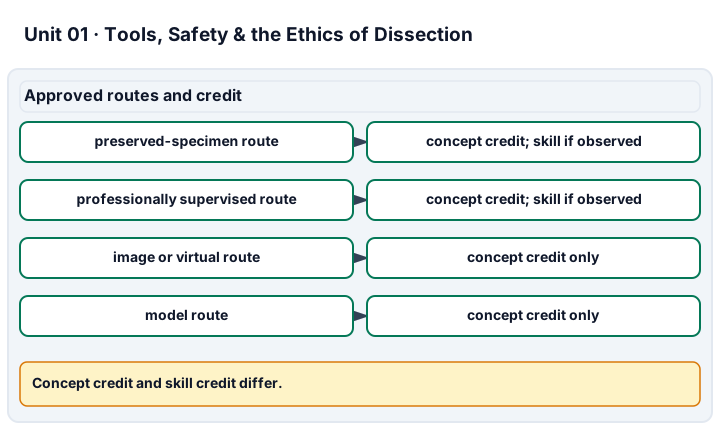
Diagram description
The grid shows approved routes and the kind of evidence each can support. Preserved-specimen and professionally supervised routes can support concept credit and skill credit if observed by an educator. Image, virtual, and model routes support concept credit only. No procedure, tool, or handling step is included.
Data, provenance, and assumptions
| Learner route | Access note | Approved plan | Skill evidence | Concept evidence |
|---|---|---|---|---|
| A | preserved specimen | educator procedure and SDS | observed | conceptual-equivalent |
| B | image-based opt-out | approved image set | not-observed | conceptual-equivalent |
| C | virtual model route | approved simulation | not-observed | conceptual-equivalent |
| D | professionally supervised lab | partner site procedure | observed | conceptual-equivalent |
Paper investigation sequence and evidence record
Scope and safety: No improvised procedures, preservatives, latex or other allergens, or instruments are introduced by these public lessons. Hands-on work must follow the educator-approved procedure and SDS, use ethically and legally sourced preserved specimens, and respect opt-out access to an equivalent image-based, virtual, or model route without penalty. No live-animal procedures are part of this course.
Materials and preparation
- [approved-routes] Use the supplied safety-route-records records, assigned source sections, calculator and an accessible graph or diagram. No physical apparatus is required.
Procedure and schedule
- [approved-routes] Question: Which evidence route is approved before the unit begins, and what kind of evidence can it support? Prerequisites: Knows instrument names, PPE expectations, opt-out rights, and that no live-animal procedures are permitted.
- [approved-routes] Variables: Route type, approval status, observed skill evidence, and conceptual evidence are recorded separately. Controls: Every route uses the same conceptual question and source standard; hands-on technique is never inferred from a paper response. Replication: Audit each route with the same checklist before instruction and again when evidence is submitted.
- [approved-routes] Analysis: Calculate the share of routes with observed practical evidence and identify where a report would overclaim. Review: An educator reviews prerequisites, source interpretation, reasoning and accessibility before assessment. A paper response does not certify unobserved practical technique; approved hands-on work requires a separate record.
Record: Retain approved-routes, the selected level, original inputs and first attempt, source/date, system and axes, units, assumptions, calculation/graph, uncertainty, correction and fresh transfer. Link only to the stated science criteria.
Worked model
Four synthetic route records include two observed practical routes and four routes with conceptual-equivalent evidence; 2/4 = 50% have practical observation and 4/4 = 100% have conceptual-equivalent evidence.
Numerical calibration
- 50 % observed practical routes
- 100 % with conceptual evidence
Attempt the assigned level
Try the tasks before reading the calibration. These are practice answers, not a secure examination; use a new specimen, image set, model, or supervised task for assessment.
Foundation: guided specimen literacy and source-backed vocabulary
- Sort each route into observed practical evidence or conceptual-equivalent evidence, then name one safety boundary that applies to all routes.
Check after your attempt
- Observed practical evidence appears only for routes A and D. All routes still require the approved procedure or approved source set, SDS where chemicals or preservatives are present, and no improvised steps.
High-school core: typically grades 9-10, semester lab-skills course with independent evidence and approved routes
- Write the course-access rule for a learner who opts out of dissection and explain how practical skill is recorded fairly.
Check after your attempt
- The learner receives an equivalent image-based, virtual, or model route without penalty for the concept. Practical skill is recorded only if an educator or approved professional observes the hands-on task.
Honors extension: typically grades 11-12, quantitative morphology and comparative physiology
- Use the route table to audit a proposed grade report and identify one entry that would overclaim practical skill.
Check after your attempt
- A report that gives B or C hands-on technique credit overclaims. Their conceptual evidence may meet the standard, but the report must say practical technique was not observed.
History, reading, and writing connection
Use the Vesalius history anchor and NABT caution to explain the course’s equivalent-route policy: concept routes can meet the standard, while practical technique is credited only when observed.
Write in your own words or use an approved accessible equivalent. Cite a specific assigned section, identify its evidence, and state one limitation.
Transfer to a new case
A student uses a high-resolution specimen video and correctly defends tool choice, orientation, and disposal. What can and cannot be credited?
Calibration: Credit conceptual understanding and the equivalent-route standard. Do not credit scalpel, pinning, or station technique unless a qualified educator observes that work on an approved task.
Evidence to retain
Completion evidence: the student defends a real specimen identification, explains a valid cross-specimen comparison, and states the limits of the evidence. Safety evidence also includes the chosen route, SDS/preservative/allergen check, legal and ethical source, disposal plan, and whether practical skill was observed.
Record route, units, source/date, observed structures, calculations, comparison category, uncertainty, and what is measured versus inferred. No improvised procedures, preservatives, latex or other allergens, or instruments are introduced by these public lessons. Hands-on work must follow the educator-approved procedure and SDS, use ethically and legally sourced preserved specimens, and respect opt-out access to an equivalent image-based, virtual, or model route without penalty. No live-animal procedures are part of this course.
Return to all eight learning pathways. Print this unit page for student learning; the linked five-page packet remains the separate assessment companion.
Evidence, routes, and comparison limits
Integration is reported separately and cannot lower the science grade or block a science demonstration pass. Science and practical criteria determine that pass.
Completion evidence: the student defends a real specimen identification, explains a valid cross-specimen comparison, and states the limits of the evidence. Safety evidence also includes the chosen route, SDS/preservative/allergen check, legal and ethical source, disposal plan, and whether practical skill was observed.
Equivalent routes: Image-based, virtual, model, and professionally supervised routes can meet the same conceptual standard without penalty. Practical skill is credited only when hands-on technique is observed on an approved route.
Safety and ethics: No improvised procedures, preservatives, latex or other allergens, or instruments are introduced by these public lessons. Hands-on work must follow the educator-approved procedure and SDS, use ethically and legally sourced preserved specimens, and respect opt-out access to an equivalent image-based, virtual, or model route without penalty. No live-animal procedures are part of this course.
- Science 1: Identifying & naming the instruments. Approved specimens, images, models, or virtual route materials can evidence correct instrument/tool identification and purpose without requiring hands-on technique. Rubric row.
- Science 2: Safe handling & cutting technique. Only an educator-observed approved practical or professionally supervised route can evidence Safe handling & cutting technique; supplied data, images, virtual routes, or models can support planning and explanation but cannot credit hands-on skill. Rubric row.
- Science 3: Specimen care & the ethics of respectful use. The route log can evidence whether care, disposal, SDS, allergen, preservative, and ethical-source planning were named before work; observed respect still requires an approved practical record. Rubric row.
- Science 4: Setting up & maintaining a clean dissection station. Only an educator-observed approved practical or professionally supervised route can evidence Setting up & maintaining a clean dissection station; supplied data, images, virtual routes, or models can support planning and explanation but cannot credit hands-on skill. Rubric row.
- Science 5: Following a procedure & recording observations. The synthetic route records evidence whether the learner distinguishes observed practical evidence from conceptual-equivalent evidence and records the route honestly; following the procedure at the bench is credited only when observed. Rubric row.
Unit mastery rubric
| Criterion | Developing | Proficient | Mastery |
|---|---|---|---|
| Identifying & naming the instruments | Cannot reliably name the scalpel, dissecting scissors, probes, forceps, or pins, or say what each is for. | Names most instruments but confuses the blunt and sharp probe or reaches for the wrong tool for the cut. | Names every instrument on sight and explains its purpose before work begins; approved image, model, or virtual routes can evidence naming, not hands-on handling. |
| Safe handling & cutting technique | Handles the scalpel carelessly, cuts toward the hand, or works without gloves or eye protection. | Cuts away from the body and wears protection when reminded, but still presses too hard or leaves sharps unguarded. | Uses PPE, sharps discipline, SDS/preservative and allergen checks, and the educator-approved procedure without improvising. |
| Specimen care & the ethics of respectful use | Handles the specimen roughly or jokes about it, lets it dry out, and disposes of it thoughtlessly. | Handles the specimen carefully and keeps it moist when reminded, but treats the work casually. | Handles ethically and legally sourced specimens respectfully when observed, or completes the conceptual specimen-care explanation on an approved alternative route without penalty. |
| Setting up & maintaining a clean dissection station | Works from a cluttered tray with the specimen unpinned and loses track of orientation and instruments. | Sets up the tray and pins the specimen but lets the station get disorganized or skips cleanup. | Sets up, maintains, and cleans the station and keeps route evidence distinct; this station criterion requires educator observation. |
| Following a procedure & recording observations | Ignores the procedure and records nothing, or writes down guesses instead of observations. | Follows the steps in order but records observations sparsely or out of sequence. | Follows and records the chosen route, observations, safety checks, and whether practical skill was observed; conceptual records may be completed on approved alternatives; following the procedure at the bench is credited only when observed. |
| Integration (cross-domain) | Makes no supported connection between the source and the science. | Uses the source but needs help connecting evidence, writing, or limitations to the science. | Independently connects History, Reading, and Writing using a cited source, appropriate evidence, a limitation, and a scientific explanation. |
Integration is reported separately and cannot lower the science grade or block a science demonstration pass. Science and practical criteria determine that pass. Use the integration guide's evidence checklist for the separately reported criterion.
“I laid out the tray, pinned the specimen down, and kept everything moist. I named each tool as I picked it up — scalpel for the first shallow cut, blunt probe to separate tissue without tearing it — and I always cut away from my hand with gloves and goggles on. I wrote down what I saw at each step, and I’ll dispose of the specimen the way the procedure says.”
“I think this one’s the scissors? I just started cutting — kind of toward myself — and it got dry and messy. I didn’t really write anything down.”
You demonstrate this unit by doing it while an instructor watches — setting up the station, naming and handling the instruments safely, caring for the specimen, and following a procedure — not a written test. Technique criteria are mastered only when an educator observes them; identification and explanation criteria can be mastered on the approved specimen, image, model, or virtual route without penalty. Mastery is demonstrated, not awarded.
A 5-page clipboard packet — unit overview, key terms, the mastery rubric, anchor examples, and a score sheet you can print and grade against.