Unit 04 · Earth's History & Geologic Time
This unit reads time out of rock: the principles of relative dating that order events without a clock, radiometric dating and half-life that put actual numbers on them, the geologic column assembled from layers worldwide, and the fossils that mark and correlate the ages. Mastery means you can read a rock sequence as a calendar millions of years deep — and grasp that geologic time is vast in a way everyday intuition is not built for.
Student learning: Connect isotope fractions, logarithmic ages and ordered events
Choose the level by readiness, not age alone, and record it before instruction. Foundation, core, and honors tasks are study pathways, not an AP course or a promise of college credit. The instructor retains practical assessment and the published science rubric; integration is reported separately.
Prerequisites: Foundation: repeated halving and time scaling. Core: ratios and relative sequence. Honors: logarithms and monotonic bounds. Readiness check: after two half-lives the parent fraction is 1/4, not zero. Use the halving table before the logarithmic extension if powers or ratios are unfamiliar.
Suggested sequence: read and discuss the explanation; attempt the worked model; analyze the data at your selected level; check the answers; then complete the source-linked response and a fresh transfer question. These activities supplement, not replace, supervised practical work and the full-year schedule.
Assigned reading and focus
- Steven Earle, Physical Geology 2e, 8.4: Isotopic Dating Methods. Read the decay-curve explanation and the assumptions about daughter material and retention. The book's K-Ar example is simplified; the exercise below deliberately uses a hypothetical single-daughter clock, not a potassium-argon laboratory calculation.
Learn the science
A constant decay probability produces exponential parent loss. If H is half-life and f the remaining parent fraction, f = (1/2)^(t/H). Therefore t = -H ln(f)/ln(2). Fractions must be positive and no larger than one in this simple clock.
The clock below has H = 100 Myr and one daughter for each decayed parent. If P is surviving parent, D total daughter and D0 initial daughter, f = P/(P + D - D0). Counts are proportional atom counts, not gram masses.
A numerical age depends on closure, a known decay law and correct initial-daughter treatment. Loss of parent or daughter, reheating, inheritance and branching decay require additional analysis. An age can date mineral closure rather than deposition of the sediment around it.
Relative ordering and numerical dating are complementary. In the supplied upright sequence, lower sediment L was deposited before ash A, then upper sediment U; intrusion I cuts all three. The ash and intrusion can constrain ages, but do not give an exact age for every grain or event.

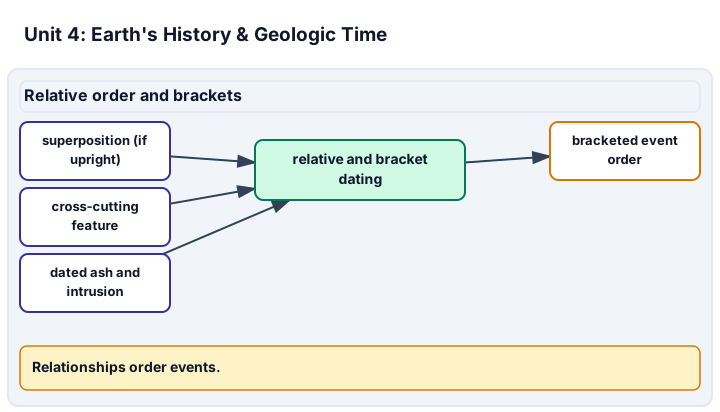
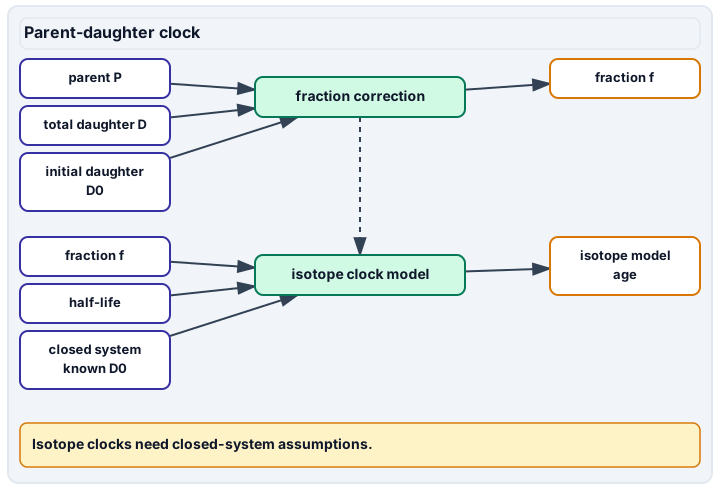
Diagram description
Relative order uses lower/upper layer relations, cross-cutting relations and dated ash/intrusion brackets to build event order. The isotope panel computes remaining parent fraction from parent, total daughter and initial daughter before using fraction and half-life to compute an isotope model age under closed-system assumptions.
Data, provenance, and assumptions
| Elapsed half-lives | Parent fraction | Time (Myr) |
|---|---|---|
| 0 | 1 | 0 |
| 1 | 0.5 | 100 |
| 2 | 0.25 | 200 |
| 3 | 0.125 | 300 |
| H (Myr) | Parent P (count units) | Daughter D (count units) | Initial D0 (count units) | Separate f lower bound | Separate f upper bound |
|---|---|---|---|---|---|
| 100 | 30 | 90 | 20 | 0.22 | 0.28 |
| Event | Supplied relation | Model age (Myr before present) |
|---|---|---|
| L | Lower sediment, below A | Not directly dated |
| A | Ash above L, below U | 200 |
| U | Upper sediment, above A | Not directly dated |
| I | Intrudes L, A and U | 150 |
Worked model
For f = 0.25, -100 ln(0.25)/ln(2) = 200 Myr, matching two halvings. In the separate count example D - D0 = 90 - 20 = 70 radiogenic daughter units, so f = 30/(30 + 70) = 0.30 and t = about 173.697 Myr. Using total daughter without subtracting D0 would incorrectly give f = 0.25 and 200 Myr.
Numerical calibration
- 200 Myr, hypothetical closed clock
- 173.6966 Myr, after initial-daughter correction
- 183.6501 Myr, separate fraction-bound exercise
- 218.4425 Myr, separate fraction-bound exercise
Attempt the assigned level
Try the tasks before reading the calibration. These are practice answers, not a secure examination; use a new dataset or changed assumption for the assessed transfer.
Foundation: typically grades 7-8
- Complete the reasoning for the 0.125 parent-fraction row. Put 100, 200 and 300 Myr on a timeline with 1 cm = 50 Myr.
- Order L, A, U and I from oldest to youngest using the supplied relations.
Check after your attempt
- Three halvings leave 0.125, so the time is 300 Myr. The model timeline places 100, 200 and 300 Myr at 2, 4 and 6 cm from zero.
- L, A, U, I. Superposition and cross-cutting order these events; a numerical date is not required for that ordering.
High-school core: typically grades 9-10
- Calculate f from the corrected counts. Explain why including the initial daughter would bias the inferred age older in this case.
- Use the ash and intrusion dates to bound U's depositional age. Explain what is known about L.
Check after your attempt
- f = 30/(30 + 90 - 20) = 0.30. Counting the initial 20 as decay products makes the surviving fraction too small and the inferred time too long.
- U is younger than the 200 Myr ash and older than the 150 Myr intrusion: between 150 and 200 Myr before present. L predates 200 Myr; its exact age is not given.
Honors extension: typically grades 11-12
- Calculate the corrected count-example age with logarithms and compare it with the uncorrected age.
- For the separate f = 0.25 sample with f between 0.22 and 0.28, calculate age bounds. Explain why the larger fraction produces the smaller age.
Check after your attempt
- The corrected age is about 173.697 Myr, versus 200 Myr without the initial-daughter correction, a difference of about 26.303 Myr.
- t(0.28) = 183.650 Myr and t(0.22) = 218.442 Myr. More parent remaining means less elapsed decay time. These bounds omit uncertainty in H and open-system effects.
History, reading, and writing connection
Explain how numerical dating added a clock to relative ordering, using Earle's account and the supplied event sequence. Separate historical development of the method from the invented clock constants used here; do not describe this calculation as a new measurement of Earth's age.
Write in your own words or use an approved accessible equivalent. Cite a specific assigned section or figure, identify its evidence, and state one limitation or counterargument. Use the AI practice contract only for permitted coaching, never to invent observations or write the assessed response.
Transfer to a new case
A new hypothetical closed clock has H = 80 Myr, P = 25, D = 85 and D0 = 10. Foundation: use the supplied corrected f = 0.25 to find age by halving. Core: derive f from the counts. Honors: verify the age with logarithms and explain the bias if daughter escaped.
Calibration: Foundation: two half-lives give 160 Myr. Core: f = 25/(25 + 85 - 10) = 0.25. Honors: -80 ln(0.25)/ln(2) = 160 Myr. Daughter loss violates closure and biases this simple age younger; a calculated value cannot be accepted without checking retention.
Evidence to retain
Retain the agreed level's ordered sequence, fraction/timeline or logarithm work, assumptions and new-clock transfer. Grade these as evidence in the Dating quantities and Relative chronology science criteria. This model exercise does not demonstrate practical laboratory dating. Sources checked 2026-09-27.
Record units, calculations, source/date, uncertainty, and what is measured versus inferred. A simulation or supplied dataset must stay labeled as such. No field exposure or weather chasing; no water sampling, ingestion, or chemical tests; no solar viewing. Use supplied data and approved images or non-destructive indoor alternatives only. A worksheet does not demonstrate practical performance or authorize a real location or safety forecast.
Return to all eight learning pathways. Print this unit page for the student lessons; the linked five-page packet remains the separate assessment companion.
Unit mastery rubric
| Criterion | Developing | Proficient | Mastery |
|---|---|---|---|
| Relative chronology | Cannot order the supplied events. | Orders layers but needs help with cross-cutting evidence. | Defends the L-A-U-I sequence and distinguishes relative order from the numerical age constraints supplied. |
| Dating quantities | Confuses fraction, half-life or initial daughter. | Calculates with help but omits clock assumptions. | At the agreed level, defends halving, corrected isotope fractions or logarithmic ages/bounds with units and closure assumptions. |
| The geologic column & fossils | Sees fossils and layers as unrelated curiosities. | Names eras or index fossils but cannot use them to correlate rock. | Uses index fossils and the geologic column to correlate and date rock across distant sites. |
| Deep time | Thinks geologic time is intuitive and the Earth is young. | Recites the Earth's age but cannot place events in proportion. | Places major events on a scaled timeline and reasons correctly about durations that dwarf human experience. |
| Decay-model reasoning | Calls model fractions laboratory measurements. | Reads the model but overlooks daughter correction or retention. | Distinguishes the single-daughter teaching clock from real isotope systems and explains a failure of its assumptions. |
| Integration (cross-domain) | Makes no supported connection between the source and the science. | Uses the source but needs help connecting evidence, writing, or limitations to the science. | Independently connects History, Reading, and Writing using a cited source, appropriate evidence, a limitation, and a scientific explanation. |
Integration is reported separately and cannot lower the science grade or block a science demonstration pass. Science and practical criteria determine that pass. Use the integration guide's evidence checklist for the separately reported criterion.
“U was deposited after the 200 Myr ash but before the 150 Myr intrusion. In the separate clock, initial daughter must be removed: f = 30/(30 + 90 - 20) = 0.30. The logarithmic model gives about 173.7 Myr, not 200 Myr. I must still justify closure before treating an isotope calculation as an age.”
“The Earth’s only a few thousand years old, right? Radiometric dates are basically guesses. A million years, a billion — same idea.”
Agree the readiness level before instruction. Retain the sequence, fraction/timeline or logarithm work and new-clock transfer; defend the units and assumptions. No radioactive materials or laboratory analysis are assigned. The synthetic clock does not certify practical dating skill, and integration is reported separately.
A 5-page clipboard packet — unit overview, key terms, the mastery rubric, anchor examples, and a score sheet you can print and grade against.