Unit 02 · Skeletal & Muscular Systems
This unit builds the body’s framework and its movers: the axial and appendicular skeleton and the major bones, how joints classify by the movement they allow, the three muscle types and the major muscle groups, and how muscles pull — never push — in antagonistic pairs to move the skeleton. Mastery means you can find a bone, muscle, or joint on a model or skeleton and defend the call from its structure, not just recognize a labeled diagram.
Use an articulated model and supplied records at the declared level, not a personal lifting or range-of-motion challenge. Model identification remains the practical target; torque and growth reasoning deepen its explanation rather than create another required demonstration.
Student learning: Connect skeletal geometry, muscle force, and endocrine growth
Choose the level by readiness, not age alone, and record it before instruction. Foundation, core, and honors tasks are study pathways, not an AP course or a promise of college credit. The instructor retains practical assessment and the published science rubric; integration is reported separately.
Prerequisites: Tissues, directions, ratios, and forces. Core uses torque = force × perpendicular moment arm; honors distinguishes equilibrium from movement and growth from remodeling.
Suggested sequence: read and discuss the explanation; attempt the worked model; analyze the data at your selected level; check the answers; then complete the source-linked response and a fresh transfer question. These activities supplement, not replace, supervised practical work and the full-year schedule.
Assigned reading and focus
- OpenStax Anatomy & Physiology 2e, 9.5: Types of Body Movements. Use the joint-motion figures to compare flexion/extension and abduction/adduction on an articulated model. Do not test anyone’s range of motion.
- OpenStax Anatomy & Physiology 2e, 10.3: Muscle Fiber Contraction and Relaxation. Read the sliding-filament and cross-bridge sections. Track calcium, troponin, and ATP; distinguish filament length from overlap.
- OpenStax Anatomy & Physiology 2e, 6.6: Exercise, Nutrition, Hormones, and Bone Tissue. Focus on bone remodeling and endocrine influences. This is a reading assignment, not an exercise program, supplement recommendation, or disease screen.
Learn the science
The axial skeleton includes skull, vertebral column, ribs, and sternum; the appendicular skeleton includes the limbs and their girdles. Compact bone forms dense supporting regions; spongy bone contains trabeculae aligned with loading patterns. Bone marrow is not empty space: red marrow supports blood-cell production. Bone is living connective tissue, not an inert lever.
Structural joint classes include fibrous, cartilaginous, and synovial. Hinge, pivot, ball-and-socket, and plane joints are examples within the synovial class. Their articular shape and surrounding tissues constrain motion. On a model, identify the joint surfaces and direction of movement rather than claiming a real person has the model’s exact angle.
Skeletal muscle attaches through connective tissues to exert tension across joints. An antagonistic pair can produce opposite movements; co-contraction can stabilize a joint. Muscle force is a pull, but contraction does not always shorten a whole muscle: an isometric contraction develops tension with approximately constant length, and active muscle can also lengthen under load.
In a skeletal-muscle fiber, an action potential triggers calcium release from the sarcoplasmic reticulum. Calcium binding to troponin moves tropomyosin away from binding sites. ATP supports cross-bridge cycling and detachment and powers calcium pumping during relaxation. Thick and thin filaments do not shorten in the sliding-filament model; overlap changes and the sarcomere can shorten. Cardiac and smooth muscle have different control and calcium-regulation arrangements.
A static lever balances clockwise and counterclockwise torque. Use perpendicular moment arms, not just any distance along the bone. In the simplified elbow model, a small muscle moment arm demands a muscle force larger than the external load. Real limbs add their own weight, multiple muscles, changing angles, acceleration, and joint reaction forces.
Growth plates lengthen developing long bones through cartilage growth and replacement by bone; remodeling continues after plates close. Growth hormone and IGF signals, thyroid hormones, and sex steroids contribute to development; they are not interchangeable “growth switches.” Parathyroid hormone and active vitamin D connect bone mineral stores, intestinal absorption, and renal calcium handling. Renal activation of vitamin D links this unit to Unit 06. These mechanisms are not hormone or supplement prescriptions.

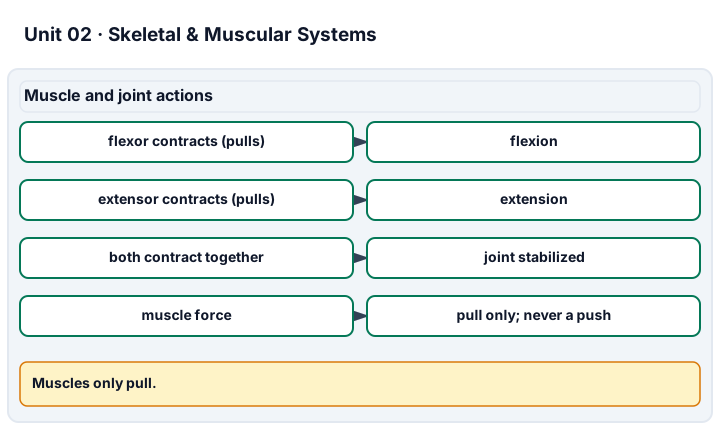
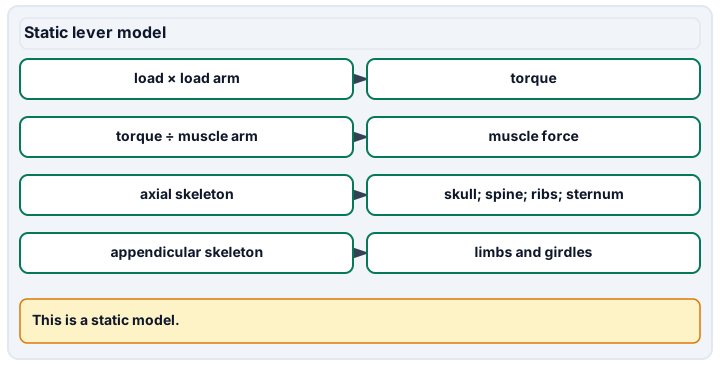
Diagram description
Flexor and extensor muscles pull to produce opposite movements, and simultaneous contraction can stabilize a joint. The lever computation uses supplied forces and perpendicular moment arms only. Axial and appendicular skeleton labels are included as anatomical framework.
Data, provenance, and assumptions
| Model | External load (N) | Load moment arm (m) | Muscle moment arm (m) |
|---|---|---|---|
| A | 40 | 0.3 | 0.04 |
| B | 40 | 0.3 | 0.06 |
| State | Sarcomere length (micrometres) | A-band length (micrometres) |
|---|---|---|
| Initial | 2.4 | 1.6 |
| Shortened | 2 | 1.6 |
| Model | Formation (model units/day) | Resorption (model units/day) |
|---|---|---|
| Growing tissue | 9 | 7 |
| Balanced remodeling | 7 | 7 |
Worked model
Model A has external torque 40 × 0.30 = 12 N m. Equilibrium requires muscle force 12/0.04 = 300 N. Increasing the muscle moment arm to 0.06 m reduces the force to 200 N for the same load, not because the load became lighter. Sarcomere shortening is (2.4 − 2.0)/2.4 × 100 = 16.6667%, while the A band stays 1.6 micrometres. Tissue formation minus resorption gives 9 − 7 = +2 model units/day.
Numerical calibration
- 12 N m
- 300 N
- 16.666667 percent
- 2 model units/day
Attempt the assigned level
Try the tasks before reading the calibration. These are practice answers, not a secure examination; use a new dataset or changed assumption for the assessed transfer.
Foundation
- Locate an axial bone, an appendicular bone, and a hinge joint on an approved model; use two structural clues for each identification.
- Sort skeletal, cardiac, and smooth muscle by location and describe an antagonistic pair without performing an exercise.
- Compare the two sarcomere records. Does the thick filament shorten?
Check after your attempt
- For example, a vertebra has a body and vertebral opening; a humerus has a rounded proximal head and distal elbow articulation. The elbow permits flexion/extension in the simplified hinge model.
- Skeletal muscle moves/stabilizes the skeleton, cardiac muscle is in the heart, and smooth muscle is in many hollow-organ walls. Biceps and triceps can oppose elbow movement.
- The sarcomere shortens by 0.4 micrometres, while the A band stays unchanged. The thick filament does not shorten in this model.
Core
- Calculate torque and muscle force for both levers with units; show why the shorter arm requires more force.
- Explain calcium and ATP roles without saying calcium supplies the energy or that every contraction shortens muscle.
- Calculate net bone change in both records; distinguish growing tissue from balanced remodeling.
Check after your attempt
- Both loads create 12 N m. Required forces are 300 N and 200 N. Force multiplied by its perpendicular moment arm must balance the same external torque.
- Calcium exposes binding sites via troponin/tropomyosin; ATP supports cycling, detachment, and calcium pumping. Isometric contraction can maintain length while generating force.
- Net changes are +2 and 0 model units/day. Zero net change can conceal substantial formation and resorption. Growth-plate activity is not equivalent to adult remodeling.
Honors extension: typically grades 11-12
- Add a hypothetical 10 N forearm load at a perpendicular 0.15 m moment arm to model A. Calculate the new muscle force.
- Compute percentage sarcomere shortening and explain why that does not determine whole-limb movement.
- Build a causal diagram connecting kidney vitamin-D activation, intestine, extracellular calcium, and bone. Identify a missing variable in any claim that formation rate predicts fracture risk.
Check after your attempt
- Total external torque = 12 + 1.5 = 13.5 N m; muscle force = 13.5/0.04 = 337.5 N. No personal load trial is requested.
- Shortening is about 16.667%. Tendon compliance, pennation, joint angle, other muscles, and load also affect movement.
- Kidney activation supports active vitamin D, which promotes intestinal calcium absorption; bone stores and releases mineral under hormonal regulation. Architecture, material quality, loading, and measurement history matter beyond net formation.
History, reading, and writing connection
Cite the contraction figure in OpenStax 10.3 and the joint-motion figure in 9.5 in a short explanation of why an anatomical drawing alone cannot establish the molecular mechanism of movement. Model response: attachments constrain possible torque direction, while the calcium/ATP account draws on later cellular experiments. A model can reveal geometry but cannot demonstrate ATP turnover. Label the historical contrast as an inference about evidence, not as a quotation or experiment attributed to Vesalius.
Write in your own words or use an approved accessible equivalent. Cite a specific assigned section or figure, identify its evidence, and state one limitation or counterargument. Use the AI practice contract only for permitted coaching, never to invent observations or write the assessed response.
Transfer to a new case
A new static model places a 30 N load 0.24 m from a pivot and a muscle force at a 0.03 m perpendicular arm. What balances it, and what changes if the limb accelerates?
Calibration: 30 × 0.24/0.03 = 240 N balances torque in the static model. During acceleration, net torque is not zero; moment of inertia and angular acceleration are additional required inputs.
Evidence to retain
Keep the source-identified model sketch, force arrows, moment arms, unit conversions, tissue-balance reasoning, and calcium/ATP explanation. Model manipulation does not certify examination of a real joint or an exercise protocol.
Record units, calculations, source/date, uncertainty, and what is measured versus inferred. A simulation or supplied dataset must stay labeled as such. Educational fictional cases only: no diagnosis of the learner, real patient uploads, treatment or dosing prescriptions, invasive tests, medical procedure instructions, exercise challenges, breath-holding, or forced personal measurements. No personal, reproductive, or health disclosure is required. Use supplied data and models or an instructor-approved noninvasive demonstration with an agreed alternative. Textbook equations do not certify diagnostic or professional skill; this elective is not a licensed medical course, an AP course, or a claim of college credit.
Return to all eight learning pathways. Print this unit page for the student lessons; the linked five-page packet remains the separate assessment companion.
Unit mastery rubric
| Criterion | Developing | Proficient | Mastery |
|---|---|---|---|
| Skeleton, bone structure & growth | Cannot sort axial/appendicular bones or identify their tissue structure. | Names major bones but needs help connecting compact/spongy bone and marrow to growth or remodeling. | Identifies major axial/appendicular bones, compact/spongy bone and marrow; distinguishes growth-plate lengthening from remodeling and connects bone to endocrine mineral regulation. |
| Joint types, movement & leverage | Cannot match a joint to its movement or load direction. | Classifies joints but needs help explaining movement or the supplied moment arms. | Classifies hinge, ball-and-socket, pivot, and plane joints on a model; explains permitted motion and the selected static-lever calculation using perpendicular moment arms. |
| The three muscle types & major muscle groups | Cannot name the three muscle types, or mixes them up. | Names skeletal, cardiac, and smooth muscle but cannot say where each is found or name the major muscle groups. | Names the three muscle types with where each is found and identifies the major muscle groups on a torso model. |
| Muscle force & antagonistic pairs | Claims muscle pushes or that the filaments themselves shorten. | Names an antagonistic pair but needs help with calcium, ATP, or isometric force. | Explains antagonistic pulls, calcium/ATP roles, and sliding without filament shortening; distinguishes shortening from isometric force and interprets the assigned sarcomere record. |
| Lab technique (model / skeleton ID defense) | Cannot locate a requested bone, muscle, or joint on the model or skeleton. | Points to a bone, muscle, or joint on the model but cannot defend the call from its structure. | Identifies a bone, muscle, or joint on a model or skeleton and defends the call by linking its structure to what it does. |
| Integration (cross-domain) | Makes no supported connection between the source and the science. | Uses the source but needs help connecting evidence, writing, or limitations to the science. | Independently connects History, Reading, and Writing using a cited source, appropriate evidence, a limitation, and a scientific explanation. |
Integration is reported separately and cannot lower the science grade or block a science demonstration pass. Science and practical criteria determine that pass. Use the integration guide's evidence checklist for the separately reported criterion.
“This is the biceps brachii — it crosses the front of the elbow, so when it shortens it pulls the forearm up and the elbow flexes. It can’t push the arm back down; that’s the triceps on the other side pulling the opposite way. The two are an antagonistic pair.”
“It’s an arm muscle. It makes the arm move. The bones are… the long one and the two little ones?”
You demonstrate this unit through model and skeleton identification labs — locating a bone, muscle, or joint and defending it aloud — plus short oral checks where you explain how a muscle pulls, not a multiple-choice test. A criterion counts as mastered only when you can both find the structure on the model and justify the anatomy behind it. Mastery is demonstrated, not awarded.
A 5-page clipboard packet — unit overview, key terms, the mastery rubric, anchor examples, and a score sheet you can print and grade against.