Unit 07 · Endocrine & Reproductive Systems
Two systems share this unit because they run on the same currency — chemical messengers. The endocrine system releases hormones from ductless glands into the blood to regulate metabolism, growth, the stress response, and blood sugar from a distance; the reproductive system is itself hormone-driven, producing gametes and the sex hormones that shape it. Mastery means you can name a gland, the hormone it releases, and the target that hormone reaches — and, for the reproductive system, use the clinical anatomical vocabulary precisely and without euphemism.
Declare age-appropriate selected content before instruction: Foundation uses curated structure/function and gamete diagrams; Core adds cycles and feedback; Honors adds quantitative/developmental models. Use supplied material only, with no personal, reproductive, or health disclosure. Image/model identification does not certify a medical examination, and the added practice is not another required practical.
Student learning: Follow endocrine feedback, gametes, and early developmental mechanisms
Choose the level by readiness, not age alone, and record it before instruction. Foundation, core, and honors tasks are study pathways, not an AP course or a promise of college credit. The instructor retains practical assessment and the published science rubric; integration is reported separately.
Prerequisites: Cell division, receptor/target relationships, conservation, and selected earlier homeostatic loops. Foundation uses curated anatomical diagrams; core connects cycles and development; honors uses recurrence and first-order decay.
Suggested sequence: read and discuss the explanation; attempt the worked model; analyze the data at your selected level; check the answers; then complete the source-linked response and a fresh transfer question. These activities supplement, not replace, supervised practical work and the full-year schedule.
Assigned reading and focus
- OpenStax Anatomy & Physiology 2e, 17.3: The Pituitary Gland and Hypothalamus. Read anterior/posterior distinctions, tropic hormones, and target-gland feedback. Trace where a hormone is synthesized versus released.
- OpenStax Anatomy & Physiology 2e, 27.1: Testicular Reproductive System. Foundation: instructor-selected structure/function figures only. Core/honors: sperm production, ducts, and hormonal regulation. Use factual anatomical terms; no personal comparison or disclosure.
- OpenStax Anatomy & Physiology 2e, 27.2: Ovarian Reproductive System. Foundation: instructor-selected ovary, uterine-tube, and uterus diagrams. Core/honors: oogenesis and hormonal cycles, distinguishing typical patterns from fixed calendars.
- OpenStax Anatomy & Physiology 2e, 28.2: Embryonic Development. Read cleavage, implantation, gastrulation, and placental exchange. Ages here are described relative to fertilization; do not infer personal pregnancy dates or outcomes.
Learn the science
Hormones circulate, but a target response depends on receptors and intracellular machinery. Peptide and many amine hormones commonly act at cell-surface receptors; steroid and thyroid hormones can regulate gene expression through intracellular receptors. Sensitivity, pulsatility, and delays matter. A “master gland” label does not mean the pituitary is independent of hypothalamic input or target-gland feedback.
Hypothalamic releasing signals regulate anterior-pituitary secretion through portal blood. In the thyroid axis, TRH supports TSH secretion, TSH stimulates thyroid hormone output, and thyroid hormone feeds back on hypothalamus and pituitary. ADH and oxytocin are synthesized in the hypothalamus and stored/released by the posterior pituitary, not manufactured by the posterior lobe. Pancreatic insulin/glucagon regulation and parathyroid calcium regulation show that not all feedback runs through a pituitary axis.
Insulin generally supports nutrient uptake/storage and restrains hepatic glucose output; glucagon supports hepatic glucose availability during appropriate conditions. Kidney water handling, bone mineral balance, and reproductive signaling are other endocrine targets. A graph of a hormone alone cannot distinguish secretion, clearance, binding, and target sensitivity. No hormone dose or treatment is calculated here.
Negative feedback reduces a departure from a controlled state; it does not mean every arrow is inhibitory. Our discrete model y_next = y + g(target − y) assumes a fixed target, constant gain, no delay, and a linear response. It represents a generic feedback variable, not a measured hormone axis. Physiological set points and responsiveness can change with time and development. A linear rule can predict impossible values outside its domain.
Use models to locate testes, epididymis, ductus deferens, accessory glands, urethra, and external structures, and ovaries, uterine tubes, uterus/cervix, vagina, and external structures. Sperm production occurs in seminiferous tubules and maturation continues in the epididymis. Oocytes develop in ovarian follicles. Meiosis reduces chromosome number; after fertilization, the typical diploid complement is restored. These descriptions are general biological patterns, not tests of identity, fertility, or anyone’s anatomy.
GnRH, FSH, LH, gonadal hormones, and inhibin form interacting loops. In a simplified testicular pathway, LH supports testosterone production and FSH supports Sertoli-cell functions in sperm production. In an ovarian cycle, follicular growth, ovulation, and luteal activity connect to changes in the uterine lining. Sustained high estradiol can briefly favor positive feedback leading to an LH surge, unlike the usual negative feedback. A 28-day cycle is an illustration, not a universal schedule; timing and pubertal development vary.
Fertilization typically occurs in a uterine tube; implantation is a later interaction with uterine endometrium. They are not synonyms. Early cleavage increases cell number without proportional overall growth in our simplified geometry. Gastrulation establishes ectoderm, mesoderm, and endoderm: nervous tissue and epidermis are largely ectodermal, muscle/vascular tissue and much renal tissue mesodermal, and much gut/airway epithelium endodermal. Whole organs combine several tissue origins.
Placental exchange connects maternal and embryonic/fetal support systems while their blood normally remains in distinct circulations across a barrier. It supports gas, nutrient, and waste exchange rather than making fetal lungs the main prenatal gas exchanger. Organ systems develop over time; adult water-compartment proportions and renal concentrating capacity cannot simply be assigned to an infant. Calendar gestational age and fertilization age use different starting conventions, often roughly two weeks apart in a textbook example, not an exact rule for an individual.
Selected levels must be declared before instruction: Foundation studies curated age-appropriate structure/function, gametes, and broad development; Core adds feedback and ovarian/testicular cycles; Honors adds quantitative model critique and germ-layer/placental connections. No personal, reproductive, or health disclosure is required. All students use supplied educational diagrams and fictional records; no intimate examination, pregnancy tracking, or real patient image is part of the course.
The ovarian time series below are synthetic teaching records, not observations of any person. Day 1 is the stipulated start of uterine shedding in each fictional model; later samples are irregularly spaced. Estradiol, LH, FSH, and progesterone use different assay scales. Compare a hormone with itself across time; do not compare the numerical heights of different hormones as if they were equal concentrations. Model B deliberately stretches the earlier part of the sequence without making a claim about a population range.
Pulsatile GnRH supports anterior-pituitary FSH and LH. FSH supports follicular granulosa-cell functions; LH supports theca-cell androgen production used in estradiol synthesis. Growing follicles increase estradiol, promoting endometrial proliferation. Estradiol and inhibin usually reduce parts of the upstream drive. Sustained high estradiol in the appropriate feedback state can instead support a positive-feedback LH surge, which participates in ovulation and luteinization. The corpus luteum then produces progesterone and estradiol; progesterone supports secretory endometrial changes. Falling ovarian steroids after luteal regression can permit shedding. This causal account comes from broader physiology, not from fitting one invented graph.
An estradiol maximum at sampled day 12 followed by a sampled LH maximum at day 14 does not prove a two-day biological response delay. Sampled peaks are not necessarily true peaks, the actual maximum can lie between samples, and endocrine effects depend on duration and other signals. The dataset alone does not establish the occurrence or exact time of ovulation. An area under a relative assay-time curve summarizes a signal over a stated interval; it is not the amount of hormone secreted, receptor occupancy, or a fertility measure.
The testicular axis is not a monthly ovarian cycle. LH supports Leydig-cell testosterone production; FSH and testosterone support Sertoli-cell functions involved in spermatogenesis. Testosterone feeds back on hypothalamus/pituitary, while Sertoli-derived inhibin B chiefly restrains FSH. Our hypothetical paired states hold LH and testosterone constant while changing the inhibin/FSH relation. They illustrate a selective feedback hypothesis, not the full pulsatile dynamics or proof from a two-point correlation.
Use no personal cycle tracking, no reproductive disclosure, no fertility predictions, and no pregnancy advice or diagnosis. Cycle timing and patterns vary within and between people, especially across development; neither a universal 28-day calendar nor this invented pair describes everyone. Foundation uses instructor-selected factual diagrams and within-column arithmetic; Core connects phase mechanisms and feedback; Honors compares irregular time series and inference limits. Record the chosen level before instruction and use the supplied records only.

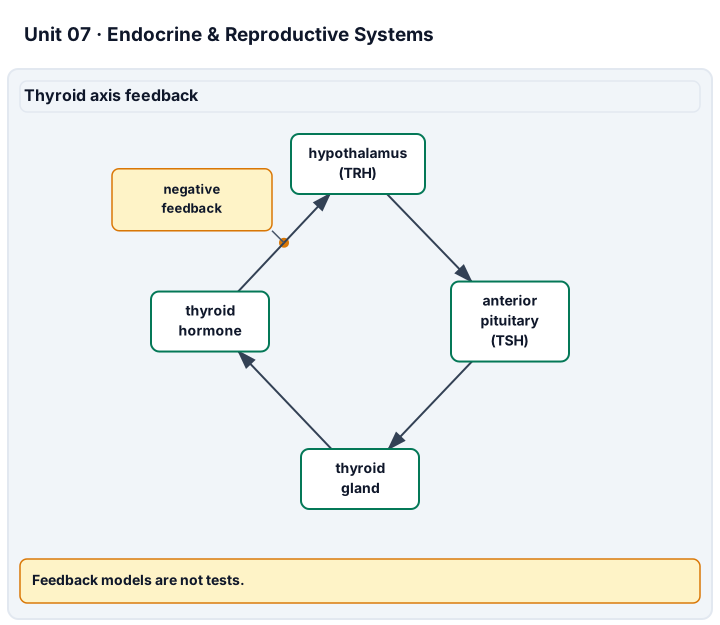
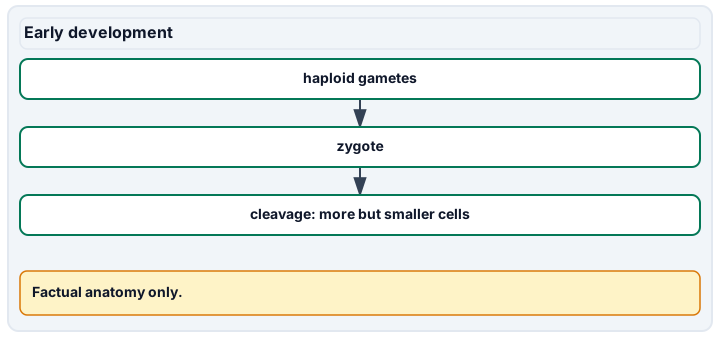
Diagram description
Hypothalamic TRH stimulates anterior pituitary TSH, TSH stimulates the thyroid gland, and thyroid hormone provides negative feedback to hypothalamus and pituitary. This feedback model is separate from gametes and development. Haploid gametes form a zygote, and cleavage makes more, smaller cells without growth in the simplified model.
Data, provenance, and assumptions
| Model | Initial signal (model units) | Target signal (model units) | Gain (dimensionless) |
|---|---|---|---|
| A | 2 | 8 | 0.5 |
| Time (min) | Signal (relative assay units) |
|---|---|
| 0 | 80 |
| 30 | 40 |
| 60 | 20 |
| State | Chromosomes | Chromatids |
|---|---|---|
| Completed haploid gamete | 23 | 23 |
| Zygote before DNA replication | 46 | 46 |
| Zygote after DNA replication | 46 | 92 |
| Model | Total cell volume (nL) | Cell count |
|---|---|---|
| Eight-cell | 1 | 8 |
| Model day | Estradiol (E assay units) | LH (LH assay units) | FSH (FSH assay units) | Progesterone (P assay units) |
|---|---|---|---|---|
| 1 | 15 | 5 | 9 | 2 |
| 5 | 25 | 5 | 8 | 2 |
| 9 | 55 | 7 | 7 | 2 |
| 12 | 90 | 12 | 10 | 3 |
| 14 | 70 | 60 | 15 | 5 |
| 16 | 35 | 10 | 7 | 18 |
| 21 | 55 | 5 | 5 | 50 |
| 25 | 30 | 5 | 7 | 25 |
| 28 | 15 | 5 | 9 | 3 |
| Model day | Estradiol (E assay units) | LH (LH assay units) | FSH (FSH assay units) | Progesterone (P assay units) |
|---|---|---|---|---|
| 1 | 15 | 5 | 9 | 2 |
| 7 | 25 | 5 | 8 | 2 |
| 13 | 55 | 7 | 7 | 2 |
| 17 | 90 | 12 | 10 | 3 |
| 20 | 70 | 60 | 15 | 5 |
| 22 | 35 | 10 | 7 | 18 |
| 27 | 55 | 5 | 5 | 50 |
| 31 | 30 | 5 | 7 | 25 |
| 34 | 15 | 5 | 9 | 3 |
| Hypothetical state | LH (relative units) | FSH (relative units) | Testosterone (relative units) | Inhibin B (relative units) |
|---|---|---|---|---|
| Starting state | 8 | 7 | 40 | 24 |
| Lower-inhibin comparison | 8 | 10 | 40 | 12 |
Worked model
Starting at y = 2 with target 8 and gain 0.5 gives 5, then 6.5, then 7.25 model units. The remaining error is 8 − 7.25 = 0.75 units; each step halves the error. In the separate decay record, 80 → 40 → 20 over equal 30-minute intervals supports a model half-life of 30 min; predicted signal at 90 min is 10 relative units if there is no new secretion. Two completed haploid gametes contribute 23 + 23 = 46 chromosomes. Replication doubles DNA/chromatids, not the centromere-based chromosome count. Eight equal cells sharing 1 nL have 0.125 nL each. In model A the sampled estradiol maximum is 90 on day 12 and the sampled LH maximum 60 on day 14: their sampled gap is 2 days. In B the LH sample maximum occurs on day 20, 6 days later on the model-day axis than in A. Between A days 5 and 12, mean estradiol change is (90 − 25)/(12 − 5) = 9.285714 E assay units/day. A progesterone rises from 2 at day 5 to 50 at day 21: 25-fold within the P assay, not a comparison with estradiol. The trapezoidal estradiol area from day 9 to 16 is 3 × (55 + 90)/2 + 2 × (90 + 70)/2 + 2 × (70 + 35)/2 = 482.5 E assay unit-days, assuming straight-line interpolation between samples. Inhibin falls from 24 to 12 in the separate testicular thought experiment, a 50% reduction; FSH rises by 3/7 × 100 = 42.857143%. These numerical patterns do not by themselves demonstrate causation.
Numerical calibration
- 7.25 model signal units
- 0.75 model signal units
- 30 min
- 10 relative assay units
- 46 chromosomes
- 0.125 nL per cell
- 2 days between sampled maxima
- 6 model days
- 9.285714 E assay units/day
- 25 fold within the P assay
- 482.5 E assay unit-days
- 50 percent reduction within the inhibin assay
Attempt the assigned level
Try the tasks before reading the calibration. These are practice answers, not a secure examination; use a new dataset or changed assumption for the assessed transfer.
Foundation
- Use the selected diagrams to locate gonads, transport ducts, uterus, hypothalamus, and pituitary. Distinguish a site of gamete production from a transport route.
- Complete 23 + 23 and explain why fertilization and implantation are separate events.
- Follow the generic feedback rule for one step using arrows toward the target; no personal body changes are discussed.
- Using only model A, name the days of the largest sampled estradiol and progesterone values and calculate the sampled estradiol-to-LH peak gap. Match follicle, corpus luteum, and endometrium to their roles using the assigned diagram; do not infer personal timing.
Check after your attempt
- Testes and ovaries are gonads; epididymis/ductus deferens transport or support sperm and uterine tubes transport the oocyte/conceptus. Hypothalamus and pituitary coordinate signals rather than acting as reproductive ducts.
- 46 chromosomes is the typical restored diploid count. Fertilization combines gamete contributions; implantation is later attachment within the uterine lining.
- 2 + 0.5 × (8 − 2) = 5 model units. The response reduces the gap; it is not a prediction of an individual hormone concentration.
- Largest sampled estradiol: day 12; progesterone: day 21; sampled estradiol-to-LH peak gap: 2 days. Follicles support oocyte development and estradiol secretion, the corpus luteum produces progesterone/estradiol, and the endometrium is the uterine lining. Sampling does not establish exact event times.
Core
- Trace the TRH–TSH–thyroid feedback loop and distinguish ADH synthesis from release. Connect ADH to the collecting duct.
- Explain the main ovarian/testicular hormonal relationships and why a calendar cannot precisely predict an individual cycle.
- Complete three feedback steps and compare chromosome and chromatid counts before and after S phase.
- Sketch separate, labeled hormone axes for A and B. Relate the sequence to follicular growth, context-dependent positive feedback, luteal activity, and endometrial changes. Compare the sampled LH timing and progesterone within-assay ratio.
- Explain why selectively lower inhibin could permit higher FSH in the testicular thought experiment without demanding a parallel LH rise. Calculate both percentage changes and name the producing/supporting cells.
Check after your attempt
- TRH → TSH → thyroid hormone, with thyroid feedback toward hypothalamus/pituitary. ADH is synthesized in hypothalamic neurons, released from posterior pituitary, and can increase collecting-duct water permeability.
- GnRH regulates FSH/LH; gonadal signals feed back. Sustained estradiol can permit a positive-feedback LH surge, but cycle and developmental timing vary. The course does not track anyone’s cycle.
- 5, 6.5, 7.25; final error 0.75. In the supplied zygote, 46 chromosomes stay 46 after DNA replication while chromatids increase from 46 to 92.
- B’s sampled LH maximum is 6 model days later; A’s progesterone day-21/day-5 ratio is 25. The expected mechanism links estradiol to proliferation and the transient LH-positive-feedback state, then progesterone to secretory support. The sequence is consistent with that teaching model, not proof of a fixed calendar or ovulation date.
- Inhibin B falls 50%; FSH rises about 42.857143%. Sertoli-derived inhibin principally restrains FSH, whereas LH acts on Leydig cells and is held constant here along with testosterone. GnRH pulsatility, time lags, and other feedback are excluded, so these two states do not establish a causal response size.
Honors extension: typically grades 11-12
- Derive the feedback error multiplier 1 − g and compare g = 0.5, 1.5, and 2.2. State why this is not a literal endocrine simulation.
- Estimate the decay half-life and 90-minute signal; describe how ongoing secretion would change interpretation.
- Use the cleavage data and a germ-layer diagram to explain why cell division, body growth, and differentiation are different. Link placenta, respiratory function, and developmental renal differences.
- Calculate A’s estradiol secant rate from day 5 to 12 and trapezoidal area from day 9 to 16 with units. Explain why an unweighted mean of irregular samples is not generally a time average.
- Re-express both time axes relative to each model’s sampled LH maximum. Identify what alignment helps compare and what the sampling still cannot establish.
Check after your attempt
- For a fixed target, error_next = (1 − g)error. Multipliers are 0.5, −0.5, and −1.2: monotonic decay, alternating decay, and alternating growth in magnitude. Delays, saturation, changing targets, and multiple loops are omitted, so impossible model outputs must not be treated as physiological concentrations.
- Half-life 30 min; signal at 90 min 10 relative units. Continued secretion would add a source term and could mask the clearance rate.
- Eight cells share 1 nL, or 0.125 nL each in this model; early cleavage does not imply eightfold volume growth. Germ layers differentiate into tissue families. Placenta supports prenatal exchange, and developing renal/respiratory systems are not just smaller adult systems.
- Rate: 9.285714 E assay units/day; area: 482.5 E assay unit-days; interval mean under linear interpolation: 482.5/7 = 68.928571 E assay units. Irregular intervals must be weighted by duration. The assay area is not secretion or hormone mass.
- Subtract day 14 for A and day 20 for B. This aligns a sampled landmark and makes relative ordering easier to compare, but true peaks and ovulatory events were not measured continuously. Interpolation and visual alignment cannot determine fertility, an individual schedule, or causal delay.
History, reading, and writing connection
Cite the feedback figure in OpenStax 17.3 and a cleavage/implantation figure in 28.2. Write a source-linked explanation of how a useful “master gland” metaphor or a fixed developmental calendar can mislead. Model response: target-gland feedback makes control reciprocal, and a textbook sequence describes mechanisms rather than an exact timetable for every individual. Distinguish the source’s age convention from your wording and identify a question the figures cannot answer. Personal or family experiences are not evidence required for this response.
Write in your own words or use an approved accessible equivalent. Cite a specific assigned section or figure, identify its evidence, and state one limitation or counterargument. Use the AI practice contract only for permitted coaching, never to invent observations or write the assessed response.
Transfer to a new case
A new feedback model starts at 4 with target 10 and gain 0.25. Find its first two outputs. Separately, does a cell with 46 chromosomes and 92 chromatids necessarily have twice the chromosome number of a cell before S phase? Additional fresh case: A fresh synthetic hormone record has sample times 0, 2, 6 days and values 20, 60, 40 relative units. Find its trapezoidal area and interval mean. If the highest measured LH is on day 6, does that supply an exact ovulation date?
Calibration: Outputs are 5.5 and 6.625 model units. No: DNA has replicated, but sister chromatids still share centromere-based chromosome identities until separation. The supplied post-S state still has 46 chromosomes. Area = 2 × (20 + 60)/2 + 4 × (60 + 40)/2 = 280 relative unit-days; interval mean = 280/6 = 46.666667 units. No: a sampled LH maximum is neither a continuous peak-time measurement nor direct evidence of an ovulatory event.
Evidence to retain
Keep selected-level and source records, anatomical pathway diagrams, feedback steps, chromosome-count conventions, and one developmental-model limitation. Use no private health records, patient images, reproductive histories, or dosing calculations. Add separately labeled hormone axes, within-assay calculations, the weighted-area work, feedback arrows with their signs and targets, and a sampling-limit statement. Record that all times and values are synthetic and that no individual reproductive information was used.
Record units, calculations, source/date, uncertainty, and what is measured versus inferred. A simulation or supplied dataset must stay labeled as such. Educational fictional cases only: no diagnosis of the learner, real patient uploads, treatment or dosing prescriptions, invasive tests, medical procedure instructions, exercise challenges, breath-holding, or forced personal measurements. No personal, reproductive, or health disclosure is required. Use supplied data and models or an instructor-approved noninvasive demonstration with an agreed alternative. Textbook equations do not certify diagnostic or professional skill; this elective is not a licensed medical course, an AP course, or a claim of college credit.
Return to all eight learning pathways. Print this unit page for the student lessons; the linked five-page packet remains the separate assessment companion.
Unit mastery rubric
| Criterion | Developing | Proficient | Mastery |
|---|---|---|---|
| Endocrine glands & hormone sources | Cannot locate glands or distinguish synthesis from release. | Pairs some hormones/glands but needs help with targets or hypothalamic/pituitary roles. | Locates major glands and pairs hormones with sources/targets, distinguishing hypothalamic synthesis from posterior-pituitary release and endocrine from exocrine pancreatic function. |
| Hormone action & feedback | Confuses feedback targets or equates all hormone assay scales. | Names a loop but needs help with feedback signs, targets, or quantitative assumptions. | Explains receptor-dependent response and GnRH/FSH/LH/gonadal feedback; defends assigned recurrence, decay, or within-assay signal calculations with sampling and model limits, not treatment doses. |
| Reproductive anatomy & pathways | Cannot distinguish gonads, ducts, or implantation site. | Names some structures but needs help with transport order or function. | Identifies the selected testicular/ovarian reproductive structures with factual anatomical terms, tracing gamete routes and distinguishing fertilization from implantation without personal comparisons. |
| Gametes, cycles & development | Confuses gametes or development, or treats sampled peaks as exact personal event dates. | Names events but needs help relating supplied signals to phase mechanisms and variability. | Distinguishes chromosome/chromatid counts and developmental sequences; interprets supplied gonadal time series and phase mechanisms at the declared level without a universal calendar or personal reproductive predictions. |
| Lab technique (gland / gonad ID) | Cannot bring a slide into focus or identify a gland on a model. | Names a gland or gonad but cannot point to the features that justify the call. | Identifies an endocrine gland or gonad on a model or prepared slide and defends the ID with two visible distinguishing features. |
| Integration (cross-domain) | Makes no supported connection between the source and the science. | Uses the source but needs help connecting evidence, writing, or limitations to the science. | Independently connects History, Reading, and Writing using a cited source, appropriate evidence, a limitation, and a scientific explanation. |
Integration is reported separately and cannot lower the science grade or block a science demonstration pass. Science and practical criteria determine that pass. Use the integration guide's evidence checklist for the separately reported criterion.
“This is thyroid tissue — the round follicles filled with pink colloid are the giveaway. The thyroid releases T3 and T4, which set the metabolic rate of nearly every tissue, and TSH from the pituitary controls it through negative feedback.”
“Some gland with circles in it. Hormones do stuff to your body.”
Identify glands and reproductive structures on the selected models or prepared reference images and explain their functions. Use factual, age-appropriate educational biology, not a clinical examination. Families and instructors declare depth and alternatives before study; no student must discuss private development, identity, fertility, cycles, or family history to demonstrate the science.
A 5-page clipboard packet — unit overview, key terms, the mastery rubric, anchor examples, and a score sheet you can print and grade against.