Unit 05 · Evolution & Adaptation
Living things fit their homes in amazing ways — a polar bear’s thick fur, a cactus’s spines. This unit studies the part of that story anyone can watch and test: how differences within a species, plus survival and reproduction, change a population across generations, as researchers have measured in Galápagos finches and as doctors see in drug-resistant germs. You’ll also weigh competing explanations with the Cycle of Scientific Enterprise and sort out which questions about life’s origins reach beyond a classroom test. Mastery means you can explain how natural selection changes a population and weigh the evidence fairly.
Student learning: When can a change in a population support natural selection?
Choose the level by readiness, not age alone, and record it before instruction. Foundation, core, and honors tasks are study pathways, not an AP course or a promise of college credit. The instructor retains practical assessment and the published science rubric; integration is reported separately.
Prerequisites: Variation, inheritance, counts and percentages; distinguish an individual from a population.
Suggested sequence: read and discuss the explanation; attempt the worked model; analyze the data at your selected level; check the answers; then complete the source-linked response and a fresh transfer question. These activities supplement, not replace, supervised practical work and the full-year schedule.
Assigned reading and focus
- OpenStax Biology 2e, 18.1: Understanding Evolution. Read the opening paragraphs and Charles Darwin and Natural Selection, through the Grants' Galapagos finch study. Mark three historical explanations of how living things change or stay the same: Plato's unchanging species, Lamarck's inheritance of acquired characteristics, and Darwin and Wallace's natural selection (presented in 1858; Darwin's book followed in 1859). Record what the Grants measured on Daphne Major and when the trend stopped. Checked 2026-10-02.
- CDC, About Antimicrobial Resistance. Read Overview and How antimicrobial resistance happens. Identify the variation (germs that carry resistance traits), the pressure (antibiotic or antifungal use) and the result (resistant germs survive, multiply and spread). This is background on a living example, not medical advice or a reason to change any treatment. Checked 2026-10-02.
Learn the science
Natural selection requires pre-existing heritable variation and differences in reproductive success in a particular environment. Individuals do not acquire a needed beak by deciding to adapt; population frequencies can change across generations.
People have proposed competing explanations for how living things change. Plato held that species were unchanging. In the early 1800s Lamarck proposed that changes acquired during a lifetime, such as a structure strengthened by use, are passed to offspring. Darwin and Wallace presented natural selection in 1858, and Darwin published On the Origin of Species in 1859. The explanations predict different results: if acquired changes were inherited, a change made to a parent's body would show up in its offspring, while selection predicts that only inherited variation is passed on. Later observations and genetics supported selection on inherited variation; OpenStax notes that Lamarck's mechanism was discredited even though his ideas influenced later thinking.
Selection can be watched in living populations. Peter and Rosemary Grant measured medium ground finches on Daphne Major every year from 1976; after a wet El Nino period, small-billed birds survived and reproduced better and average bill size fell, and the trend stopped when large seeds returned in 1987. CDC describes the same logic in germs: resistant bacteria and fungi survive a drug, multiply and spread, so resistance becomes more common. A classroom model illustrates the argument but is not the Grants' field record.
Natural selection explains how populations change; by itself it does not settle where life and its variety came from. Most biologists interpret fossils, anatomy and DNA as evidence that living things share common ancestors. Families also hold other views, including intelligent design and creation, and many people hold a faith alongside evolutionary science. This unit focuses on what can be observed and tested directly. It does not ask you to adopt or give up a belief; it asks you to say what each piece of evidence can and cannot show.
In the deliberately simplified model, beak category is inherited unchanged, no individuals migrate, and every survivor contributes two offspring. The assigned survival rule is a model assumption, not evidence that all deep beaks are always better.

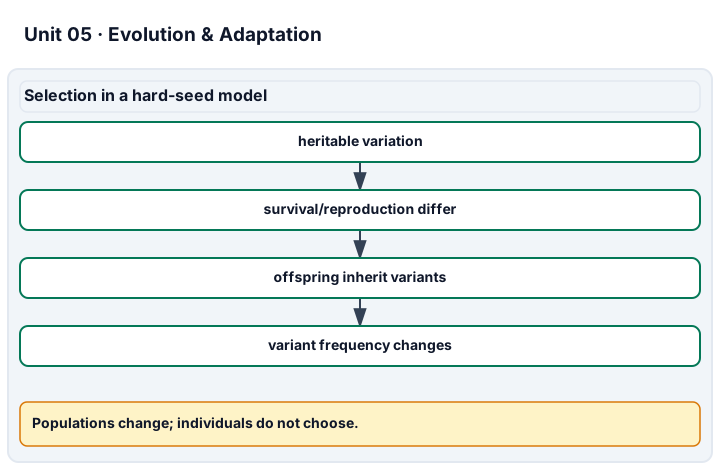
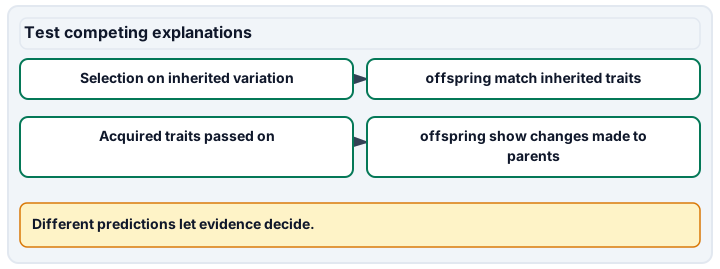
Diagram description
Selection starts with heritable variation. In a stated environment, survival and reproduction differ by variant. Offspring inherit variants, so variant frequency changes across generations. A second panel compares two explanations: selection on inherited variation predicts offspring that match their inherited traits, while Lamarck's idea that acquired traits are passed on predicts offspring that show changes made to their parents during life. Because the predictions differ, evidence can decide between them.
Data, provenance, and assumptions
| Environment | Inherited beak category | Starting birds | Survivors | Offspring per survivor |
|---|---|---|---|---|
| Hard seeds | Shallow | 32 | 8 | 2 |
| Hard seeds | Deep | 32 | 24 | 2 |
| Soft seeds | Shallow | 32 | 24 | 2 |
| Soft seeds | Deep | 32 | 8 | 2 |
Paper-model procedure: one generation in each environment
Scope and safety: Use paper labels or drawn tally boxes only. The seed types are words on cards, not food to handle or eat.
Materials and preparation
- A sheet with 32 tally boxes for each beak category, pencil, and the supplied survival rule table.
- Two record columns labeled starting generation and offspring generation; keep the environments separate.
Procedure and schedule
- Mark the 32 starting individuals of each type for the hard-seed environment.
- Apply the listed survival counts, retaining survivors as a separate count rather than relabeling individuals.
- Record two offspring per survivor, retire the starting generation, and calculate offspring frequencies.
- Reset to the original 32/32 for the soft-seed environment and repeat. Record each round and rule; do not describe the result as an observation of living birds.
Record: Environment, starting counts, survivors, offspring counts, denominators, frequencies, and the rule applied. If you only analyze the supplied table, label it supplied-data analysis; the instructor separately observes any model-running skill.
Worked model
In hard seeds, shallow survival is 8/32 = 25% and deep survival is 24/32 = 75%. Offspring are 16 shallow and 48 deep, so deep beaks change from 50% to 48/64 = 75% of the next generation. Survival probability and next-generation frequency happen to match numerically here, but use different denominators.
Numerical calibration
- 75 % of initial deep-beak birds surviving in hard seeds
- 75 % deep-beak offspring under two offspring per survivor
Attempt the assigned level
Try the tasks before reading the calibration. These are practice answers, not a secure examination; use a new dataset or changed assumption for the assessed transfer.
Foundation: typically grades 7-8
- Draw a before/after bar chart of the hard-seed population and label survivors separately from offspring.
- Use the Grants' finches or the CDC reading to describe selection in a living population today. Name the inherited variation, the pressure from the environment and the trait that became more common.
Check after your attempt
- Starting 32/32; survivors 8/24; offspring 16/48. No individual changes beak category in this model.
- Finches: bill size varied and was inherited; after the wet El Nino years small soft seeds were plentiful, small-billed birds survived and reproduced better, and average bill size fell. Germs: some carry resistance traits; a drug kills susceptible germs, and resistant survivors multiply and spread. In neither case does an individual decide to change.
Core
- Calculate survival percentages and next-generation frequencies in both environments. Explain the role of inheritance and reproduction.
- Give an alternative explanation for a changed trait frequency in a real small population, such as migration or chance, and identify data needed to distinguish it.
- Lamarck's explanation and natural selection both try to explain why a population changes. Write one prediction that differs between them and describe evidence that would tell them apart.
Check after your attempt
- Hard: 25%/75% survival, offspring 25% shallow and 75% deep. Soft: 75%/25% survival, offspring 75% shallow and 25% deep.
- Track parent/offspring traits, survival, reproductive output, migration and repeated populations; a frequency shift alone is not a unique signature of selection.
- If acquired traits were inherited, a change made to parents during their lives, such as a trimmed model beak or a strengthened muscle, would appear in their offspring; selection predicts offspring that match their inherited variation instead. Parent and offspring records across generations, together with genetics, tell them apart, and that evidence supports selection on inherited variation.
Extension
- Keep hard-seed survivor counts but let each shallow survivor contribute four offspring and each deep survivor one. Recalculate deep-beak frequency.
- Explain why a conclusion based only on survival can miss the selection outcome, even if survival counts are accurate.
Check after your attempt
- 32 shallow and 24 deep offspring: 24/56 = 42.86% deep, lower than the original 50%.
- Reproductive success includes offspring contributions, not survival alone. The changed reproduction assumption reverses the directional prediction.
History, reading, and writing connection
Original response: Write a six-sentence explanation comparing Lamarck's explanation of inherited change with Darwin and Wallace's 1858 idea. State what each predicts, cite OpenStax 18.1 and either the Grants' finch measurements or the CDC example, include a numerical frequency change from your two-environment paper model, and give one reason the model is not a historical field observation. Report each explanation fairly rather than repeating a generic finch story.
Write in your own words or use an approved accessible equivalent. Cite a specific assigned section or figure, identify its evidence, and state one limitation or counterargument. Use the AI practice contract only for permitted coaching, never to invent observations or write the assessed response.
Transfer to a new case
Ten deep-beak immigrants enter a population, and deep beaks become more common. Does this demonstrate local natural selection?
Calibration: Not by itself. Immigration changes frequencies without showing a difference in local survival or reproduction; evidence about those processes is needed.
Evidence to retain
Adaptations & survival: environment-specific advantage explanation. Variation within a species: starting 32/32 counts. Natural selection: inherited categories, survival and offspring frequencies. Evidence & competing explanations: the alternative-mechanism comparison, the differing Lamarck and selection predictions, and one observed case of selection in a living population. Lab technique (natural-selection simulation): separately observe the paper-model run and inspect its round log; supplied calculations alone do not certify the practical. Retain both graphs, alternative mechanism and transfer, with integration reported separately.
Record units, calculations, source/date, uncertainty, and what is measured versus inferred. A simulation or supplied dataset must stay labeled as such. This is reading, paper-model, and data work, not authorization to collect pond water, swab people, culture organisms, dissect, expose wildlife, or ingest study materials. Use only instructor-approved prepared slides, images, or in-room materials for separately observed practical skills. Supplied data are not your observations.
Return to all eight learning pathways. Print this unit page for the student lessons; the linked five-page packet remains the separate assessment companion.
Unit mastery rubric
| Criterion | Developing | Proficient | Mastery |
|---|---|---|---|
| Adaptations & survival | Thinks an animal changes its own body on purpose to fit in. | Names an adaptation but can’t say how it helps survival. | Explains how an adaptation helps an organism survive and reproduce in its environment. |
| Variation within a species | Thinks all members of a species are exactly the same. | Notices differences but doesn’t connect them to survival. | Explains how natural differences within a species can make some individuals more likely to survive. |
| Natural selection | Believes traits an animal builds in its lifetime get passed on. | Describes survival but skips inheritance, reproduction or denominators. | Uses inherited variation, survival and offspring counts to explain population-frequency change under stated model conditions. |
| Evidence & competing explanations | Treats one story or one change in a population as proof of a single explanation. | Names more than one explanation but cannot say what evidence would tell them apart. | Uses evidence to compare explanations for a population change, such as selection, migration, chance or the inheritance of acquired traits, and states what the evidence can and cannot show. |
| Lab technique (natural-selection simulation) | Runs the simulation without tracking what survives. | Collects data but can’t explain the pattern it shows. | Runs a natural-selection simulation, records each round, and explains how the population changed. |
| Integration (cross-domain) | Makes no supported connection between the source and the science. | Uses the source but needs help connecting evidence, writing, or limitations to the science. | Independently connects History, Reading, and Writing using a cited source, appropriate evidence, a limitation, and a scientific explanation. |
Integration is reported separately and cannot lower the science grade or block a science demonstration pass. Science and practical criteria determine that pass. Use the integration guide's evidence checklist for the separately reported criterion.
“Under the hard-seed paper rule, 24 of 32 deep-beak birds survive and contribute 48 of 64 offspring: 75% of the next generation. Individuals did not change beaks. The soft-seed rule reverses the advantage; these are synthetic rules, not observations of wild birds.”
“Animals change because they try to. The giraffe stretched its neck and passed it on, and that proves it.”
You demonstrate this unit through natural-selection simulations and evidence from living populations — running the activity and explaining how a population changes over time aloud, not on a multiple-choice test. A criterion counts as mastered only when you can both show the change and explain the biology behind it. Mastery is demonstrated, not awarded.
A 5-page clipboard packet — unit overview, key terms, the mastery rubric, anchor examples, and a score sheet you can print and grade against.