Unit 06 · Classification & the Kingdoms of Life
With millions of species on Earth, scientists need a way to sort them all. This unit is about classification — grouping living things by the traits they share. You’ll survey the great kingdoms of life, learn how species get their two-part scientific names, and both use and build dichotomous keys to identify organisms. Mastery means you can key out a living thing using its observable traits and explain your choices.
Student learning: What does a working identification key actually identify?
Choose the level by readiness, not age alone, and record it before instruction. Foundation, core, and honors tasks are study pathways, not an AP course or a promise of college credit. The instructor retains practical assessment and the published science rubric; integration is reported separately.
Prerequisites: Read yes/no branches, compare observable traits, and distinguish names from evidence for ancestry.
Suggested sequence: read and discuss the explanation; attempt the worked model; analyze the data at your selected level; check the answers; then complete the source-linked response and a fresh transfer question. These activities supplement, not replace, supervised practical work and the full-year schedule.
Assigned reading and focus
- OpenStax Biology 2e, 20.1: Organizing Life on Earth. Read Phylogenetic Trees, Limitations of Phylogenetic Trees, and Classification Levels; examine Figures 20.4-20.6. Distinguish a branching ancestry hypothesis from a practical identification key. Checked 2026-09-27.
- The Linnean Society, His career and legacy. Read the paragraphs beginning How do we make sense of biodiversity? through the final paragraph on Species plantarum (1753) and Systema naturae (10th edition, 1758). Explain how shared names help communication without endorsing Linnaeus's false racial hierarchy. Checked 2026-09-27.
Learn the science
Classification groups organisms and gives a shared language. The three-domain framework distinguishes Bacteria, Archaea and Eukarya. In a survey, distinguish animals (ingesting heterotrophs), fungi (absorptive heterotrophs), plants, and diverse protist groups; kingdom arrangements can change with evidence. Not every organism fits a plants-versus-animals split.
A binomial has a capitalized genus and lower-case specific epithet, conventionally italicized. The Linnean Society identifies Species plantarum (1753) and the tenth Systema naturae (1758) as naming foundations. Do not date the complete modern binomial system simply to the first 1735 edition, or treat Linnaeus's racial hierarchy as valid biology.
The supplied key identifies four paper cards, not every species on Earth. Unknown or damaged traits should remain unresolved. A dichotomous key is not a phylogeny: useful sorting traits do not alone establish ancestry or a species name.

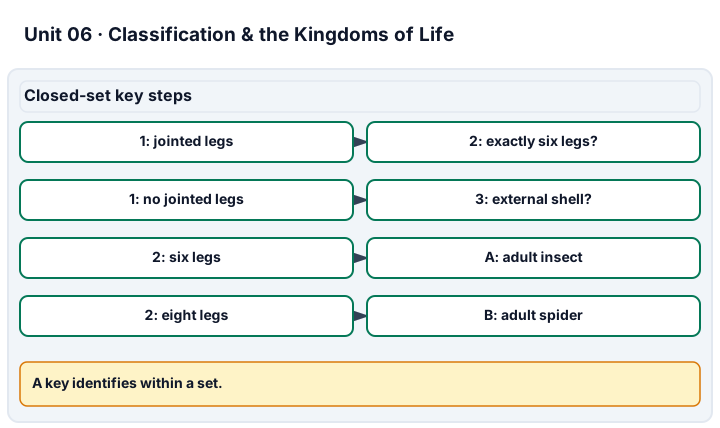
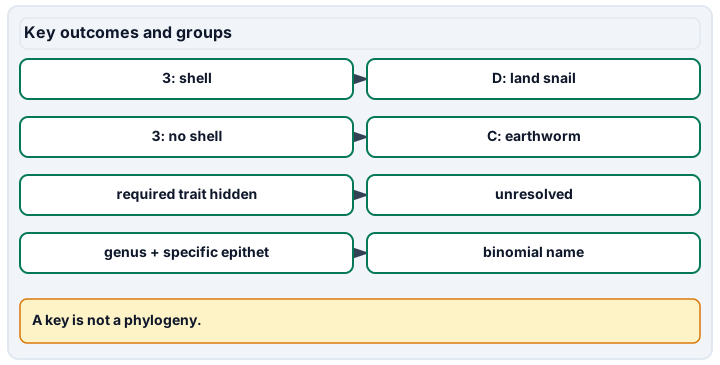
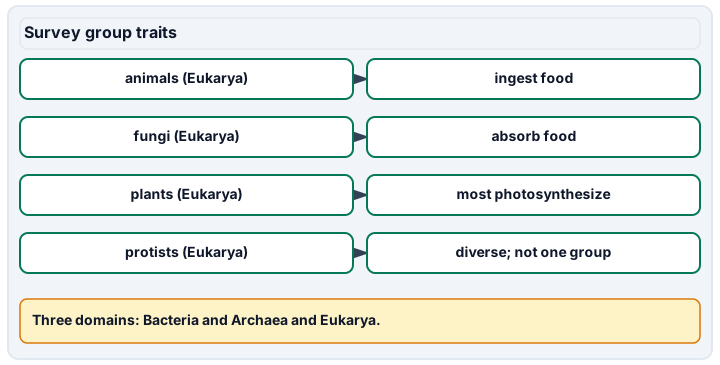
Diagram description
A closed-set dichotomous key branches by observable traits to card labels, with hidden evidence left unresolved. A key is useful for identification within its set but is not a phylogeny. Survey group rows give key traits for animals, fungi, plants, and diverse protist groups; binomial names combine genus and specific epithet.
Data, provenance, and assumptions
| Card | Reference group | Jointed legs | External shell |
|---|---|---|---|
| A | Adult insect | 6 | Absent |
| B | Adult spider | 8 | Absent |
| C | Earthworm | 0 | Absent |
| D | Land snail | 0 | Present |
| Step | Question | Yes | No |
|---|---|---|---|
| 1 | Are jointed legs present? | Go to 2 | Go to 3 |
| 2 | Are there exactly six jointed legs? | A (six) | B only if exactly eight |
| 3 | Is an external shell present? | D | C |
Worked model
Card D has no jointed legs, so follow 1 -> 3; its shell gives D. Each fully specified card needs two decisions. The three branching questions yield four terminal card labels. A card with legs obscured has no defensible first decision.
Numerical calibration
- 2 decisions per complete card in the supplied key
- 4 distinct terminal card labels, not four proven species names
Attempt the assigned level
Try the tasks before reading the calibration. These are practice answers, not a secure examination; use a new dataset or changed assumption for the assessed transfer.
Foundation: typically grades 7-8
- Write the complete branch path for all four cards and the trait supporting each step.
- Write a correctly styled binomial from the assigned classification figure; distinguish genus, specific epithet, and the broader animal kingdom.
Check after your attempt
- A: 1 yes, 2 yes; B: 1 yes, 2 no with eight legs; C: 1 no, 3 no; D: 1 no, 3 yes.
- Use the source's named example, such as Canis lupus: Canis is genus and lupus the specific epithet. Our four trait cards do not supply enough evidence to assign that or any other exact species name.
Core
- Make and test an alternative key that starts with shell presence. Include all A-D and retain an unresolved option for missing evidence.
- Build a short domain/kingdom comparison with bacteria, archaea, a plant, a fungus, an animal and a protist; explain why it is not a ladder.
Check after your attempt
- Shell present -> D; otherwise legs absent -> C; otherwise six -> A, eight -> B; other/unknown leg counts remain unresolved. All four cards must reach a unique terminal.
- Bacteria and Archaea are distinct prokaryotic domains; the other examples are eukaryotes. Group membership is not a rank of advancement, and protists are diverse rather than one simple ancestral ladder.
Extension
- An unknown has six jointed legs but an externally attached shell-like fragment. Explain why the alternative key may fail.
- Compare a sorting key with the phylogenetic tree in OpenStax 20.1 and name a second evidence type that could revise an ancestry claim.
Check after your attempt
- The new case may lie outside the reference set or contain an artifact; inspect provenance and the actual feature rather than announcing a species.
- A key routes observations to labels; a tree proposes common ancestry. Molecular sequences, fossils or additional anatomical characters can change that hypothesis.
History, reading, and writing connection
Original response: Create a one-paragraph museum label on Linnaeus using the Linnean Society reading and OpenStax 20.1. Include the 1753 and 1758 publication contexts, explain why agreed names help readers compare evidence, then use one tested key path to show why naming requires more than color. Identify one limitation of your closed set and distinguish practical classification from ancestry. Do not reproduce or endorse racial classifications.
Write in your own words or use an approved accessible equivalent. Cite a specific assigned section or figure, identify its evidence, and state one limitation or counterargument. Use the AI practice contract only for permitted coaching, never to invent observations or write the assessed response.
Transfer to a new case
A supplied photograph hides an organism's legs. Should you use its color to select A or B?
Calibration: No. The required trait is unavailable. Mark unresolved, request an appropriate view, and keep a proposed label separate from a confirmed key path.
Evidence to retain
Sorting by shared traits: trait matrix and explicit branch decisions. The kingdoms of life: domain/kingdom comparison. Species & scientific names: correctly styled name with its source and rank. Reading a dichotomous key: four paths plus unresolved transfer. Lab technique (building & using a dichotomous key): separately observe a tested key on new instructor-approved images or specimens; supplied cards do not prove specimen observation. Retain the alternate key, comparison and source/date; integration is reported separately.
Record units, calculations, source/date, uncertainty, and what is measured versus inferred. A simulation or supplied dataset must stay labeled as such. This is reading, paper-model, and data work, not authorization to collect pond water, swab people, culture organisms, dissect, expose wildlife, or ingest study materials. Use only instructor-approved prepared slides, images, or in-room materials for separately observed practical skills. Supplied data are not your observations.
Return to all eight learning pathways. Print this unit page for the student lessons; the linked five-page packet remains the separate assessment companion.
Unit mastery rubric
| Criterion | Developing | Proficient | Mastery |
|---|---|---|---|
| Sorting by shared traits | Groups organisms by one surface clue, like color. | Groups by traits but relies on just one at a time. | Sorts living things into groups using several shared, observable traits. |
| The kingdoms of life | Thinks living things are just plants and animals. | Names a few kingdoms but not what sets them apart. | Names the main kingdoms of life and gives a key trait for each at a survey level. |
| Species & scientific names | Doesn’t know living things have scientific names. | Knows names exist but writes them incorrectly. | Explains what a species is and reads a two-part scientific name correctly. |
| Reading a dichotomous key | Can’t follow a key’s yes/no steps. | Follows familiar branches but guesses when a required trait is missing. | Records each supported key decision and leaves cases outside the reference set or missing traits unresolved. |
| Lab technique (building & using a dichotomous key) | Writes key steps that are vague or don’t split the group. | Builds a key but the questions overlap or leave gaps. | Builds and tests a complete closed-set key on approved images or specimens, explaining its limits on species identification. |
| Integration (cross-domain) | Makes no supported connection between the source and the science. | Uses the source but needs help connecting evidence, writing, or limitations to the science. | Independently connects History, Reading, and Writing using a cited source, appropriate evidence, a limitation, and a scientific explanation. |
Integration is reported separately and cannot lower the science grade or block a science demonstration pass. Science and practical criteria determine that pass. Use the integration guide's evidence checklist for the separately reported criterion.
“Card D has no jointed legs and has an external shell, so my recorded path is 1 no, 3 yes. The key identifies D in this closed set, not an exact species. If the shell or legs are obscured, I record unresolved rather than choose by color.”
“I sorted them by color because that’s easy. A key is just a list, right? I’m not sure why they have those long Latin names.”
You demonstrate this unit by building and using dichotomous keys — sorting real specimens by their traits and explaining each choice aloud, not on a multiple-choice test. This unit also leads into the timed classification challenge, where you key out organisms under time pressure. A criterion counts as mastered only when you can both make the identification and defend the traits behind it. Mastery is demonstrated, not awarded.
A 5-page clipboard packet — unit overview, key terms, the mastery rubric, anchor examples, and a score sheet you can print and grade against.