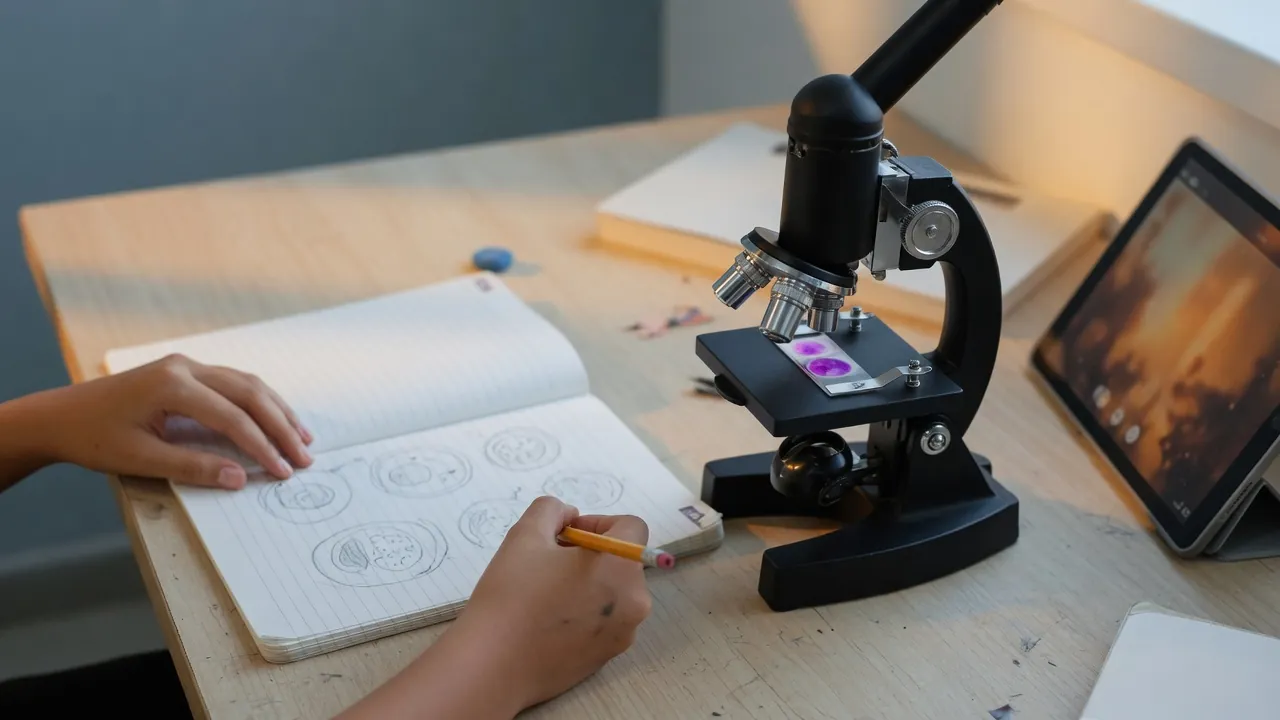
What AI can help with in science.
Can a student use AI without undermining real learning? Yes, if the boundary is clear: AI may support explanation and study, but it cannot replace observations, notebook evidence, or live assessment.
Families do not need a panic button for AI. They need a boundary. Bright Minds course guides take the same position: we do not ban AI; we teach it. The question is not whether a student ever uses an assistant. The question is what the assistant is allowed to do.
The safest line is easy to remember: AI can help with explanation and practice. It cannot produce the student’s evidence.
A chatbot can coach a student. It cannot be the student.
What AI can help with
A careful AI assistant can be a useful study partner when the student remains in charge. The course AI-use guides include practice-coach prompts that ask one question at a time, wait for the student’s attempt, give a targeted hint, and keep practice data clearly labeled. Those are good boundaries.
- Re-explaining a concept. “Explain diffusion again using a simpler analogy, then ask me one question.”
- Vocabulary practice. “Quiz me on these ten terms and wait for my answer before giving feedback.”
- Generating practice. “Create a clearly synthetic practice case and keep the solution hidden until I try it.”
- Planning study blocks. “Help me review completed units over several short sessions instead of cramming tonight.”
Those uses fit the broader education conversation. The U.S. Department of Education’s AI report discusses AI as a tool that requires human judgment, guardrails, and attention to evidence rather than replacement of teaching.1
What AI cannot touch
The Biology AI-use guide, for example, says not to write assessed responses, supply invented observations, suggest hazardous procedures, or treat a fluent answer as proof of mastery. Those are not small rules; they are the integrity boundary.
- No fabricated observations. If the notebook says the student saw it, the student must have seen it.
- No ghostwritten defense. AI can help rehearse questions; it cannot write a script that pretends to be the student’s reasoning.
- No private records or restricted assessment help. The guide pages tell students not to upload private records or obtain help on restricted assessments.
- No certification of mastery. The instructor assesses practical work. A chatbot does not award mastery.
Good prompts and bad prompts
A good prompt keeps the student active: “Ask me one question about my microscope drawing. Wait for my answer. Then tell me one thing to check against my actual slide.”
A bad prompt replaces the student: “Write my lab conclusion and make it sound like I observed this under the microscope.”
The difference is not tone. It is ownership. AI4K12’s grade-band progression charts describe AI literacy as something students learn over time, including understanding what AI systems can and cannot do.2 Bright Minds applies that idea at the bench: learn the tool, then defend your own evidence.
Why hands-on work still matters
AI makes polished language cheaper. It does not make a student better at focusing a microscope, labeling a specimen, keeping units straight, or explaining what changed their mind. The hands-on essay and capstone defense essay both come back to the same point: science learning has to show up in what a student can do and explain.
The proposed remote home-lab track is designed to protect that boundary by keeping appropriate practical work physical and making formal assessment a live conversation from the student’s own materials.
A family agreement checklist
- AI may explain, quiz, and help plan practice.
- The student writes notebook entries from real observations, not generated text.
- The student labels synthetic practice data as synthetic.
- The student does not upload private records, identifying images, or restricted assessment materials.
- The student puts AI away before giving an assessed explanation.
- The family agrees to these rules before AI use begins and revisits them with each new course; each pack’s AI-use guide adds subject-specific limits.
Common Sense Education recommends that schools and families handle AI with clear guidance rather than silence.3 That is the practical path here too: teach the tool, name the boundary, and assess the student.
Sources & further reading
- U.S. Department of Education, Artificial Intelligence and the Future of Teaching and Learning: Insights and Recommendations, verified Sept. 29, 2026. Used for the human-judgment and guardrails framing.
- AI4K12, Grade Band Progression Charts, verified Sept. 29, 2026. Used for the idea that AI literacy develops across grade bands.
- Common Sense Education, ChatGPT and Beyond: How to Handle AI in Schools, verified Sept. 29, 2026. Used for parent/teacher guidance on clear AI expectations.