Unit 02 · Minerals & Rocks (the rock cycle)
This unit builds from the mineral up to the rock and back around again: the physical properties — streak, hardness, luster, cleavage — that let you name a mineral by testing it rather than guessing, the three great rock families and how each one forms, and the rock cycle that can turn any rock into any other given enough heat, pressure, and time. Mastery means you can read a rock as a record of the processes that made it, not a fixed object to memorize.
Student learning: Use density, independent properties and rock proportions as evidence
Choose the level by readiness, not age alone, and record it before instruction. Foundation, core, and honors tasks are study pathways, not an AP course or a promise of college credit. The instructor retains practical assessment and the published science rubric; integration is reported separately.
Prerequisites: Foundation: mass/volume division and percentages. Core: compare intervals and classify properties. Honors: endpoint combinations and denominator changes. Readiness check: 30 mL equals 30 cm^3, and 40 of 100 points is 40%. Revisit those conversions with a guide before independent calculation.
Suggested sequence: read and discuss the explanation; attempt the worked model; analyze the data at your selected level; check the answers; then complete the source-linked response and a fresh transfer question. These activities supplement, not replace, supervised practical work and the full-year schedule.
Assigned reading and focus
- Steven Earle, Physical Geology 2e, 2.6: Mineral Properties. Read Density, Hardness and Cleavage and Fracture. Use the supplied property records instead of performing the scratch, powder or acid procedures described in the reference. Color alone is not a reliable identifier.
- Steven Earle, Physical Geology 2e, 3.1: The Rock Cycle. Read the opening explanation and the rock-cycle diagram. Identify the processes and energy sources connecting rock families; the cycle has alternative paths, not one mandatory sequence.
Learn the science
Density = mass/volume. A measured value and its bounds constrain a possible identification but rarely identify a mineral by themselves. Combine density with independent supplied hardness and cleavage evidence.
Within the limited calcite/quartz key, calcite has hardness 3 and three cleavage directions not at right angles; quartz has hardness 7 and no cleavage. Mohs hardness is ordinal: 7 is not a measured amount of hardness that is 7/3 times 3.
The point-count table describes a supplied rock image, not a pile of weighed minerals. Fractions of classified image points are not mass fractions; an unbiased, sufficiently large point sample can estimate area proportions, with additional stereological assumptions needed for volume.
A rock is an aggregate rather than a single mineral. Texture and context, not proportions alone, help distinguish igneous cooling, sedimentary deposition/cementation and metamorphic change without wholesale melting.

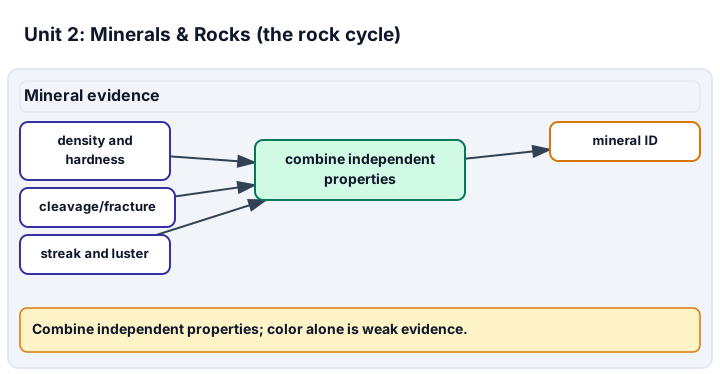
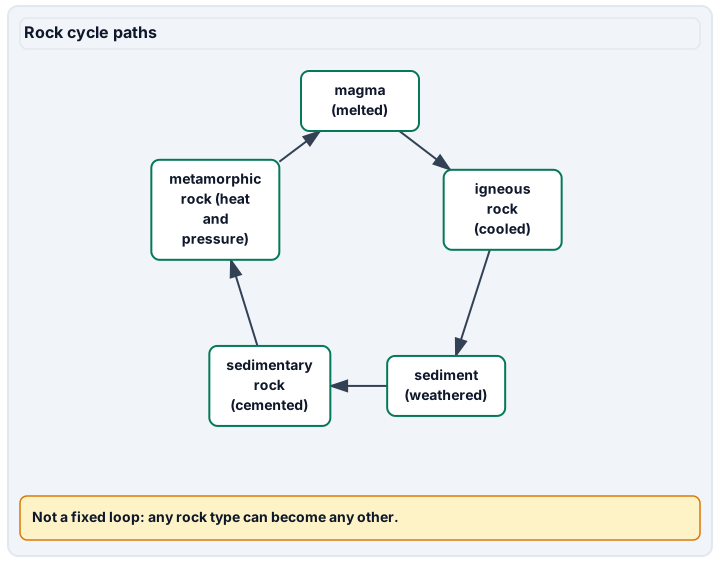
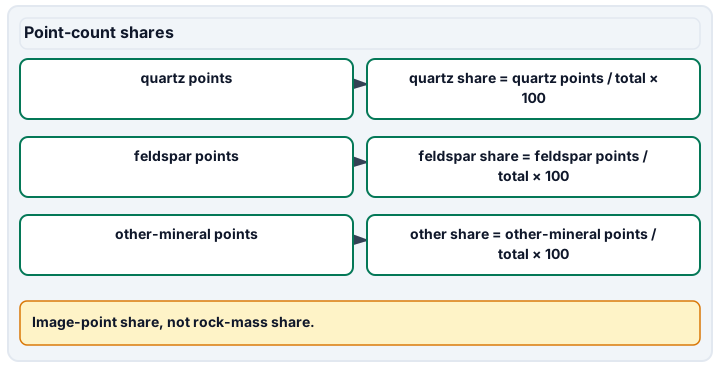
Diagram description
Mineral ID combines density, hardness, cleavage or fracture, streak and luster; the caption notes that color alone is weak evidence. Each rock-cycle stage names the process that forms it: melting makes magma, cooling makes igneous rock, weathering makes sediment, cementing makes sedimentary rock, and heat and pressure make metamorphic rock; the caption states that this is not a fixed loop, because any rock type can become any other. Point-count shares are formulas from image counts, not mineral mass fractions.
Data, provenance, and assumptions
| Sample | Mass (g) | Volume (mL) | Supplied hardness | Supplied break pattern |
|---|---|---|---|---|
| A | 81 | 30 | 3 | Three cleavage directions, not right angles |
| B | 79.5 | 30 | 7 | No cleavage; conchoidal fracture |
| Category | Number of points |
|---|---|
| Quartz | 40 |
| Feldspar | 35 |
| Other minerals | 25 |
Worked model
A has density 81/30 = 2.70 g/cm^3; B has 79.5/30 = 2.65 g/cm^3. For A, the minimum is 80.7/30.5 = 2.646 and maximum 81.3/29.5 = 2.756 g/cm^3. These are endpoint bounds, not a statistical confidence interval. The nominal values are too close to replace the supplied cleavage and hardness evidence.
Numerical calibration
- 2.7 g/cm^3
- 2.65 g/cm^3
- 2.6459 g/cm^3, endpoint lower bound
- 2.7559 g/cm^3, endpoint upper bound
- 40 % of classified points, not mass
Attempt the assigned level
Try the tasks before reading the calibration. These are practice answers, not a secure examination; use a new dataset or changed assumption for the assessed transfer.
Foundation: typically grades 7-8
- Calculate densities of A and B with units, and identify which supplied property distinguishes them in the limited key.
- Compute each point-count percentage and verify the percentages sum to 100.
Check after your attempt
- A is 2.70 and B is 2.65 g/cm^3. The supplied hardness and cleavage distinguish calcite-like A from quartz-like B in this key.
- Quartz 40%, feldspar 35%, other minerals 25%; these are fractions of 100 image points.
High-school core: typically grades 9-10
- Calculate A's density bounds and decide whether a nominal density near 2.65 alone is sufficient for identification.
- A second image has 80 quartz points out of 200. Compare the quartz proportions and explain whether this proves equal mineral mass.
Check after your attempt
- A spans about 2.646-2.756 g/cm^3 and includes values near B. A density-only identification is not justified; use independent properties.
- Both image samples are 40% quartz by point count. Twice as many points does not double the fraction or establish equal mineral mass.
Honors extension: typically grades 11-12
- Calculate B's density interval and compare it with A's. Explain why overlapping intervals do not mean the specimens must be the same mineral.
- Of the original 40 quartz points, five are reclassified as feldspar after image review. Recalculate the composition and explain which evidence is still needed to assign a rock family.
Check after your attempt
- B spans 79.2/30.5 = 2.597 to 79.8/29.5 = 2.705 g/cm^3. The intervals overlap, but cleavage and hardness still distinguish the limited reference candidates.
- The revised point fractions are quartz 35%, feldspar 40%, other 25%. Texture, structures and geological context are still needed; these counts alone do not determine formation history.
History, reading, and writing connection
Explain how an ordered hardness scale and reproducible property descriptions improve classification compared with color guesses. Cite Earle's named property sections, then use your density bounds to explain the limits of a number without an independent observation.
Write in your own words or use an approved accessible equivalent. Cite a specific assigned section or figure, identify its evidence, and state one limitation or counterargument. Use the AI practice contract only for permitted coaching, never to invent observations or write the assessed response.
Transfer to a new case
A new reference card gives 54 +/-0.2 g and 20 +/-0.4 mL, but no hardness or cleavage information. Foundation: calculate nominal density. Core: calculate its bounds. Honors: compare that interval with a nominal 2.65 g/cm^3 candidate and decide whether it is excluded. All levels: state what evidence is missing.
Calibration: Foundation: nominal density = 2.70 g/cm^3. Core: bounds = 53.8/20.4 to 54.2/19.6, about 2.637-2.765 g/cm^3. Honors: 2.65 lies inside that interval and is not excluded. Several candidates can fit; identification remains unresolved without independent properties.
Evidence to retain
At the agreed level retain the density/interval calculation, point-count denominator, reference-key comparison and new-card transfer. Grade these in the Mineral properties and density and Minerals versus rocks science criteria. A property-card analysis is not a certificate of specimen-testing technique; use approved non-destructive references. Sources checked 2026-09-27.
Record units, calculations, source/date, uncertainty, and what is measured versus inferred. A simulation or supplied dataset must stay labeled as such. No field exposure or weather chasing; no water sampling, ingestion, or chemical tests; no solar viewing. Use supplied data and approved images or non-destructive indoor alternatives only. A worksheet does not demonstrate practical performance or authorize a real location or safety forecast.
Return to all eight learning pathways. Print this unit page for the student lessons; the linked five-page packet remains the separate assessment companion.
Unit mastery rubric
| Criterion | Developing | Proficient | Mastery |
|---|---|---|---|
| Mineral properties and density | Guesses identity from color or miscalculates density. | Calculates density but needs help using independent properties. | At the agreed level, calculates density or bounds and defends a limited-key identification using supplied independent properties. |
| The three rock families | Cannot sort a specimen into igneous, sedimentary, or metamorphic. | Names the families but cannot say how each one forms. | Classifies a rock into its family and explains the process — cooling, cementing, or heat and pressure — that produced it. |
| The rock cycle | Thinks rocks are permanent and unchanging. | Recites the cycle as a loop but cannot trace a real pathway. | Traces how any rock can become any other through melting, weathering, deposition, and metamorphism, with time and energy as the drivers. |
| Minerals versus rocks | Confuses a mineral with a rock or count with mass. | Finds proportions but omits the sampling denominator. | At the agreed level, calculates rock-image point fractions and explains why they are not mineral mass fractions. |
| Reference analysis method | Invents properties or unsafe tests. | Uses the reference key but incompletely records evidence. | Retains source, property records and limitations; distinguishes supplied evidence from practical specimen handling. |
| Integration (cross-domain) | Makes no supported connection between the source and the science. | Uses the source but needs help connecting evidence, writing, or limitations to the science. | Independently connects History, Reading, and Writing using a cited source, appropriate evidence, a limitation, and a scientific explanation. |
Integration is reported separately and cannot lower the science grade or block a science demonstration pass. Science and practical criteria determine that pass. Use the integration guide's evidence checklist for the separately reported criterion.
“A is 81/30 = 2.70 g/cm^3, but its density interval overlaps B’s. The supplied hardness and cleavage support different candidates in this two-mineral key. Forty quartz points out of 100 is 40% of the points, not proof that quartz is 40% of the rock’s mass.”
“A rock is just a rock — it’s been that way forever. Minerals and rocks are the same thing, aren’t they? I’d guess the name from the color.”
At the agreed level, submit density and point-count work, defend the supplied property-key comparison, and answer the new-card transfer. Use approved images or non-destructive reference specimens only; no chemical or destructive tests are assigned. Numerical analysis does not certify practical testing skill. Integration remains separately reported.
A 5-page clipboard packet — unit overview, key terms, the mastery rubric, anchor examples, and a score sheet you can print and grade against.