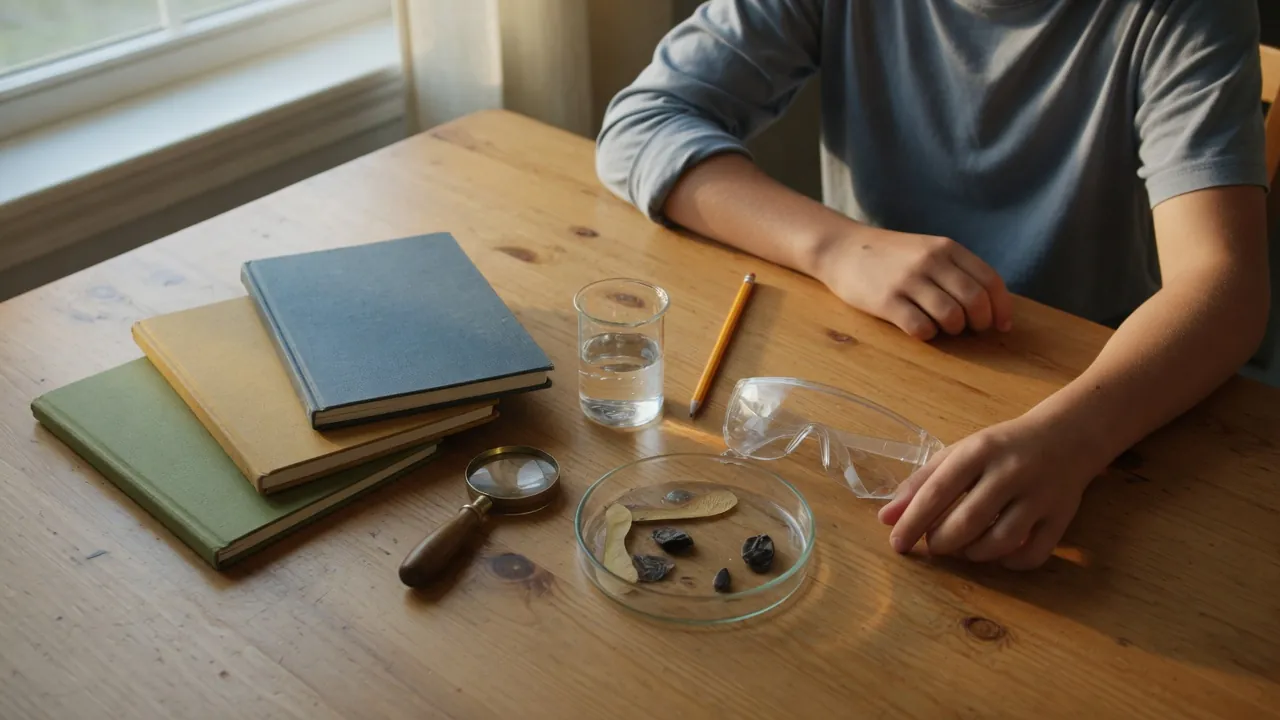
Is my student ready for a Bright Minds science pack?
Bright Minds serves grades 7–12, but every subject has its own band and its own kind of work. Here is how families can read the course hubs, notice readiness signals, and ask the right questions before choosing a pack.
Bright Minds is a grades 7–12 science program, but that sentence is only the beginning. A seventh grader, a ninth grader, and a senior can all be inside the catalog and still need different starting points. The better question is not simply what grade is my student in? It is: what kind of work can this student sustain, with what adult support, and in which subject?
The course-pack pages already make the important distinction: every subject names its own band. Families should use those bands as guardrails, then look at readiness: reading stamina, measurement comfort, notebook habits, safety judgment, and willingness to revise after feedback.
A grade band tells you where to start the conversation. It does not replace the conversation.
The actual course bands
Check the band on each course page before choosing a subject. The current hubs state:
- Biology: Grades 7–12, built to advanced high-school rigor. Its advanced target includes AP Biology topics; it is not a College Board AP course.
- Chemistry: Grades 9–12, built to advanced high-school rigor. Its advanced target includes AP Chemistry topics; it is not a College Board AP course.
- Physics: Grades 9–12, built to advanced high-school rigor. Its advanced target includes AP Physics 1 topics; it is not a College Board AP course.
- Environmental Science: Grades 9–12, built to advanced high-school rigor. Its advanced target includes AP Environmental Science topics; it is not a College Board AP course.
- Earth Science and Astronomy: Grades 7–12, built to honors-level rigor.
- Life Science: Grades 7–8, middle-school survey.
- Physical Science: Grades 7–9, middle-school survey.
- Microscopy: Grades 7–12, semester lab-skills course.
- Dissections: Grades 8–12, semester lab-skills course.
- Scientific Method & Lab Skills: Foundation typically grades 7–8; Core and Extension by prerequisites, not age alone.
- Health & Nutrition: Grades 7–12, a broad science-literacy elective.
- Botany, Forensic Science, Geology, Marine Biology, and Zoology: Grades 9–12, built to advanced high-school rigor.
- Human Anatomy: the page identifies the audience as grades 10–12 and describes readiness by levels: Foundation, high-school Core, and Honors by readiness, with curated age-appropriate selections.
Readiness is more than age
A Bright Minds pack is not just reading and answering questions. The course-pack overview says the materials are for a parent, co-op teacher, or micro-school guide who stays involved. The work expects a student to measure, observe, record, correct, explain, and try again. That is why readiness includes the adult in the room as well as the student at the bench.
A student is often ready for lab-led work when they can keep a dated notebook, slow down enough to observe before interpreting, follow a safety direction the first time, and accept that “developing” is a normal stage before mastery. NGSS describes science learning as practices, disciplinary ideas, and crosscutting concepts working together, not vocabulary alone.1
Where to start if the fit is unclear
If the student is younger, rusty, or new to hands-on science, start with the lower-band and skills-heavy choices: Scientific Method & Lab Skills, Life Science, Physical Science, Microscopy, or a conversation about tutoring. If the student is older and wants an advanced elective, look at the subject page and ask whether the student can handle the reading load, lab responsibility, and live demonstrations described there.
The course-pack FAQ explains that families should discuss readiness, fit, equipment, timing, and costs before committing. A web page can narrow the question; it cannot know your learner.
Questions to bring Leslie
Useful readiness questions are concrete: What has the student already done at a bench? Can they write observations before conclusions? What science topics make them curious enough to persist? What adult supervision is available? What hazards or materials would be a poor fit at home?
When you contact Leslie, include the subject, your student’s age or grade, whether you are teaching one learner or a group, your preferred timing, and the support you need. The course-pack overview asks for the same details, and they give Leslie enough to discuss fit and the next practical step.
Sources & further reading
- Next Generation Science Standards, Three-Dimensional Learning, verified Sept. 29, 2026. Used for the practices-plus-concepts framing.
- Next Generation Science Standards, NGSS Appendices, verified Sept. 29, 2026. Used as background on grade-band and practice progressions.
- OpenStax, Biology 2e, verified Sept. 29, 2026. A free, openly licensed college biology textbook, listed for further reading.